Difference Between Atoms and Molecules
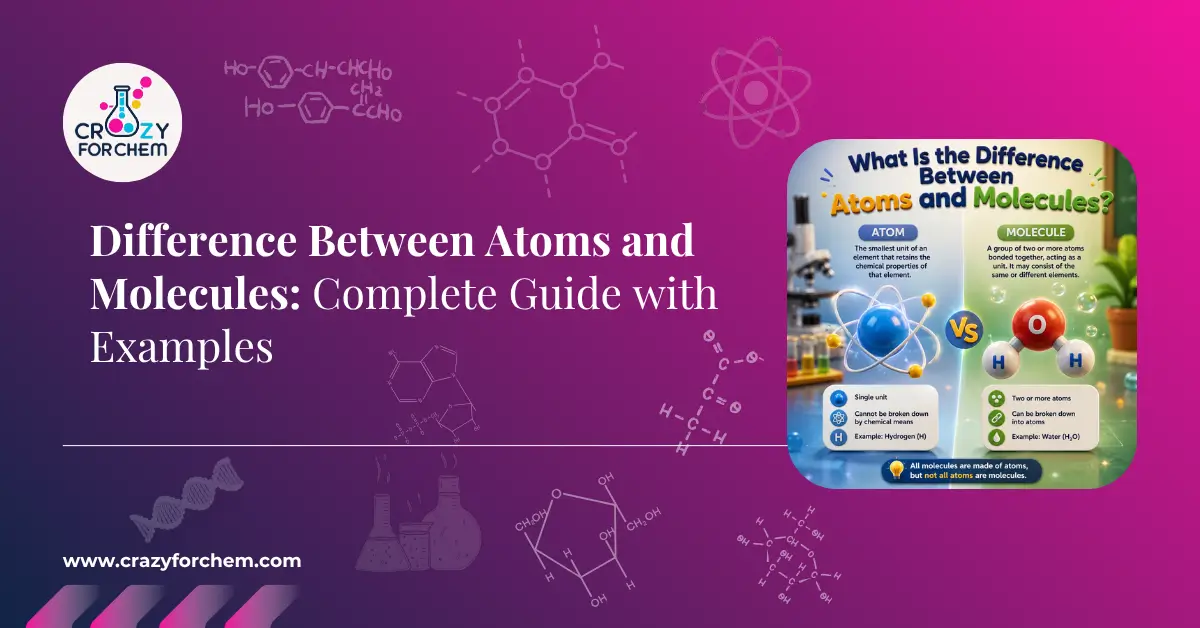
An atom is the smallest unit of matter that retains an element’s identity — a nucleus of protons & neutrons surrounded by electrons. A molecule is two or more atoms chemically bonded together, with entirely new properties. Think of atoms as individual LEGO bricks and molecules as the structures you build — one drop of water alone contains 1.67 sextillion molecules.
⚛️ Click the card to explore
An atom is the smallest unit of matter that retains the chemical properties of an element. Break it any further and you no longer have that element — you have subatomic particles. Every atom has a dense central nucleus containing positively charged protons and neutral neutrons, surrounded by negatively charged electrons in energy shells. The number of protons = atomic number = which element it is. Electrons in the outermost shell (valence electrons) decide how the atom bonds with others.
Atom = Nucleus (protons + neutrons) + Electrons in shells
Atomic number (Z) = number of protons → defines the element
A molecule is formed when two or more atoms bond together chemically, creating a new species with entirely different properties from its constituent atoms. Sodium (reactive metal) + Chlorine (toxic gas) → NaCl (table salt, safe to eat). The atoms share or transfer electrons to reach a stable configuration. Molecules exist in two types:
Homonuclear: Same element atoms bonded — O₂, N₂, H₂, Cl₂, P₄, S₈.
Heteronuclear: Different elements bonded — H₂O, CO₂, NH₃, CH₄, H₂SO₄, C₆H₁₂O₆ (glucose).
Atoms bond to achieve lower energy, more stable configurations — usually by completing their outer electron shells (the octet rule: 8 electrons in outermost shell). Think of it as atoms “wanting” to be as comfortable as possible. Two hydrogen atoms each with 1 electron combine to share 2 electrons, giving each a full shell (like helium). The bond releases energy — bond formation is always exothermic. The energy released is called bond energy (H–H bond = 436 kJ/mol).
H• + H•  →  H₂  + 436 kJ/mol (bond energy released)
Octet rule: atoms bond to reach 8 valence electrons
Molecules have specific 3D shapes determined by VSEPR theory (Valence Shell Electron Pair Repulsion) — electron pairs around a central atom repel each other and arrange to minimise repulsion. Shape determines polarity, biological function, solubility, and reactivity.
H₂O: bent (104.5°) → polar → forms hydrogen bonds → liquid at room temperature.
CO₂: linear (180°) → non-polar despite polar bonds → gas at room temp.
The Thalidomide tragedy (1950s–60s) showed this perfectly: two mirror-image molecules (same atoms, same bonds, different 3D shape) — one treated morning sickness, the other caused severe birth defects.
Atoms are the building blocks; molecules are what you build. An atom cannot be broken down chemically — breaking it requires nuclear reactions and changes the element’s identity entirely. A molecule can be broken into its component atoms by chemical reactions. Atoms of the same element are chemically identical; molecules of the same compound are structurally identical with fixed stoichiometry.
In the Universe: Hydrogen (~75%), Helium (~23%), Oxygen (~1%), Carbon (~0.5%).
In Earth’s Crust: Oxygen (~46%), Silicon (~28%), Aluminium (~8%), Iron (~5%).
In the Human Body: Oxygen (~65%), Carbon (~18%), Hydrogen (~10%), Nitrogen (~3%).
One drop of water contains approximately 1.67 sextillion (1.67 × 10²¹) water molecules. Human DNA, if fully stretched from a single cell, would contain ~30 billion atoms and measure about 2 metres long.
What's the Difference Between Atoms and Molecules?
An atom is the smallest unit of an element that retains its chemical
properties. A molecule is formed when two or more atoms bond together
chemically. The key difference: atoms are the building blocks; molecules
are the assembled structures. Most atoms cannot exist freely, only noble
gases (He, Ne, Ar) exist as stable single atoms under normal conditions.
| Property | Atom | Molecule |
|---|---|---|
| Definition | Smallest unit of an element | 2+ atoms bonded together |
| Existence | Rarely free (noble gases only) | Exists freely in nature |
| Stability | Generally unstable | More stable |
| Size | 0.1–0.5 nm | 0.15 nm to micrometres |
| Shape | Spherical | Linear, bent, tetrahedral etc. |
| Examples | H, O, C, Na, Fe | H₂O, O₂, CO₂, NaCl |
💡 One drop of water contains ~1.67 sextillion molecules. Most common atom in the universe: Hydrogen (75%). Most stable atoms that exist freely: Noble gases: He, Ne, Ar.
Table of Contents
Why Understanding Atoms vs Molecules Matters
Grasping this distinction is not just academic, it is a foundational concept in Class 9 Chemistry (NCERT Chapter 3: Atoms and Molecules) and essential for preparation for JEE Main, JEE Advanced, and NEET. Understanding how atoms differ from molecules directly affects your approach to stoichiometry, bonding, and reaction mechanisms in competitive exams.
In Medicine:- Drug molecules are designed with specific atomic arrangements to interact with receptors in your body. A slight change in atomic arrangement can turn a life-saving medicine into a harmful one. Effective COVID-19 treatments depended on precise molecular structures.
In Climate Science:- CO₂ molecules trap heat in our atmosphere. Individual carbon or oxygen atoms do not exist. Understanding molecular structure helps scientists develop carbon capture technologies.
In Technology:- Silicon atoms in crystalline arrangements power your smartphone's processor. Different arrangements of carbon atoms create graphite (pencil lead) or diamond, the hardest natural material.
In Food Science:- A ripe banana is sweet, and an unripe one is starchy because complex starch molecules transform into simple sugar molecules as the fruit ripens, a purely molecular event.
📌 Key Takeaways: Atoms are building blocks. Molecules are assembled structures. Atoms rarely exist alone (noble gases are the exception). Molecules have unique properties completely different from those of their constituent atoms.
What is an Atom? Complete Deep Dive
An atom is the smallest unit of matter that maintains all the chemical properties of a specific element. It is the fundamental building block from which all material substances are constructed, as defined by the International Union of Pure and Applied Chemistry (IUPAC).
Every atom consists of three subatomic particles:
| Property | Protons | Neutrons | Electrons |
| Charge | +1 (positive) | 0 (neutral) | −1 (negative) |
| Location | Nucleus | Nucleus | Electron shells/orbitals |
| Mass (kg) | 1.673 × 10⁻²⁷ | 1.675 × 10⁻²⁷ | 9.109 × 10⁻³¹ (≈ 1/1836 of proton) |
| Discovered by | Rutherford (1919) | Chadwick (1932) | J.J. Thomson (1897) |
| Role | Defines element identity | Adds mass; creates isotopes | Controls all chemical bonding |
Atomic Structure: Protons, Neutrons, and Electrons
Protons :- Located in the nucleus. Each carries a +1 charge. The number of protons (atomic number, Z) uniquely identifies the element. Cannot change by chemical reaction, only by nuclear reaction.
Neutrons:- Located in the nucleus alongside protons. Neutral charge. Provide nuclear stability and give rise to isotopes. Different neutron counts = same element, different mass.
Electrons:- Orbit the nucleus in energy shells. Each carries a −1 charge. Mass is 1/1836 that of a proton. Responsible for ALL chemical bonding and chemical properties of atoms.
In a neutral atom, protons always equal electrons. Change the proton count, and you change the element entirely.
| Jewellery, electronics | Symbol | Atomic Number | Protons | Common Uses |
| Hydrogen | H | 1 | 1 | Fuel, chemical reactions |
| Carbon | C | 6 | 6 | Organic compounds, life |
| Oxygen | O | 8 | 8 | Respiration, combustion |
| Sodium | Na | 11 | 11 | Table salt, batteries |
| Iron | Fe | 26 | 26 | Steel, hemoglobin |
| Gold | Au | 79 | 79 | Jewelry, electronics |
How Small Is an Atom? (Size and Scale)
Atoms are extraordinarily tiny, existing at the nanoscale (1 nm = 1 billionth of a metre):
- Average atomic diameter: 0.1 to 0.5 nanometers
- Hydrogen atom (smallest): approximately 0.1 nm
- Uranium atom (among the largest): approximately 0.35 nm
- Atomic nucleus: ~10⁻⁵ nm - 100,000 times smaller than the atom itself
If you enlarged an atom to the size of a football stadium, its nucleus would be the size of a marble at centre field. Everything else, 99.9999% of the atom, is empty space, held together by electromagnetic forces between electron clouds.
Scale Visualisation (large to small):
Human hair: ~80,000 nm → Cell: ~10,000 nm → Virus: ~100 nm → Water molecule: ~0.3 nm → Atom: ~0.1–0.5 nm → Nucleus: ~0.00001 nm
Electron Shells and Valence Electrons:- Electrons occupy specific energy levels around the nucleus:
- First shell (K): up to 2 electrons
- Second shell (L): up to 8 electrons
- Third shell (M): up to 18 electrons
- Fourth shell (N): up to 32 electrons (formula: 2n²)
Valence electrons:- The electrons in the outermost shell are the key players in all chemical bonding. For example, oxygen has 6 valence electrons and needs 2 more to complete its outer shell, making it highly reactive.
Types of Atoms: Neutral atoms have equal numbers of protons and electrons. Ions are atoms that have gained or lost electrons; cations are positively charged (e.g., Na⁺), and anions are negatively charged (e.g., Cl⁻). Isotopes are atoms of the same element with different numbers of neutrons (e.g., Carbon-12, carbon-13, and Carbon-14).
What Is a Molecule? Definition and Key Properties
A molecule is a group of two or more atoms bonded together by chemical bonds, forming the smallest unit of a compound or elemental substance that can exist independently while retaining the substance's characteristic properties. According to the American Chemical Society, molecules are the fundamental units that participate in chemical reactions and determine the properties of substances.
| Property | Description |
| Composition | 2 or more atoms chemically bonded |
| Size Range | 0.15 nm to several micrometres |
| Bonding Types | Covalent, ionic, or metallic bonds |
| Stability | More stable than individual atoms |
| Types | Elemental (O₂, N₂) or Compound (H₂O, CO₂) |
| Shape | Specific 3D geometric structures (linear, bent, tetrahedral…) |
Types of Molecules: Elemental vs. Compound Molecules
Elemental Molecules contain only one type of atom bonded to itself:
- O₂ (oxygen gas), N₂ (nitrogen gas), H₂ (hydrogen gas)
- O₃ (ozone - 3 oxygen atoms), S₈ (sulfur - 8 sulfur atoms)
- Mnemonic: HOFBrINCl - 7 diatomic elements: H₂, O₂, F₂, Br₂, I₂, N₂, Cl₂
Compound Molecules contain two or more different types of atoms:
| Molecule | Formula | Elements | State at Room Temp |
| Water | H₂O | H + O | Liquid |
| Carbon dioxide | CO₂ | C + O | Gas |
| Ammonia | NH₃ | N + H | Gas |
| Glucose | C₆H₁₂O₆ | C + H + O | Solid |
| Ethanol | C₂H₅OH | C + H + O | Liquid |
💡 Key Rule: All compounds are molecules (or ionic compounds), butsome molecules are note compounds. O₂ is a molecule but NOT a compound, because it contains only one element.
How Molecules Form from Atoms
Molecules form when atoms achieve greater stability by filling their outermost electron shells. The key principle is the Octet Rule: atoms gain, lose, or share electrons to achieve 8 electrons in their valence shell (or 2 for hydrogen), mimicking the stable noble gas configuration.
1. Covalent Bonding (Sharing Electrons):- The most common type. Atoms share one or more electron pairs.
- Single bond: 1 pair shared (e.g., H–H, C–C)
- Double bond: 2 pairs shared (e.g., O=O, C=O)
- Triple bond: 3 pairs shared (e.g., N≡N, C≡C), strongest
- Example: Water (H₂O), oxygen shares electrons with two hydrogen atoms; each H gets 2 electrons (stable), oxygen gets 8 electrons (stable)
2. Ionic Bonding (Transferring Electrons):- One atom donates electrons; another accepts them.
- Metal loses electrons → becomes a positive cation
- Non-metal gains electrons → becomes a negative anion
- Opposite charges attract → ionic bond forms
- Example: NaCl, Na loses 1e⁻ → Na⁺; Cl gains 1e⁻ → Cl⁻; forms stable salt crystal
3. Hydrogen Bonding (Weak Intermolecular Force):- Not a bond within a molecule, but between molecules.
- Occurs when H is bonded to highly electronegative atoms (N, O, or F)
- Creates a partial positive charge on H, which attracts neighbouring molecules
- Responsible for water's high boiling point, surface tension, and ice floating
- Holds DNA double helix together (A-T: 2 bonds; G-C: 3 bonds)
4. Metallic Bonding (Electron Sea 🌊):- Metal atoms share a 'sea' of freely moving electrons.
- Explains metallic properties: conductivity, malleability, ductility, lustre
- Examples: copper wiring, gold connectors, iron construction
📌 For a deep dive into all bond types and how they work, read our complete guide: How Are Atoms Held Together?
Classification of Molecules by Size:
- Diatomic (2 atoms): H₂, O₂, N₂, Cl₂, F₂, Br₂, I₂
- Triatomic (3 atoms): H₂O, CO₂, O₃, SO₂
- Polyatomic (many atoms): CH₄ (5), Glucose C₆H₁₂O₆ (24), Caffeine C₈H₁₀N₄O₂ (24), Aspirin C₉H₈O₄ (21)
- Macromolecules: Proteins (thousands of atoms), DNA/RNA (billions of atoms), Polymers (millions of atoms in repeating chains)
Molecular Shape and Geometry Molecules have specific 3D shapes determined by VSEPR theory (Valence Shell Electron Pair Repulsion):
| Shape | Bond Angle | Example | Description |
| Linear | 180° | CO₂, HCl | Straight line |
| Bent/Angular | 104.5° | H₂O, SO₂ | V-shaped |
| Trigonal Planar | 120° | BF₃ | Flat triangle |
| Tetrahedral | 109.5° | CH₄ | 3D pyramid |
| Trigonal Pyramidal | ~107° | NH₃ | Pyramid with lone pair |
| Octahedral | 90° | SF₆ | Six-sided |
Shape matters enormously; it determines polarity, biological function, solubility, and reactivity. The Thalidomide tragedy of the 1950s–60s showed this perfectly: two mirror-image forms of the same molecule, same atoms, same bonds, different 3D shape, one treated morning sickness, the other caused severe birth defects.
Atoms vs Molecules: 8 Key Differences (Comparison Table)
Here is a comprehensive comparison of atoms and molecules across all major properties:
| 0.15 nm to micrometres (varies by complexity) | Atom | Molecule |
| Definition | Smallest unit of an element retaining its chemical properties | 2 or more atoms chemically bonded together |
| Composition | Single particle: protons + neutrons + electrons | Multiple atoms bonded through chemical forces |
| Size | 0.1–0.5 nm diameter | 0.15 nm to micrometers (varies by complexity) |
| Natural Existence | Rarely exist alone (only noble gases: He, Ne, Ar…) | Commonly exist independently in nature |
| Stability | Generally unstable; highly reactive (incomplete valence shell) | More stable — valence requirements already satisfied |
| Shape | Spherical electron probability cloud | Distinct 3D geometry: linear, bent, tetrahedral, etc. |
| Charge | Neutral, or cation (+) or anion (−) | Usually neutral; some polyatomic ions (SO₄²⁻, NH₄⁺) |
| Examples | H, O, C, N, Fe, Au, Na, Cl | H₂O, O₂, CO₂, CH₄, C₆H₁₂O₆, DNA, proteins |
Difference in Composition and Structure
Atoms are fundamental, indivisible units by chemical means. They cannot be broken down without changing the element's identity. Each atom type corresponds to one element on the periodic table.
Molecules are structural units that CAN be broken into their constituent atoms (e.g., by electrolysis). Breaking a water molecule gives hydrogen and oxygen atoms; neither is water anymore. A molecule can represent one element (O₂) or multiple elements (H₂O).
Difference in Size and Mass
Atoms are smaller than molecules because molecules contain multiple atoms bonded together. Molecular mass is simply the sum of all atomic masses in the molecule.
| Molecule | Formula | Atoms | Molecular Mass (amu) |
| Hydrogen gas | H₂ | 2 | 2.016 |
| Water | H₂O | 3 | 18.015 |
| Carbon dioxide | CO₂ | 3 | 44.009 |
| Glucose | C₆H₁₂O₆ | 24 | 180.16 |
| Hemoglobin | Complex | ~10,000 | ~64,500 |
Difference in Stability and Reactivity
Most atoms are unstable because their valence shells are incomplete. They have a strong drive to bond. Molecules, having achieved stable electron configurations through bonding, are generally more stable.
Exceptions exist — some molecules remain highly reactive:
- Free radicals (unpaired electrons) — e.g., hydroxyl radical (OH•)
- Unstable compounds — e.g., nitrogen triiodide (NI₃, explodes on touch)
- High-energy molecules — e.g., ATP, nitroglycerin
📌 Why is N₂ so unreactive? Its triple bond (N≡N) has a bond energy of 941 kJ/mol — one of the highest known. It makes up 78% of our atmosphere but doesn't react easily. This is why diamond is 'forever' — extremely strong C-C bonds in a network create a huge kinetic barrier to reaction.
Difference in Natural Existence
Atoms exist independently ONLY as noble gases: Helium (He), Neon (Ne), Argon (Ar), Krypton (Kr), Xenon (Xe), Radon (Rn). Their valence shells are already complete — no drive to bond.
Molecules exist independently everywhere: Most gases in air (N₂, O₂, CO₂, H₂O), all liquids like water and ethanol, many solids like sugar and ice, and all biological molecules (proteins, DNA, hormones).
Memory Aid — 'Building vs. Built' Method:
| Analogy | Atom (Smallest Unit) | Molecule (Combined Structure) |
| Construction | Individual bricks | Completed wall or building |
| Language | Single letters (A, B, C) | Words (CAT, DOG) |
| Music | Individual notes (C, E, G) | Chords (C major) |
| LEGO | Single LEGO pieces | Built structure or model |
Simple Trick: Atom = Alone. Molecule = Multiple atoms.
Atoms vs Molecules: Class 9 CBSE Notes (NCERT-Aligned)
Atom: The smallest particle of an element that may or may not exist independently but always takes part in chemical reactions.
Molecule: The smallest particle of an element or compound that is capable of independent existence and shows all the properties of that substance.
📌 Note: NCERT defines atoms as particles that "may or may not" exist independently — this is why noble gases (monatomic) and reactive atoms (like Na, Cl) are both covered under the same definition.
Atomicity — A Class 9 Exam Favourite
Atomicity is the number of atoms present in one molecule of an element.
| Atomicity | Type | Examples |
|---|---|---|
| 1 | Monoatomic | He, Ne, Ar, Kr (noble gases) |
| 2 | Diatomic | H₂, O₂, N₂, Cl₂, F₂, Br₂, I₂ |
| 3 | Triatomic | O₃ (ozone), H₂O |
| 4 | Tetraatomic | P₄ (phosphorus) |
| 8 | Polyatomic | S₈ (sulphur) |
Exam tip: CBSE frequently asks — "What is the atomicity of sulphur?" Answer: 8 (S₈). "What is the atomicity of ozone?" Answer: 3 (O₃).
Writing Chemical Formulae — NCERT Method
NCERT teaches chemical formula writing using the valency criss-cross method:
Step 1: Write the symbols of the elements.
Step 2: Write their valencies below each symbol.
Step 3: Criss-cross the valencies as subscripts.
Example — Magnesium Chloride:
- Mg (valency 2) + Cl (valency 1)
- Criss-cross: Mg₁Cl₂ → MgCl₂
Example — Aluminium Oxide:
- Al (valency 3) + O (valency 2)
- Criss-cross: Al₂O₃ → Al₂O₃
Mole Concept — Bridge Between Atoms and Molecules (Class 9 + JEE Foundation)
One mole of any substance contains 6.022 × 10²³ particles (Avogadro's Number).
| Quantity | Atoms | Molecules |
|---|---|---|
| 1 mole of H | 6.022 × 10²³ atoms | — |
| 1 mole of H₂ | 1.204 × 10²⁴ atoms | 6.022 × 10²³ molecules |
| 1 mole of H₂O | 1.806 × 10²⁴ atoms | 6.022 × 10²³ molecules |
Formula:
- Number of moles = Given mass ÷ Molar mass
- Number of particles = Moles × 6.022 × 10²³
CBSE Board + NEET frequently asked numerical: "How many molecules are present in 18 g of water?"
→ Molar mass of H₂O = 18 g/mol → 1 mole → 6.022 × 10²³ molecules
Common CBSE Board Exam Questions on Atoms and Molecules
1-mark questions:
- Define atomicity. Give one example of a triatomic molecule.
- What is the SI unit of the amount of substance?
- Write the chemical formula of calcium carbonate.
2-mark questions:
- Distinguish between atoms and molecules with two examples each.
- What is Avogadro's number? State its significance.
- Calculate the molecular mass of H₂SO₄.
3-mark questions:
- Explain the Law of Conservation of Mass with an example.
- Calculate the number of moles in 44 g of CO₂.
- Write the chemical formulae of (a) sodium oxide (b) aluminium chloride (c) magnesium hydroxide using the criss-cross method.
Examples of Atoms and Molecules in Daily Life
Common Examples of Atoms
In the Universe: Hydrogen (~75%), Helium (~23%), Oxygen (~1%), Carbon (~0.5%)
In Earth's Crust: Oxygen (~46%), Silicon (~28%), Aluminium (~8%), Iron (~5%), Calcium (~3.6%)
In the Human Body: Oxygen (~65%), Carbon (~18%), Hydrogen (~10%), Nitrogen (~3%), Calcium (~1.5%), Phosphorus (~1%)
Common Examples of Molecules
In the Air You Breathe:
- Nitrogen (N₂) — 78% of air; inert, essential for proteins
- Oxygen (O₂) — 21%; necessary for respiration and combustion
- Carbon dioxide (CO₂) — 0.04%; greenhouse gas; used in photosynthesis
- Water vapour (H₂O) — 0–4%; drives weather and humidity
- Ozone (O₃) — trace amount in stratosphere; absorbs UV radiation
In Your Body:
- Water (H₂O) — most abundant molecule (~60–70% of body weight)
- Glucose (C₆H₁₂O₆) — blood sugar; primary energy source
- DNA — stores genetic information; billions of atoms per molecule
- Hemoglobin — transports oxygen; ~10,000 atoms per molecule
- ATP (Adenosine Triphosphate) — energy currency of every cell
- Cholesterol — an essential component of cell membranes
In Your Kitchen:
- Table salt (NaCl) — ionic compound; sodium and chlorine ions
- Sugar/Sucrose (C₁₂H₂₂O₁₁) — sweet taste
- Vinegar — acetic acid (CH₃COOH); sour taste
- Baking soda (NaHCO₃) — sodium bicarbonate; leavening agent
- Caffeine (C₈H₁₀N₄O₂) — stimulant in coffee and tea
- Vanillin (C₈H₈O₃) — vanilla flavouring molecule
Can an Atom Exist Without Forming a Molecule?
Yes, but with very few exceptions in normal conditions.
Why most atoms cannot exist freely: Most atoms have incomplete valence shells, giving them a strong energetic drive to bond with other atoms. When two reactive atoms collide, bonding is nearly inevitable.
The noble gas exception: The six noble gases — Helium, Neon, Argon, Krypton, Xenon, and Radon — have completely filled valence shells. They do not tend to gain, lose, or share electrons. They exist as monatomic gases under all normal conditions.
Special cases where atoms exist alone:
- Ionised plasmas (in stars, lightning, fluorescent lights) — extreme temperatures strip electrons; individual ions exist briefly
- Atomic vapours — metals at extreme temperatures release individual atoms that recondense when cooled
- Laboratory isolation — ultra-high vacuum + temperatures near absolute zero + magnetic/optical traps allow single-atom isolation (used in quantum computing research)
- In interstellar space, hydrogen atoms can exist in isolation because the density is so low that atoms rarely collide
💡 Historical note: Noble gases were called 'inert' until 1962, when Neil Bartlett created the first noble gas compound — xenon hexafluoroplatinate. This proved that even 'stable' atoms can react under extreme conditions.
Atoms and Molecules in Chemical Reactions
Chemical reactions are fundamentally about atoms rearranging. Atoms are never created or destroyed in a chemical reaction (Law of Conservation of Mass); they only change partners.
What happens to atoms in reactions: Atoms break away from one molecule and form bonds with atoms from other molecules, creating new substances with entirely different properties.
What happens to molecules in reactions: Molecules break apart into atoms or smaller groups, which then reassemble into new molecules. The products of a reaction have different molecular formulas and structures from the reactants.
Example — Combustion of methane (natural gas):
CH₄ + 2O₂ → CO₂ + 2H₂O + Energy
The carbon and hydrogen atoms in methane don't disappear; they recombine with oxygen atoms to form carbon dioxide and water molecules. The total count of C, H, and O atoms on both sides is identical.
Reaction types based on atomic behaviour:
- Synthesis: Atoms/molecules combine to form a larger molecule (A + B → AB)
- Decomposition: A molecule breaks apart into simpler atoms or molecules (AB → A + B)
- Single displacement: One atom replaces another in a molecule (A + BC → AC + B)
- Double displacement: Atoms from two compounds exchange partners (AB + CD → AD + CB)
People Also Ask
Is water an atom or a molecule?
Water (H₂O) is a molecule. It consists of two hydrogen atoms and one oxygen atom bonded together by covalent bonds. A single oxygen atom or a single hydrogen atom is not water; they are individual atoms. Water's unique life-giving properties (dissolving substances, high boiling point, surface tension) arise from the bonded H₂O molecule, not from its individual atoms.
What is the smallest atom?
The smallest atom by size is hydrogen (H). Its diameter is approximately 0.1 nanometers (100 picometers). Hydrogen has just 1 proton, no neutrons (in its most common isotope), and 1 electron. By atomic mass, hydrogen is also the lightest element at approximately 1.008 atomic mass units (amu).
Are all molecules made of atoms?
Yes, without exception. Every molecule is made of atoms bonded together, whether 2 atoms (diatomic, like O₂) or billions (like a DNA strand). There is no such thing as a molecule that does not consist of atoms. Atoms are the most fundamental chemical building blocks of all matter.
Can atoms exist freely in nature?
Rarely, and only in very specific cases. Under normal conditions on Earth, almost all atoms exist as part of molecules or ionic compounds. The only atoms that naturally exist freely are the six noble gases: Helium, Neon, Argon, Krypton, Xenon, and Radon. In extreme environments like stars, plasmas, or interstellar space, isolated atoms can exist temporarily.
What is the difference between a molecule and a compound?
A molecule is any group of two or more atoms bonded together; it may consist of one element (like O₂) or multiple elements (like H₂O). A compound is a substance made of two or more different elements in a fixed ratio. All compounds are molecules (or ionic compounds), but not all molecules are compounds. For example, O₂ is a molecule but not a compound; CO₂ is both a molecule and a compound.
Is oxygen an atom or a molecule?
Oxygen can be both, depending on context. Oxygen as an atom (O) is a single particle with 8 protons and 8 electrons – highly reactive and rare in isolation. Oxygen, as we breathe it, is a molecule, O₂, two oxygen atoms bonded by a double covalent bond. Ozone (O₃) is another molecular form of oxygen with three atoms. In chemistry, when we refer to 'oxygen' in air or reactions, we almost always mean the O₂ molecule.
How many atoms are in a molecule?
It varies enormously. The minimum is 2 atoms (diatomic molecules like H₂, O₂, N₂). Simple molecules like water have 3. Complex biological molecules have far more than 24 atoms; caffeine has 24, aspirin has 21, haemoglobin has roughly 10,000, and a single DNA molecule can contain billions of atoms. There is no upper limit; some synthetic polymer molecules contain millions of atoms.
Frequently Asked Questions (FAQ)
What is the main difference between an atom and a molecule?
Atoms are single particles; molecules are groups of atoms bonded together. A molecule is made of two or more atoms bonded together. Atoms are the building blocks; molecules are the assembled structures. Most atoms are unstable alone; molecules are generally more stable because their bonding satisfies valence electron requirements.
Can you see atoms and molecules?
Not with the naked eye or ordinary light microscopes. Atoms (0.1–0.5 nm) and small molecules are far too small for visible light to resolve. However, scanning tunnelling microscopes (STM), atomic force microscopes (AFM), and electron microscopes can image individual atoms and small molecules. Large molecules like proteins and DNA can be studied using X-ray crystallography and cryo-electron microscopy, which have revealed their exact structures.
Are atoms and molecules the same thing?
No. While all molecules are made of atoms, atoms and molecules are fundamentally different things. An atom is a single particle; a molecule is a group of atoms bonded together. Think of letters versus words: letters (atoms) combine to form words (molecules). The same letters in different arrangements form completely different words, just as the same atoms in different arrangements form completely different molecules.
What holds atoms together in a molecule?
Chemical bonds hold atoms in a molecule together. The main types are: (1) Covalent bonds; atoms share electrons; most common in organic and biological molecules. (2) Ionic bonds; one atom transfers electrons to another, creating ionic compounds like NaCl. (3) Metallic bonds; electrons are shared across a lattice of metal atoms.
Which is bigger, an atom or a molecule?
Molecules are always larger than any of their constituent atoms because a molecule consists of multiple atoms bonded together. The simplest molecules (diatomic, like H₂) are slightly larger than a single atom. Complex molecules like proteins or DNA can be thousands to millions of times larger than a single atom. For example, a single atom of hydrogen is ~0.1 nm; a water molecule is ~0.27 nm; a haemoglobin molecule is ~6.5 nm across.
Do all elements form molecules?
No. The noble gases (Helium, Neon, Argon, Krypton, Xenon, Radon) exist as individual atoms; they are monatomic. They do not form molecules under normal conditions because their electron shells are completely full. Many metallic elements (like iron, copper, and gold) exist as metallic lattices rather than discrete molecules. Most non-metals, however, do form molecular structures. Oxygen exists as O₂, nitrogen as N₂, chlorine as Cl₂, and so on.
What is an example of an atom that is also a molecule?
Noble gases like Helium (He), Neon (Ne), and Argon (Ar) are sometimes called monatomic molecules because they are single atoms that exist independently and stably, like a molecule. However, strictly speaking, a molecule requires two or more atoms, so noble gas atoms are technically just atoms, not molecules. The closest example would be a noble gas atom in scientific contexts where 'monatomic molecule' terminology is used in thermodynamics and kinetic theory.
Conclusion: Atoms vs Molecules at a Glance
Atoms and molecules are two of the most fundamental concepts in all of science. Understanding their differences is the foundation of chemistry, biology, physics, and modern technology.
| Atom — Key Points | Molecule — Key Points |
| Smallest unit of an element | 2 or more atoms bonded together |
| Contains protons, neutrons, and electrons | Contains chemical bonds between atoms |
| Mostly unstable; reactive | Generally more stable than atoms |
| Rarely exists alone (noble gases only) | Exists freely in nature — gases, liquids, solids |
| Identity = atomic number (proton count) | Identity = molecular formula + 3D shape |
| Examples: H, O, C, Fe, Na | Contains protons, neutrons, and electrons |
From the water you drink to the air you breathe, from the DNA in every cell to the medicines that heal you, everything is built from atoms combined into molecules. Master this distinction, and you have the key to understanding all of chemistry.
📌 Related Articles: What Are Atoms Made Of? | What Are Molecules Made Of? | How Are Atoms Held Together? | Atomic Mass vs Atomic Number | John Dalton's Atomic Theory | Subatomic Particles Explained