
Acids, Bases & Salts — Real-Life Examples, pH & Properties
Acids donate H⁺ ions (pH < 7, sour, turns blue litmus red). Bases donate OH⁻ ions (pH > 7, bitter, slippery). Salts are their “children” formed via neutralisation — Acid + Base → Salt + Water. Real-life: HCl digests proteins in your stomach; NaOH makes soap via saponification; NaCl preserves food. Not all salts are neutral — salt hydrolysis determines their actual pH.
🧪 Click the card to explore
HCl (stomach), H₂SO₄ (battery), CH₃COOH (vinegar)
NaOH (soap), Mg(OH)₂ (antacid), NH₃ (fertiliser)
NaCl (food), KNO₃ (fertiliser), CaSO₄ (plaster)
HCl (stomach acid): Activates the enzyme pepsin to digest proteins. Your stomach lining is protected by a thick mucus layer — without it, the acid would digest the stomach wall itself. H₂SO₄ (car battery): High conductivity drives the electrochemical reaction that starts your engine. Acetic acid (vinegar): Food preservative. Citric acid (lemons): The word “acid” comes from Latin acere = sour — exactly what citric acid tastes like.
NaOH (caustic soda): Reacts with fatty acids in saponification to produce soap. Soap feels slippery because the base is reacting with oils on your skin. Mg(OH)₂ (Milk of Magnesia): Antacid — neutralises excess stomach HCl:
Mg(OH)₂ + 2HCl → MgCl₂ + 2H₂O
All alkalis are bases, but not all bases are alkalis — only water-soluble bases are called alkalis. CaCO₃ is a base but insoluble, so it is NOT an alkali.
The biggest misconception: “All salts have pH 7.” This is wrong. Salt pH depends on the strength of parent acid and base:
Strong Acid + Strong Base → Neutral salt    (pH = 7)  e.g. NaCl
Strong Acid + Weak Base  → Acidic salt     (pH < 7)  e.g. NH₄Cl
Weak Acid   + Strong Base → Basic salt     (pH > 7)  e.g. Na₂CO₃
In NH₄Cl solution, NH₄⁺ hydrolyses water → releases H⁺ → pH < 7. In Na₂CO₃ solution, CO₃²⁻ hydrolyses water → releases OH⁻ → pH > 7. Soap (from weak acid + strong base) has pH 8–10 — that’s why it’s basic.
pH = −log[H⁺]. Every unit is a 10× change in H⁺ concentration. Battery acid (pH 0) is 10 million times more acidic than pure water (pH 7).
pH 0–3: Strong acids (battery acid, HCl) · pH 4–6: Weak acids (tomato juice pH 4, milk pH 6) · pH 7: Neutral (pure water) · pH 8–11: Weak alkalis (baking soda pH 9) · pH 12–14: Strong alkalis (bleach pH 13, lye pH 14)
Never taste chemicals in a lab. Use these instead:
Litmus: Blue → red in acid; Red → blue in base.
Phenolphthalein: Colourless in acid; Pink in base (used in titrations).
Methyl orange: Red in acid; Yellow in base.
Universal indicator: Full colour range — red/orange/yellow (acid) → green (neutral) → blue/purple (base).
Olfactory indicators: Onion, vanilla, clove oil — change smell rather than colour in acids/bases.
| Property | Acid | Base | Salt |
|---|---|---|---|
| Ion released | H⁺ | OH⁻ | Cation + Anion |
| pH | < 7 | > 7 | Depends (hydrolysis) |
| Taste | Sour | Bitter | Salty/varies |
| Litmus | Blue → Red | Red → Blue | No change |
| Feel | Corrosive | Slippery | Crystalline/Gritty |
| Conductivity | High (electrolyte) | High (electrolyte) | High when dissolved |
| Real example | HCl, H₂SO₄, CH₃COOH | NaOH, Mg(OH)₂, NH₃ | NaCl, Na₂CO₃, KNO₃ |
In the vast world of chemistry, almost all inorganic compounds can be classified into three distinct categories: acids, bases, or salts.
While acids and bases are often viewed as chemical opposites, salts represent the product of their union through a process known as neutralisation.
You'll find acids bases and salts real-life examples everywhere; from the sourness of a lemon to the sting of an ant bite, and from the soap in your bathroom to the antacid tablet in your medicine cabinet.
Understanding the fundamental differences in acids, bases and salts is crucial for anyone studying the chemical reactions that power everything from our digestive systems to industrial manufacturing.
Think of Acids and Bases as the 'chemical parents' of the world. When they react together, they undergo a marriage known as neutralisation, and their 'children' are the Salts. This family dynamic is the reason why understanding one requires a firm grasp of the others.
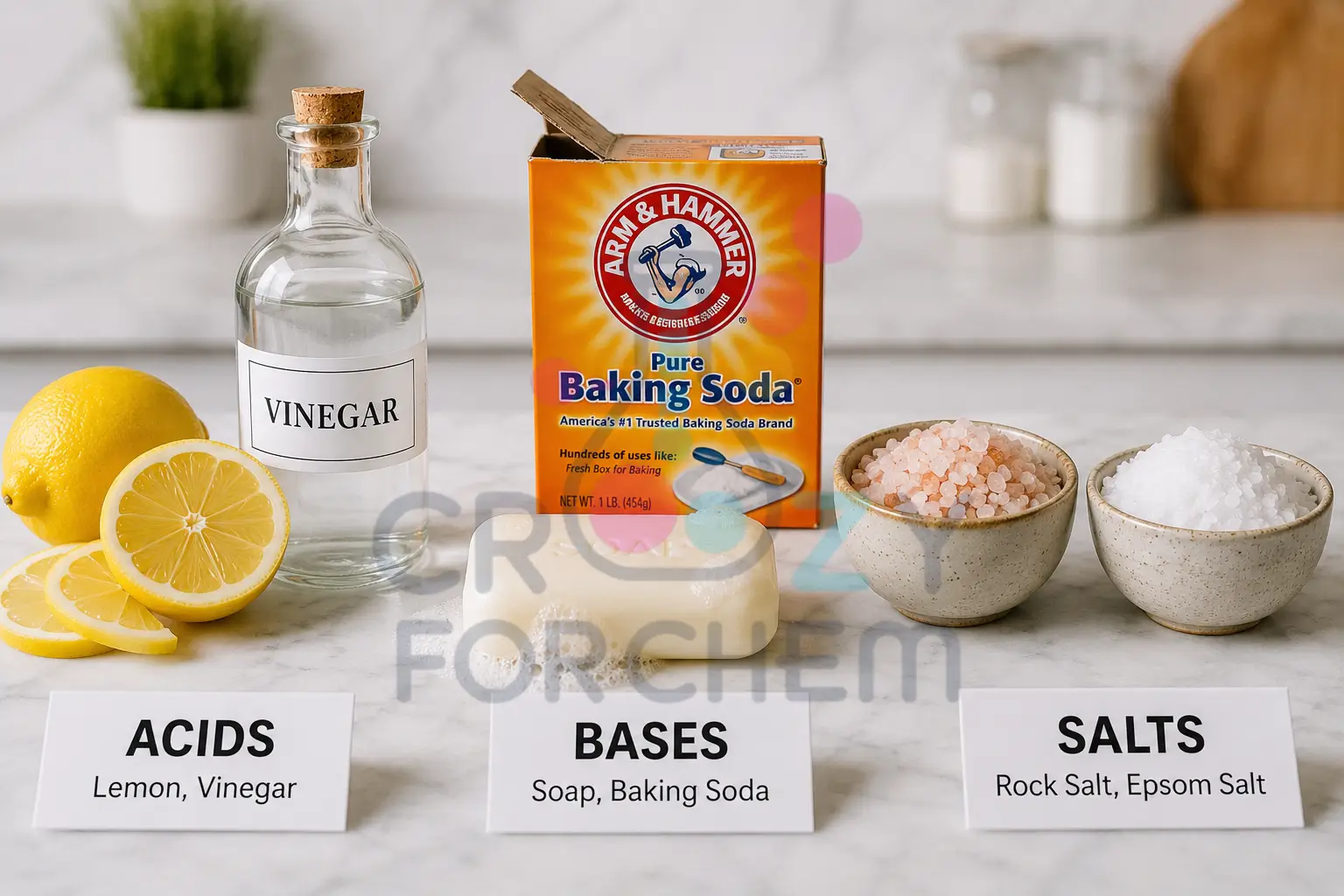
Table of Contents
The Big Three: A Comparative Overview
Before we dive into the specific molecular behaviours of these substances, it is useful to look at their basic definitions. Acids are characterised by the presence of the hydrogen ion (H⁺), which makes a solution acidic when it is dissolved in water.
Bases, conversely, are substances that either contain the hydroxide ion (OH⁻) or react with water to produce it. When these two meet, they react to form a salt, an ionic compound composed of a cation from the base and an anion from the acid.
Mega-Comparison Table: Quick Reference for Students
Students often find it easiest to distinguish these substances by their physical and observable properties. This table serves as a "cheat sheet" for identifying acids bases and salts:
| Property | Acids | Bases | Salts |
|---|---|---|---|
| Definition | Release H⁺ ions in water | Release OH⁻ions in water | Formed via neutralisation |
| pH Range | Less than 7 | Greater than 7 | Typically around 7 (Neutral)* |
| Taste | Sour (e.g., Lemons) | Bitter (e.g., Baking Soda) | Salty, sour, or bitter |
| Texture/Feel | Corrosive/Stinging | Slippery or Soapy | Crystalline/Gritty |
| Litmus Test | Turns Blue Litmus Red | Turns Red Litmus Blue | Generally no change |
| Conductivity | High (Electrolyte) | High (Electrolyte) | High (when dissolved/molten) |
*Note: As discussed below, not all salts are perfectly neutral due to salt hydrolysis.
Acids, Bases and Salts: Real-Life Examples
Real-life examples of acids, bases, and salts are all around you — you're interacting with all three before you've even finished breakfast.
Acids in Everyday Life
Sulphuric acid (H₂SO₄) is the lifeblood of car batteries, where its high conductivity drives the chemical reaction that starts your engine.
Closer to home, hydrochloric acid (HCl) in your stomach is essential for digestion; it activates the enzyme pepsin to break down proteins. Interestingly, it doesn't dissolve your stomach lining itself, because a protective layer of mucus shields the tissue from the acid's corrosive effect.
Bases in Everyday Life
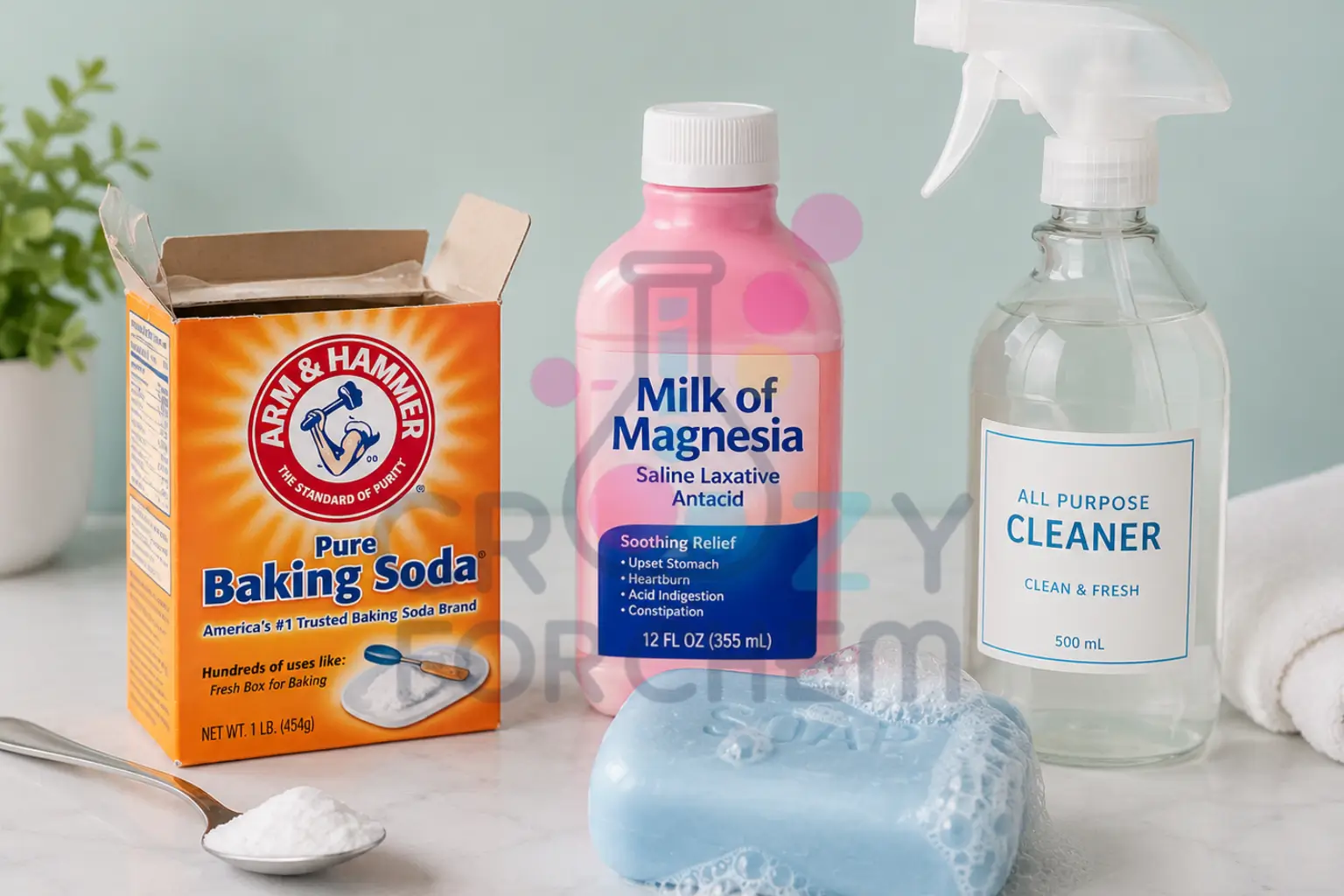
Sodium hydroxide (NaOH) is the primary base used in soap-making. Through a reaction called saponification, it combines with fatty acids to form soap, which is why soap feels slippery: the base is reacting with the natural oils on your skin, exactly as described earlier in this article.
Magnesium hydroxide, sold as Milk of Magnesia, is used as an antacid. It works through a straightforward neutralisation reaction
Mg(OH)₂ + 2HCl → MgCl₂ + 2H₂O
that neutralises excess stomach acid and helps relieve heartburn. (See our post on 7 Types of Chemical Reactions Every Student Must Master to understand this neutralisation reaction in more depth.)
Salts in Everyday Life
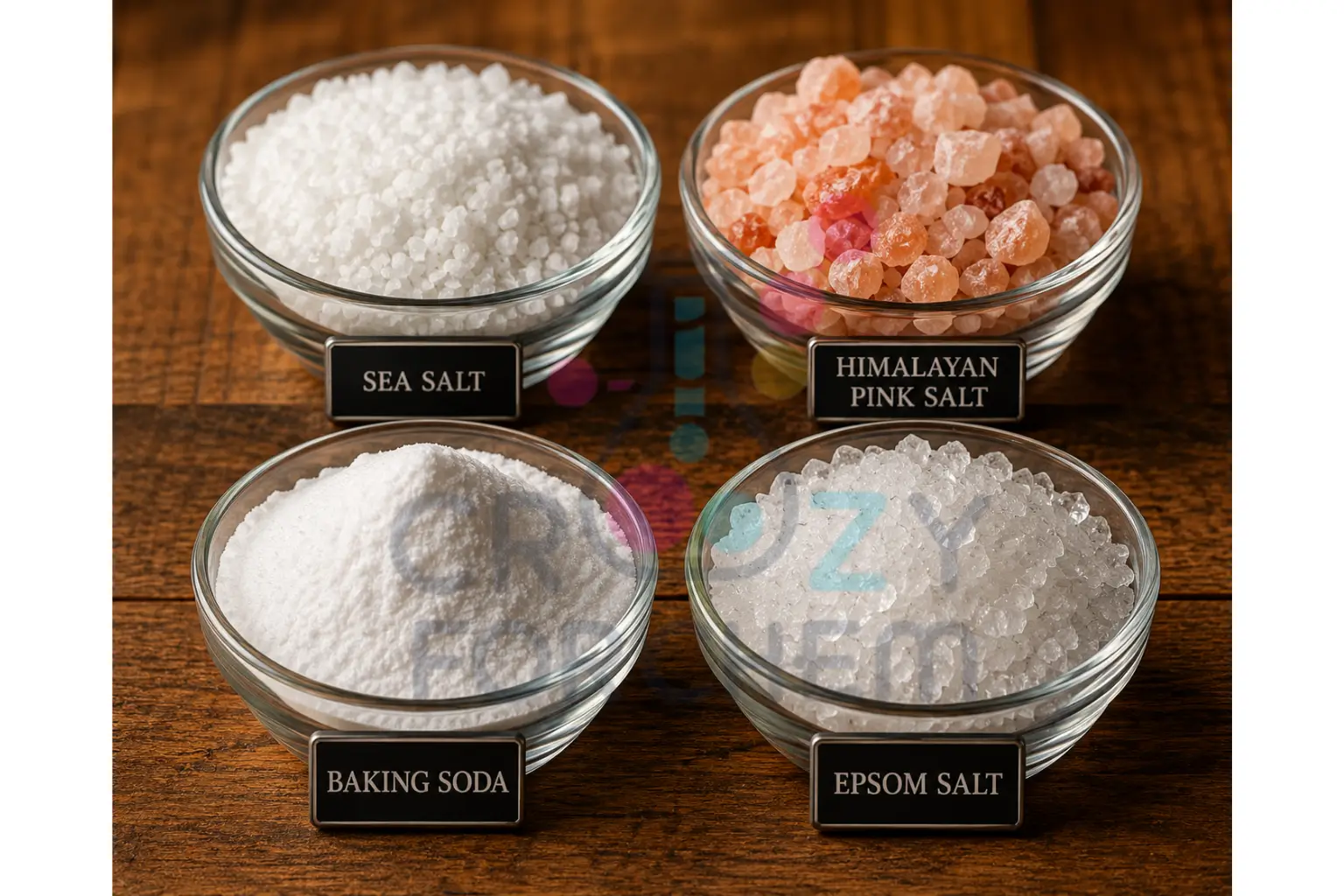
Sodium chloride (NaCl) does more than season food; it's also a preservative, drawing water out of bacteria to prevent spoilage.
Potassium nitrate (KNO₃) supplies the potassium ion plants need for growth, making it a key ingredient in fertilisers.
Calcium sulphate, in its hemihydrate form, is Plaster of Paris used for medical casts because it sets into a hard, stable structure when mixed with water and allowed to rehydrate.
These acids, bases and salts real-life examples show how a handful of core chemical principles quietly run everything from digestion to disinfection.
Properties of Acids: The Proton Donors
The chemical identity of an acid is tied to its ability to donate a proton (H⁺). This singular action defines its reactivity and its impact on the environment around it.
Physical Characteristics
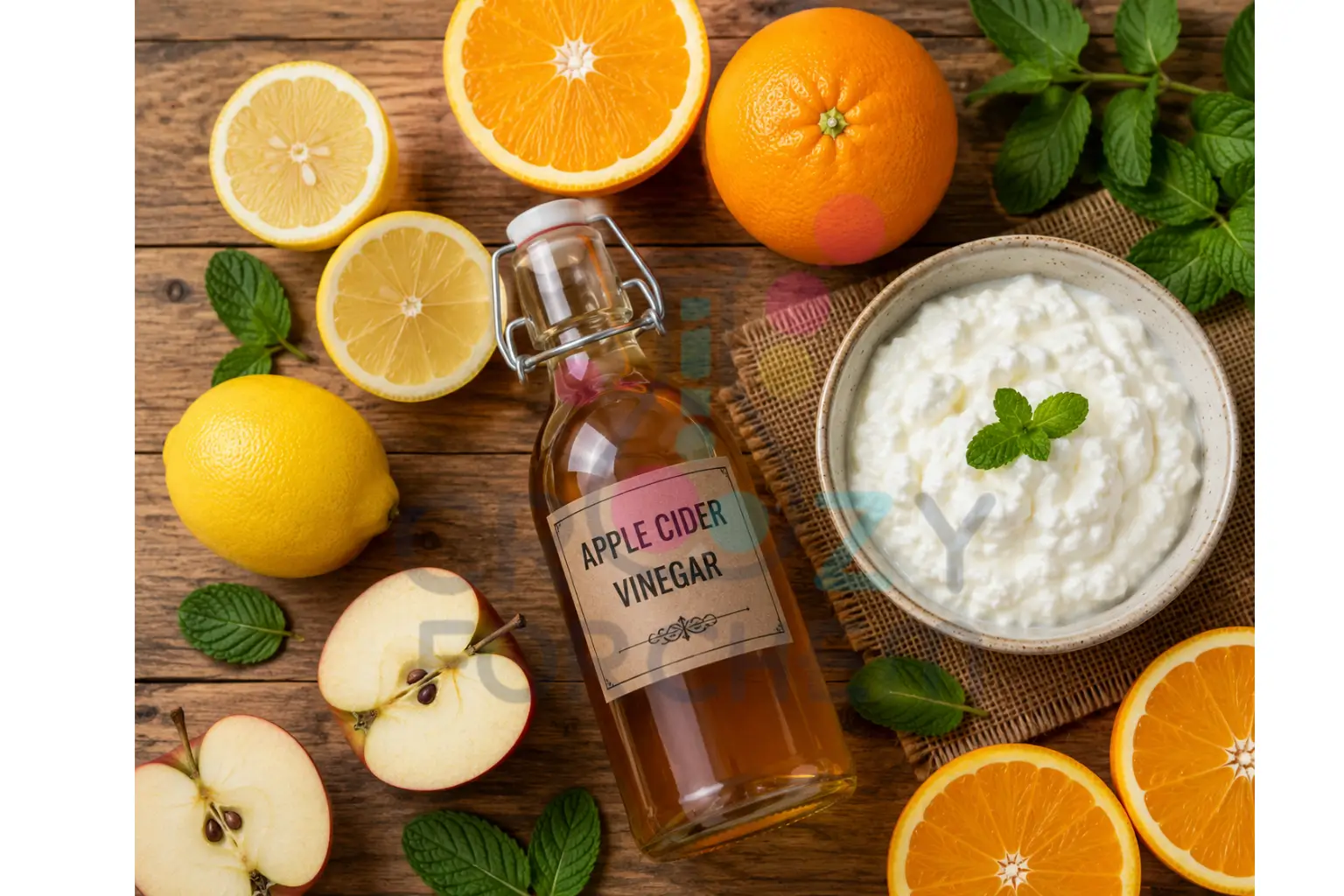
- Taste: The word "acid" comes from the Latin acere, meaning sour. This is why citrus fruits (containing citric acid) and vinegar (acetic acid) have their characteristic tang.
- Texture: Strong acids are highly corrosive to both living tissues and metals, capable of dissolving proteins and metallic structures.
Chemical Behaviour
- Indicator Change: Acids are famously known for turning blue litmus paper red.
- Reactivity with Metals: A hallmark of acids is their reaction with active metals like zinc or magnesium to produce hydrogen gas (H₂) and a salt.
- Conductivity: Because acids dissociate into ions (H⁺ and an anion) when dissolved in water, they act as excellent electrolytes and conduct an electric current.
To see these behaviours in action, read our post on 7 Types of Chemical Reactions Every Student Must Master.
Properties of Bases: The Proton Acceptors
Bases are the chemical counterparts to acids, often acting as proton acceptors in a reaction.
Physical Characteristics
- Taste: Bases have a distinctly bitter taste.
- Texture: Bases are slippery or soapy to the touch. This feeling occurs because bases react with the natural oils on your skin.
Chemical Behaviour
- Indicator Change: Bases turn red litmus paper blue.
- Alkalis vs Bases: It is vital to distinguish between the two: while all alkalis are bases, only bases that are soluble in water are called alkalis.
- Conductivity: Much like acids, bases dissociate into ions (such as
OH⁻) in aqueous solutions, allowing them to conduct electricity.
Properties of Salts: The Products of Neutralisation
Salts are ionic compounds that result when the hydrogen of an acid is replaced by a metal or ammonium ion.
Formation and Structure
- The Reaction: The general formula for salt formation is: Acid + Base → Salt + Water.
- Crystalline Nature: Most salts are crystalline solids at room temperature with high melting and boiling points. They consist of positively charged cations and negatively charged anions held together by strong electrostatic attraction.
Solubility and Conductivity
- Dissociation: While many salts like sodium chloride (NaCl) are highly soluble in water, some, such as barium sulphate (BaSO₄), are insoluble and form precipitates.
- Electrolytes: In their molten state or when dissolved in water, salts dissociate into mobile ions, making them effective conductors of electricity.
- It is important to remember that solid salts do not conduct electricity because their ions are locked in a rigid crystal lattice; conductivity only occurs when the salt is molten or dissolved, allowing the ions to move freely.
The pH Scale: Quantifying the Differences
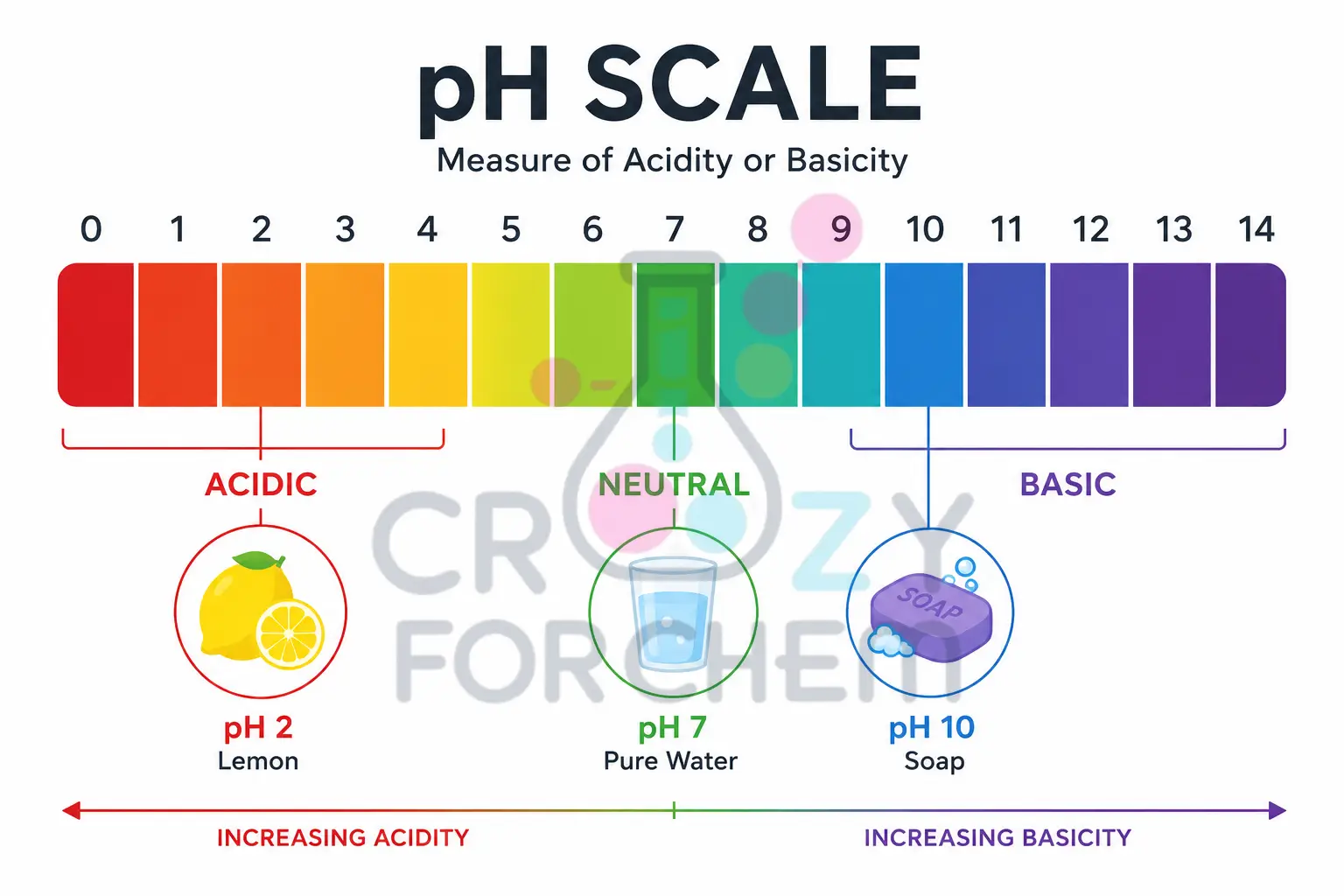
The pH scale is a numeric tool used to specify the acidity or alkalinity of a solution, ranging from 0 to 14.
- Acids (pH 0–6.9): Solutions with a pH of 0–3 are considered strongly acidic (like battery acid), while those with a pH of 5–7 are weakly acidic (like milk).
- Neutral (pH 7): A pH of exactly 7 is neutral, representing pure water or a neutral salt solution.
- Bases/Alkalis (pH 7.1–14): A pH of 8–11 represents a weak alkali (like baking soda), while a pH of 12–14 is a strong alkali (like bleach or lye).
Not All Salts are Neutral: Salt Hydrolysis
A common misconception is that all salts have a pH of 7. In reality, the pH of a salt solution depends on the strength of the parent acid and base that created it, a concept known as 'salt hydrolysis'.
The term Salt Hydrolysis refers to the reaction of an ion from a salt with water, which can release either H⁺ or OH⁻ ions, thereby altering the pH of the resulting solution.
- Neutral Salts: Formed from a Strong Acid + Strong Base. Example: Sodium chloride (NaCl). pH = 7.
- Acidic Salts: Formed from a Strong Acid + Weak Base. Example: ammonium chloride (NH₄Cl). In water, the ammonium ion (NH₄⁺) undergoes hydrolysis, solving with a pH < 7.
- Basic Salts: Formed from a Strong Base + Weak Acid. Example: Sodium carbonate (Na₂CO₃). The carbonate ion reacts with water to release
OH⁻ions, resulting in a pH > 7.
Indicators: How to Test the Difference
Indicators are chemical dyes that change colour based on the pH of the solution they are in.
| Indicator | Colour in the acid. | Colour in the base. |
|---|---|---|
| Litmus Paper | Red | Blue |
| Phenolphthalein | Colourless | Pink |
| Methyl Orange | Red | Yellow |
| Universal Indicator | Red/Orange/Yellow | Blue/Purple |
Olfactory Indicators: Some substances, like onion, vanilla, and clove oil, change their smell rather than their colour in acidic or basic environments, making them useful for pH testing
Conclusion
Mastering the relationship between acids bases and salts is more than just a classroom exercise; it is the foundation of chemical literacy. From the salt hydrolysis that determines the pH of our soil to the neutralisation that saves us from indigestion, these three categories of compounds form a fundamental chemical cycle.
By understanding their unique properties and pH differences, students can safely and effectively navigate the complexities of laboratory and industrial chemistry.
Want to dive deeper into concentration levels? Check out our Complete Guide to Strong vs Weak Acids.
Frequently Asked Questions
-
What is the main difference between an acid, a base, and a salt?
Answer: The primary difference lies in their chemical composition and ion release. An acid produces hydrogen ions (H⁺) in water, a base produces hydroxide ions (OH⁻) or accepts protons, and a salt is an ionic compound formed when an acid and a base neutralise each other. While acids are sour and bases are bitter, salts are generally neutral.
-
How can you distinguish between an acid and a base without tasting them?
Answer: Tasting chemicals is dangerous and strictly prohibited in laboratories. Instead, you can use indicators. The simplest method is the litmus test: an acid will turn blue litmus paper red, while a base will turn red litmus paper blue. You can also use a pH meter; acids have a pH below 7, and bases have a pH above 7.
-
Are all salts neutral in nature?
Answer: No, not all salts are neutral. The pH of a salt depends on the strength of its "parent" acid and base. A salt formed from a strong acid and a weak base will be acidic (pH < 7), whereas a salt formed from a weak acid and a strong base will be basic (pH > 7). Only salts from a strong acid and a strong base, like Sodium Chloride, are truly neutral (pH 7).
-
Is soap an acid, a base, or a salt?
Answer: Soap is technically a basic salt. It is produced through a process called saponification, where a strong base (like Sodium Hydroxide) reacts with fatty acids. This is why soap has the characteristic slippery feel of a base and a pH typically between 8 and 10.
-
Why are acids and bases called electrolytes?
Answer: Acids and bases are called electrolytes because they dissociate into free-moving ions when dissolved in water. These ions act as charge carriers, allowing the solution to conduct an electric current. Salts also act as electrolytes when they are in a molten state or dissolved in a solvent.
-
What happens to the pH when an acid reacts with a base?
Answer: When an acid and a base react, they undergo neutralisation, which moves the pH of the solution closer to the neutral point (pH 7). The H⁺ from the acid and OH⁻ from the base combine to form water (H₂O), while the remaining ions form a salt.