
Spin-Spin Coupling in NMR: J-Values, Multiplicity & the n+1 Rule
Spin-spin coupling is an indirect, through-bond interaction between neighbouring non-equivalent nuclei that splits one signal into a multiplet. With I = ½ nuclei, n neighbours give n+1 lines with Pascal’s triangle intensities. The line spacing is the coupling constant J in Hz — independent of field strength — and via the Karplus relationship it reveals dihedral angles and stereochemistry.
🧪 Click the card to explore
Spin-spin (J) coupling is an indirect scalar interaction between the magnetic moments of neighbouring non-equivalent nuclei, relayed through the bonding electrons (the Fermi contact mechanism). Direct dipole-dipole coupling is ~1000× larger but averages to zero in liquids because of rapid tumbling — so only J-coupling survives.
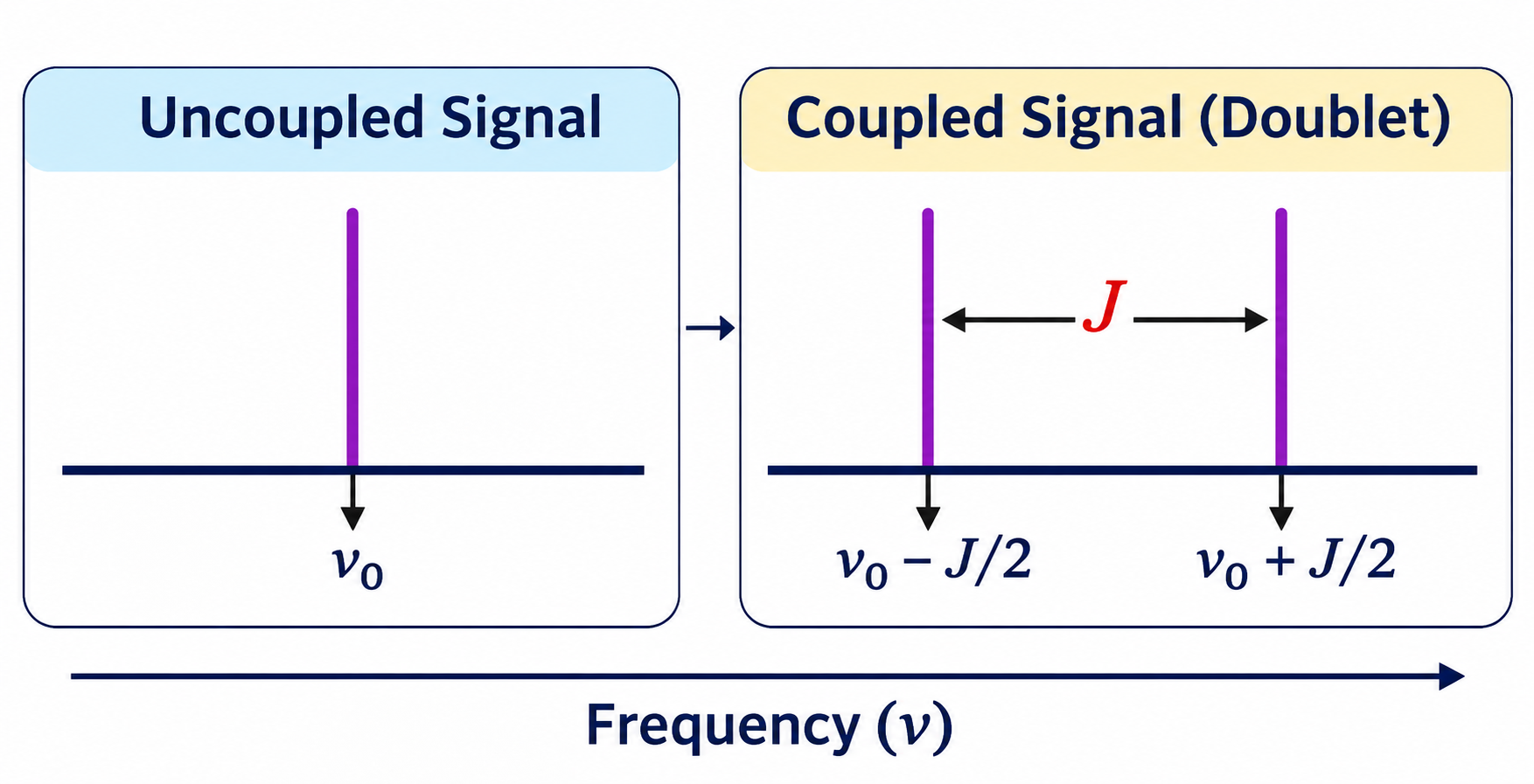
A neighbouring proton HX is either α (aligned with B₀) or β (opposed). HA therefore feels a slightly stronger or weaker field, and its single line splits into two equal-intensity lines — a doublet. The splitting is only a few Hz on top of MHz precession frequencies.
Splitting is observed only between chemically non-equivalent protons that are within three or fewer bonds. Equivalent protons never split each other: the 3 H of an isolated CH₃, the 4 H of ClCH₂CH₂Cl and the 6 H of benzene all appear unsplit by their own set.
For n equivalent neighbours with spin I = ½, the signal splits into n+1 lines. The general formula covers other nuclei:
M = 2nI + 1      (I = ½ → M = n + 1)
²H or ¹⁴N (I = 1), one nucleus → M = 2(1)(1)+1 = 3 (triplet)
Ethyl bromide (CH₃CH₂Br): CH₃ sees 2 H → triplet; CH₂ sees 3 H → quartet.
1,1,2-Trichloroethane: CHCl₂ sees 2 H → triplet (δ 5.76); CH₂Cl sees 1 H → doublet (δ 3.96).
2-Chloropropane: CH sees 6 H → septet; the two CH₃ groups (6H) see 1 H → doublet.
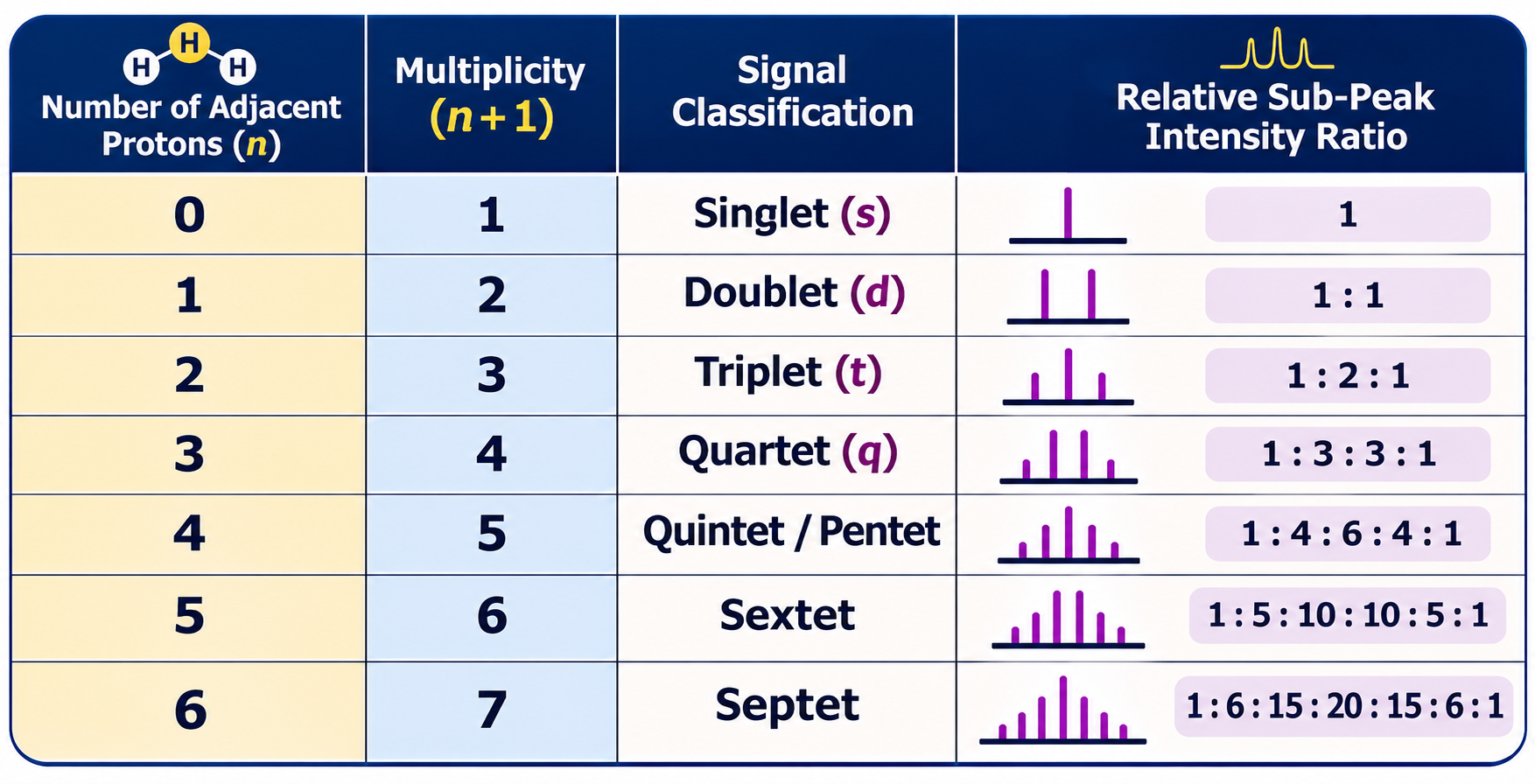
Line heights follow binomial coefficients: each number is the sum of the two above it. A triplet is 1:2:1 because the middle line comes from two degenerate spin combinations (αβ and βα), while the outer lines come from single states (αα and ββ). The outer line is always 1/n of the second line, and all lines in a first-order multiplet add up to 2ⁿ.
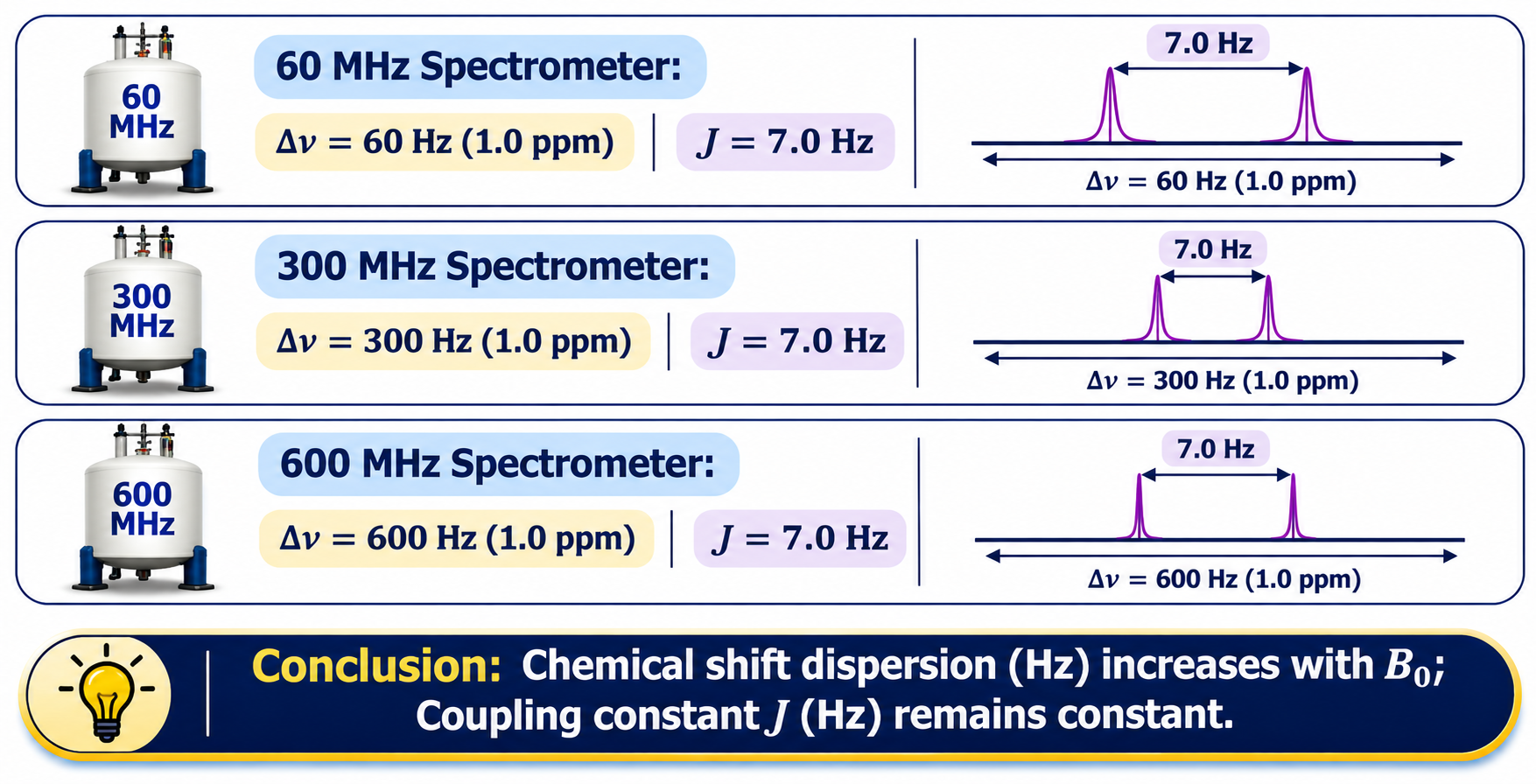
J is the spacing between adjacent lines in Hz. It is field independent: δ (ppm) spreads out in Hz as B₀ rises, but J stays the same at 60, 300 or 800 MHz. Coupling is reciprocal (JAX = JXA), so two coupled multiplets must show the same J — the key to pairing partners in a crowded spectrum.
Geminal ²JHH (2 bonds): sp³ values are negative, −10 to −15 Hz; wider H–C–H angles move it toward 0, and an adjacent C=O pushes it to about −25 Hz. Exceptions: ethene +2.5 Hz, formaldehyde +41 Hz.
Vicinal ³JHH (3 bonds): freely rotating chains average 6–8 Hz; rigid systems range 0–18 Hz. In alkenes, trans 12–18 Hz > cis 6–12 Hz.
Long-range (4+ bonds): ≤1 Hz in saturated chains, but allylic 0–3 Hz, aromatic ortho 7–10 / meta 1–3 / para 0–1 Hz, and W-coupling 1–7 Hz in rigid frameworks.
³J(φ) = A cos²φ + B cosφ + C
Ethane-type: ³J = 12 cos²φ − cosφ + 2
Coupling is maximum at φ = 180° (12–15 Hz) and 0° (10–12 Hz) and minimum near 90° (0–2 Hz). In chair cyclohexane, diaxial H (φ ≈ 180°) show ³J = 8–13 Hz, while axial-equatorial and diequatorial H (φ ≈ 60°) show only 2–5 Hz. In cyclopropane, cis (≈0°) is 8–11 Hz and trans (≈120°) is 5–8 Hz.
Rotamer average ≈ (1/3)(4) + (1/3)(4) + (1/3)(13) ≈ 7 HzWith non-equivalent partners the line count is (n₁+1)(n₂+1)(n₃+1)… A splitting tree builds the pattern one coupling at a time. The largest J gives the first name of the multiplet and the smallest J gives the last.
Δν/J ≥ 10: first-order — symmetric multiplets, spacing = J, Pascal intensities (AX system).
Δν/J ≤ 3: strong coupling (AB system) — the roof effect (inner lines grow, outer lines shrink), multiplet centres no longer equal true shifts, and as Δν → 0 the pattern collapses to a singlet (A₂).
True shift difference: Δν = √[(f₁ − f₄)(f₂ − f₃)]
A higher-field spectrometer increases Δν in Hz while J stays fixed, turning second-order patterns back into first-order ones.
A second rf field at the coupled nucleus’ frequency forces rapid α↔β flipping, averaging the coupling to zero.
Homonuclear: irradiate one ¹H signal; its partner’s multiplet collapses, proving connectivity.
Heteronuclear (¹³C{¹H}): removes all ¹JCH (125–250 Hz) so each carbon gives one sharp line.
Off-resonance: keeps one-bond coupling — CH₃ quartet, CH₂ triplet, CH doublet, C singlet.
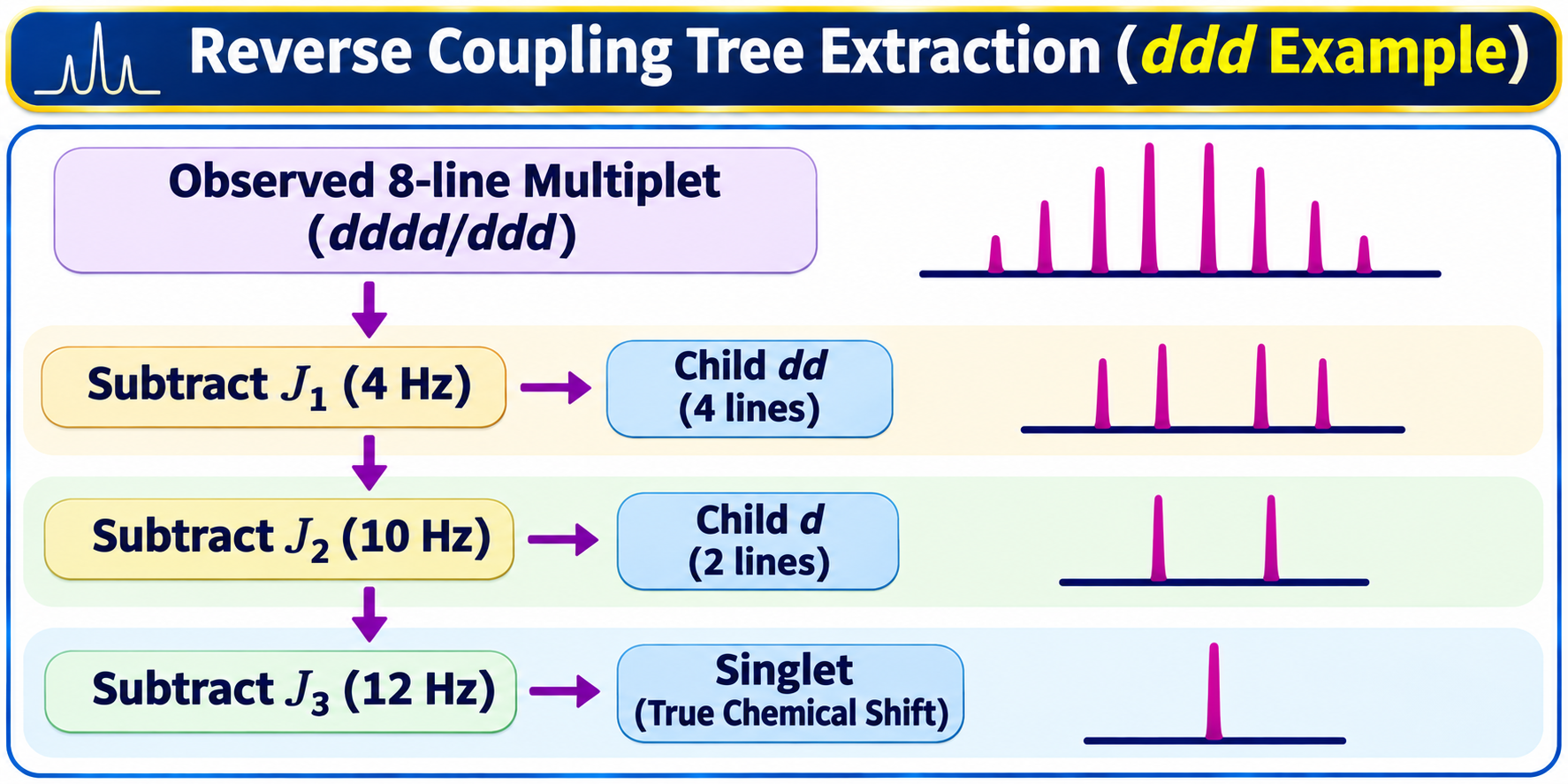
1. Match partners by identical J values. 2. Assign isomers: alkene trans 12–18 vs cis 6–12 Hz; aromatic ortho 7–10, meta 1–3, para 0–1 Hz. 3. Reverse tree analysis: subtract the smallest line spacing first, then the next, until the uncoupled shift remains.
| Coupling type | Bonds | Typical J (Hz) |
|---|---|---|
| Geminal ²J (sp³) | 2 | −10 to −15 |
| Vicinal ³J (free rotation) | 3 | 6–8 |
| Alkene trans / cis | 3 | 12–18 / 6–12 |
| Diaxial (chair) | 3 | 8–13 |
| Ax-eq or eq-eq (chair) | 3 | 2–5 |
| Aromatic ortho / meta / para | 3 / 4 / 5 | 7–10 / 1–3 / 0–1 |
| Allylic | 4 | 0–3 |
| W-coupling (rigid) | 4 | 1–7 |
| Multiplet | Lines | Intensity | Arises from |
|---|---|---|---|
| dd | 4 | 1:1:1:1 | 2 non-equiv. H, J₁ ≠ J₂ |
| dt | 6 | 1:2:1:1:2:1 | 1 H (large J) + 2 H (small J) |
| td | 6 | 1:1:2:2:1:1 | 2 H (large J) + 1 H (small J) |
| ddd | 8 | all equal | 3 non-equiv. H |
Fundamentals of Spin-Spin Coupling in NMR
The Magnetic Interaction Through Bonds
As part of our detailed study on modern instrumental methods in chemistry, spin-spin coupling in NMR represents an indirect, scalar interaction between the magnetic moments of neighbouring non-equivalent active nuclei transmitted through intervening chemical bonds. Unlike direct magnetic dipole-dipole interactions, which are roughly 1000 times larger in magnitude but average completely to zero in isotropic liquids due to rapid, random molecular motion, scalar J-coupling persists in mobile liquids. This coupling is mediated primarily by the Fermi contact interaction mechanism, in which a nuclear magnetic moment perturbs (polarises) the spin orientation of surrounding bonding valence electrons. This electronic polarisation cascade is transmitted across intervening σ-orbitals, altering the local magnetic field experienced by adjacent nuclei.
When an external static magnetic field (B0) is applied, a neighbouring active proton (HX) occupies either an α spin state (aligned parallel to B0) or a spin state (antiparallel to B0). Consequently, an observed adjacent proton (HA) experiences two distinct effective local magnetic fields: one slightly stronger than (B0) when (HX) is aligned with the field, and one slightly weaker than (B0) when (HX) opposes the field. What would otherwise appear as a single resonance absorption line is thereby split into two distinct sub-peaks of equal area and intensity, giving rise to a doublet. The vertical energy scales of scalar couplings are on the order of Hertz (Hz), representing minute perturbations imposed upon Megahertz (MHz) nuclear precessional frequencies.
Distinguishing Coupled vs Non-Coupled Protons
Observing signal splitting requires that interacting protons be chemically non-equivalent. Chemically or magnetically shift-equivalent protons, such as the three hydrogen atoms of an isolated methyl group, the four protons of symmetrical 1,2-dichloroethane, or the six protons of benzene, do not exhibit mutual signal splitting in isotropic spectra. Although scalar coupling interactions exist between equivalent nuclei, the quantum mechanical selection rules render these splittings unobservable in single-dimensional spectra. Observable signal splitting occurs exclusively when non-equivalent protons reside within three or fewer covalent bonds of one another, establishing a predictable relationship between chemical environment and spectral multiplicity.
The Mechanics of Multiplicity and the n+1 Rule
Applying the n+1 Rule in First-Order Spectra
In first-order spectra, signal multiplicity is governed by the n+1 rule in NMR spectroscopy. When a set of equivalent protons couples to (n) adjacent, chemically equivalent protons with a spin quantum number of I = 1/2, the resonance signal splits into (n+1) sub-peaks. For coupling to nuclei possessing spin quantum numbers where I ≠ 1/2 (such as deuterium, I = 1, or nitrogen-14, I = 1), the generalised multiplicity formula is expressed as M = 2nI + 1.
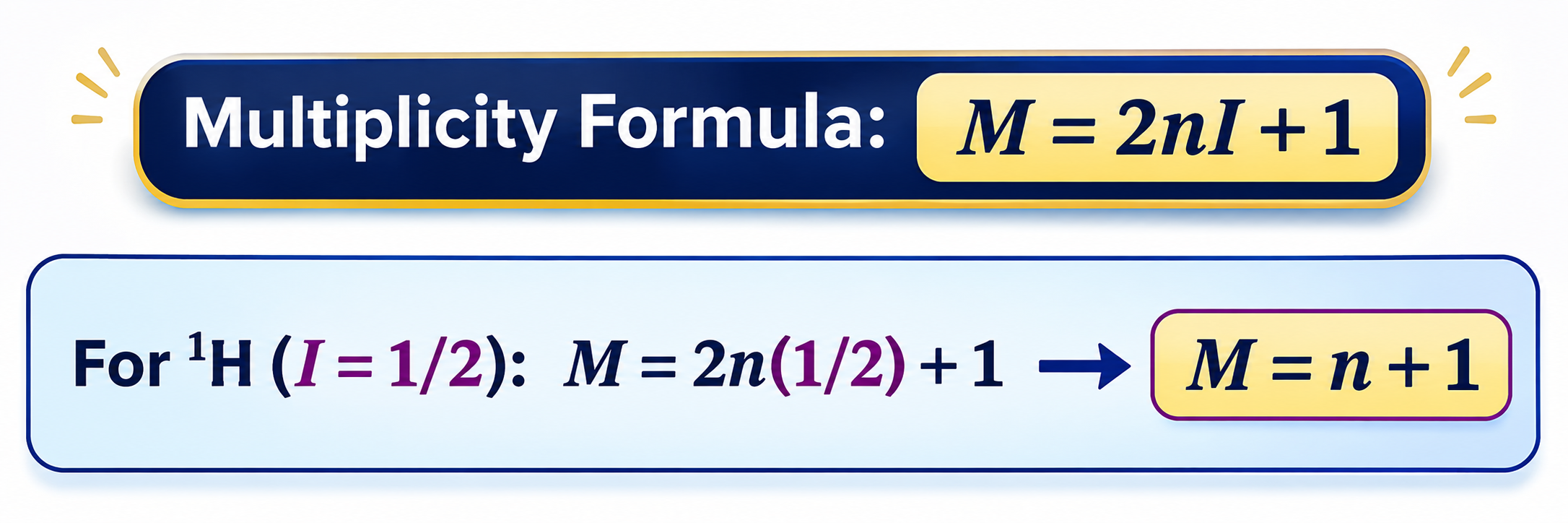
¹H, I = 1/2). .The application of the (n+1) rule is demonstrated across diverse molecular frameworks:
- 1,1,2-Trichloroethane (CHCl₂-CH₂Cl): The methine proton (-CHa-) is coupled to two equivalent methylene protons (-CH₂b-, n=2), yielding a triplet (2+1=3) at δ 5.76 ppm. Conversely, the methylene protons are coupled to one methine proton (n=1), appearing as a doublet (1+1=2) at δ 3.96 ppm.
- Ethyl bromide (CH₃CH₂Br): The methyl protons (-CH₃, 3H) couple to two methylene protons (n=2), resulting in a triplet at δ 1.6 ppm. The methylene protons (-CH₂-, 2H) couple to three methyl protons (n=3), producing a quartet (3+1=4) at δ 3.5 ppm.
- 2-Chloropropane ((CH₃)₂CHCl): The single methine proton (-CH-, 1H) is adjacent to six equivalent methyl protons (n=6), splitting the signal into a septet (6+1=7) at δ 3.68 ppm. The six methyl protons couple to the lone methine proton (n=1), yielding a 6H doublet at δ 1.55 ppm.
Pascal’s Triangle and Peak Intensity Ratios
The relative sub-peak intensity ratios within a split multiplet obey the statistical probability of nuclear spin state combinations (α) and (β) among neighbouring nuclei. These relative line heights mirror binomial expansion coefficients (a+b)n, which are conveniently visualised through Pascal's triangle.
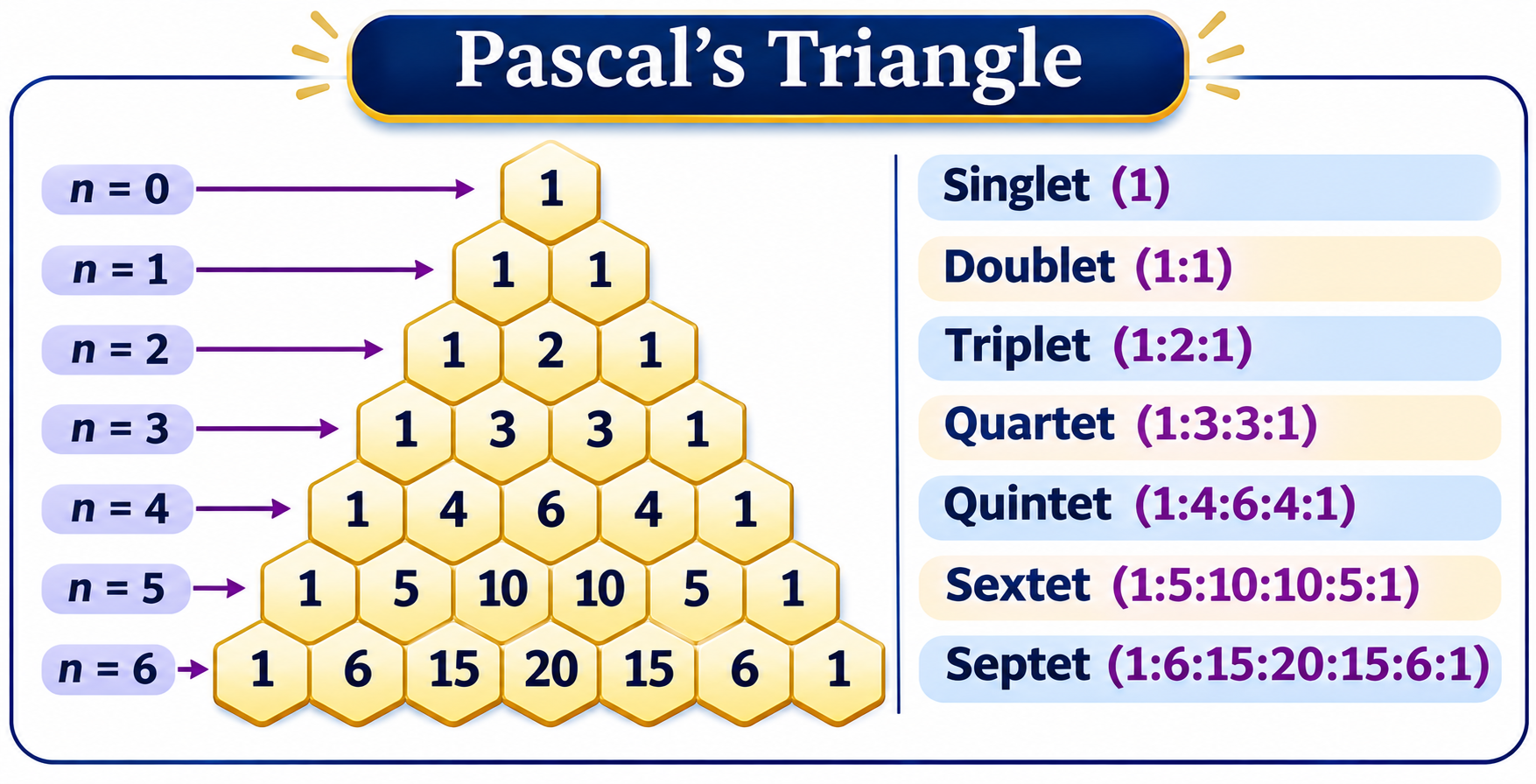
Pascal's triangle peak intensities NMR rules dictate that each value in an underlying row represents the sum of the two entries directly above it. For a triplet (n=2), the central line is twice as intense as the two outer lines (1:2:1) because two degenerate spin combinations (αβ) and (βα) yield identical local field contributions, whereas the extreme lines correspond to unique non-degenerate states (αα) and (ββ). Diagnostic intensity relationships indicate that the height of the outermost sub-peak is always (1/n) times the height of the second line, and the sum of all sub-peak intensities within a first-order multiplet equals (2n).
Understanding Coupling Constants (J-Values)
Definition and Field Independence of J
The physical separation between adjacent sub-peaks within a split signal defines the coupling constant J in Hz. Expressed strictly in hertz (cycles per second), (J) quantifies the magnitude and efficacy of the electron-coupled magnetic interaction. A fundamental property of scalar coupling is its field independence. While chemical shifts (δ, in ppm) scale linearly in frequency (Hz) with increasing external magnetic field strength (B₀), the magnitude of (J) remains invariant whether measured on a 60 MHz, 300 MHz, or 800 MHz spectrometer.
Furthermore, scalar coupling is strictly reciprocal: JAX = JXA. The magnetic influence exerted by proton HA upon proton HX is identical in magnitude to the influence exerted by HX upon HA, ensuring that mutually coupled multiplets share matching peak separation values.
Structural Categorisation: Geminal, Vicinal, and Long-Range Coupling
Systematic analysis of vicinal and geminal coupling constants provides precise dimensional data regarding bond distances, hybridisation states, and spatial orientations:
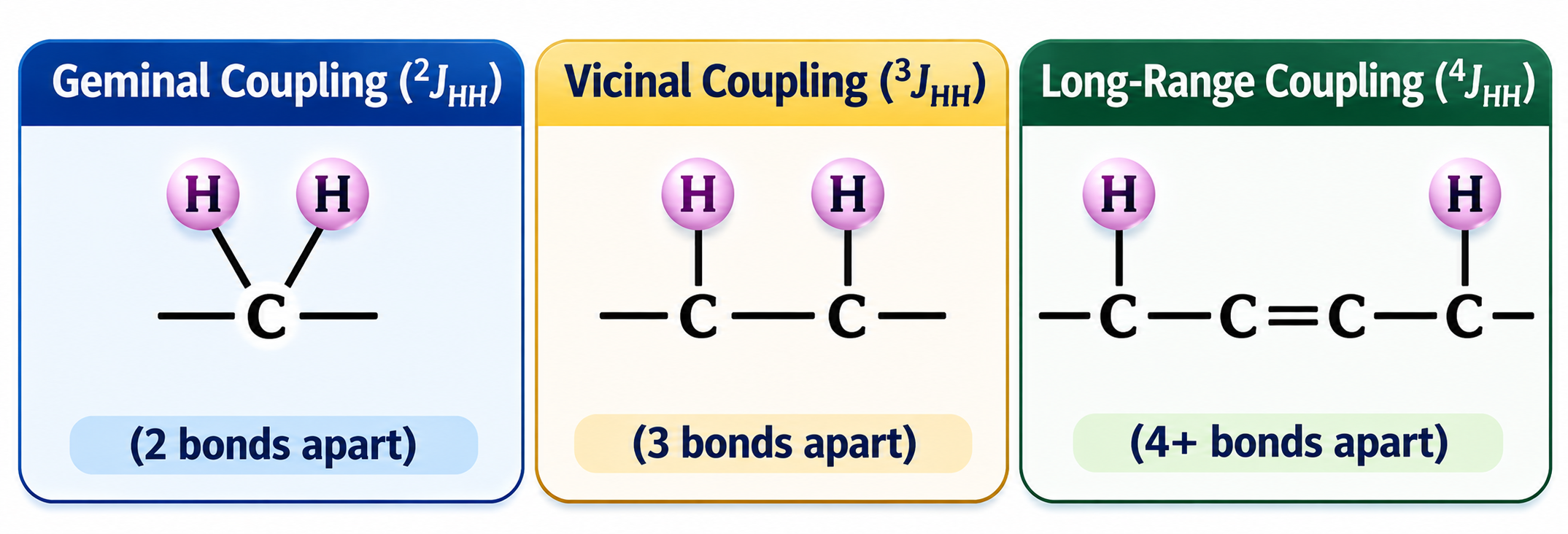
- Geminal Coupling (2JHH): Refers to coupling between non-equivalent protons attached to the same carbon atom (separated by two bonds). In saturated (sp3) alkanes, (2JHH) values are generally negative, ranging from -10 to -15 Hz. The magnitude of (2JHH) depends strongly on the (H-C-H) bond angle and substituent electronegativity. Increasing the bond angle from (109.5°) toward (125°) reduces the absolute magnitude toward (0 Hz), whereas attaching π-acceptor carbonyl groups makes (2JHH) more negative (down to (-25 Hz). Notable exceptions occur in (sp2) systems like ethene (+2.5 Hz) and formaldehyde (+41 Hz).
- Vicinal Coupling (3JHH): Involves protons attached to adjacent carbons (separated by three bonds). In freely rotating aliphatic chains, (3JHH) averages (6-8 Hz). In rigid systems, (3JHH) ranges from 0 to 18 Hz, depending primarily on the dihedral torsion angle. In alkenes, vicinal coupling across double bonds provides definitive geometric assignment: trans coplanar coupling (3Jtrans = 12 - 18 Hz) is significantly larger than (cis) coplanar coupling (3Jcis = 6 -12 Hz) due to superior (π)-mediated orbital overlap.
- Long-Range Coupling (4JHH, 5JHH): Interactions across four or more bonds are typically (1 Hz) in saturated acyclic chains but become prominent across unsaturated (π)-systems or rigid geometries. Allylic coupling (H-C-C=C-H) ranges from 0 to 3 Hz. Aromatic systems display distinct position-dependent couplings: ortho (³Jortho = 7–10 Hz), meta (⁴Jmeta = 1–3 Hz), and para (⁵Jpara = 0–1 Hz). In rigid saturated frameworks (e.g., bicycloalkanes or chair cyclohexanes), 4-bond coupling is observed when atoms form a coplanar "W-conformation" (⁴JW = 1–7 Hz).
The Karplus Relationship and Conformational Geometry
The magnitude of vicinal coupling (³JHH) is intrinsically linked to the dihedral torsion angle (φ) between adjacent C-H bonds, as formalised by Martin Karplus:
³J(φ) = A cos²φ + B cosφ + C
Where A, B, and C are empirical parameters derived for specific molecular families. For typical ethane derivatives, the equation is parameterised as ³J(φ) = 12 cos²φ - cosφ + 2. Alternatively, the parameterised forms for 0° ≤ φ ≤ 90° and 90° ≤ φ ≤ 180° are expressed as:
Jvic = 8.5 cos²φ - 0.28 (0° ≤ φ ≤ 90°)
Jvic = 9.5 cos²φ - 0.28 (90° ≤ φ ≤ 180°)
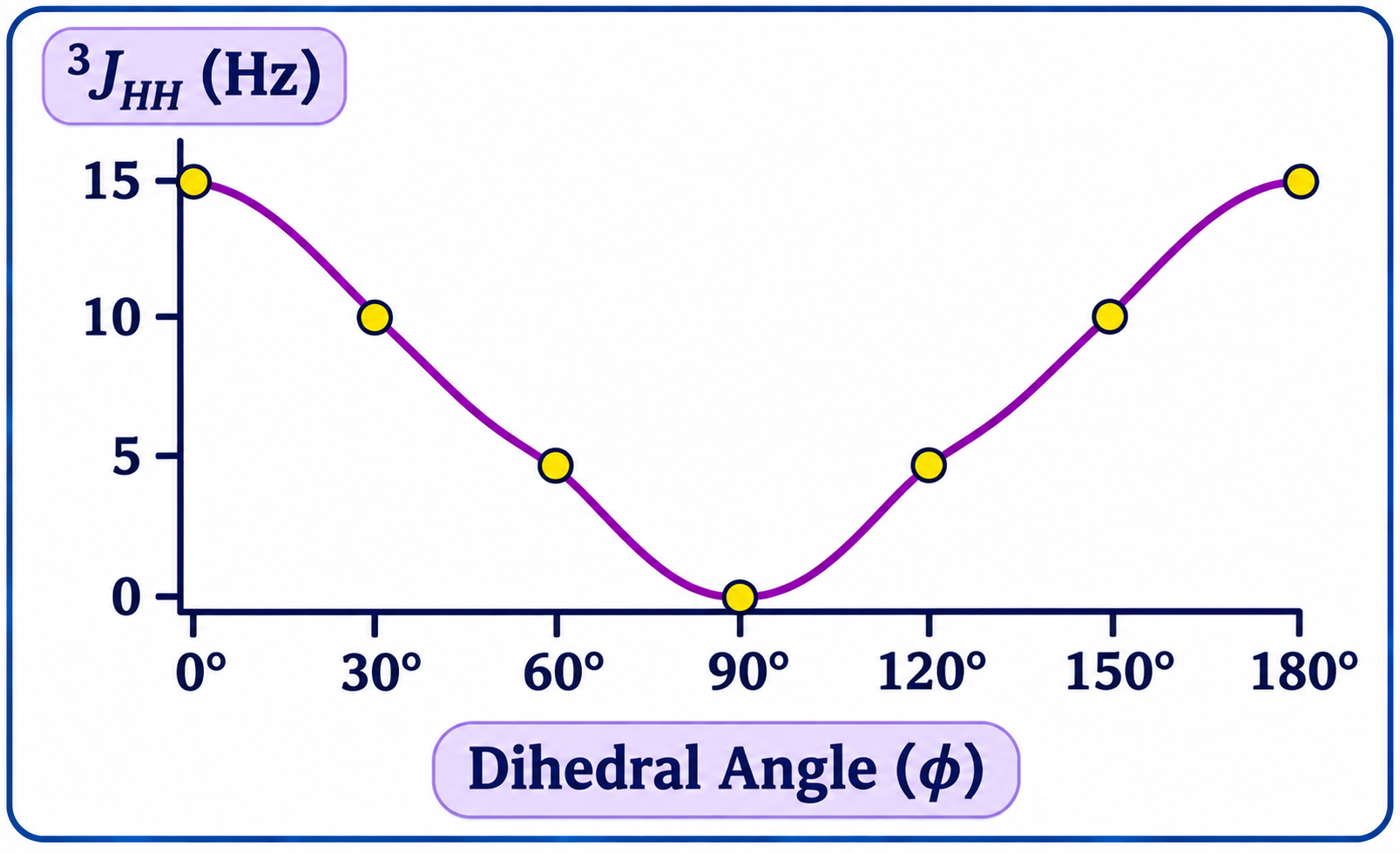
Orbital overlap between sp³ hybrid orbitals governs coupling strength. Overlap reaches maximum values at anti-coplanar (φ = 180°, ³J ≈ 12–15 Hz) and syn-eclipsed (φ = 0°, ³J ≈ 10–12 Hz) geometries. Conversely, when the C-H bonds are orthogonal (φ = 90°), orbital overlap drops to near zero, yielding minimal coupling (³J ≈ 0–2 Hz).
The Karplus relationship dihedral angle dependence serves as the foundation for conformational analysis:
- Chair Cyclohexanes: Diaxial protons (φ ≈ 180°) display large coupling constants (³Ja,a = 8–13 Hz). Axial-equatorial (φ ≈ 60°) and diequatorial (φ ≈ 60°) protons display small coupling constants (³Ja,e ≈ ³Je,e ≈ 2–5 Hz).
- Cyclopropanes: Rigid three-membered rings hold cis protons in eclipsed orientations (φ ≈ 0°), resulting in ³Jcis ≈ 8–11 Hz, which is consistently larger than trans coupling (φ ≈ 120°, ³Jtrans ≈ 5–8 Hz).
- Acyclic Rotamer Averaging: Fast single-bond rotation in open-chain alkanes yields a population-weighted average across two gauche rotamers (φ = 60°, ³J ≈ 4 Hz) and one trans rotamer (φ = 180°, ³J ≈ 13 Hz):
³Jobserved = F₁·³J₁ + F₂·³J₂ + F₃·³J₃ ≈ (1/3)(4) + (1/3)(4) + (1/3)(13) ≈ 7.0 HzComplex Multiplicity and Splitting Tree Diagrams
Non-Equivalent Coupling Partners (dd, dt, td)
When a proton couples to multiple non-equivalent neighbouring protons possessing distinct J-values, complex multiplets form instead of simple (n+1) patterns. The theoretical number of lines is governed by (n1 + 1)(n2 + 1)(n3 + 1)... Constructing splitting tree diagrams dd dt allows systematic graphical analysis of these signals.
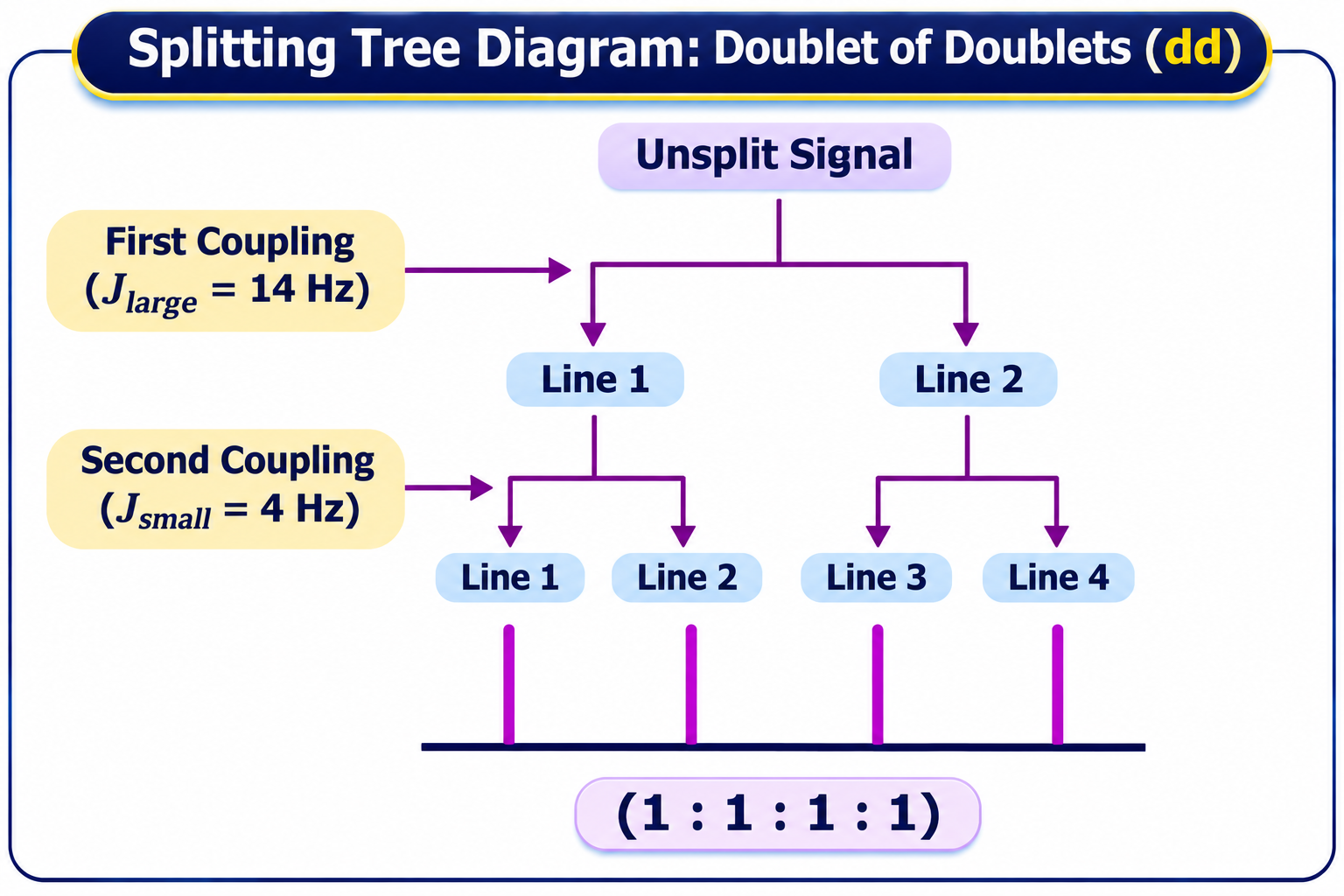
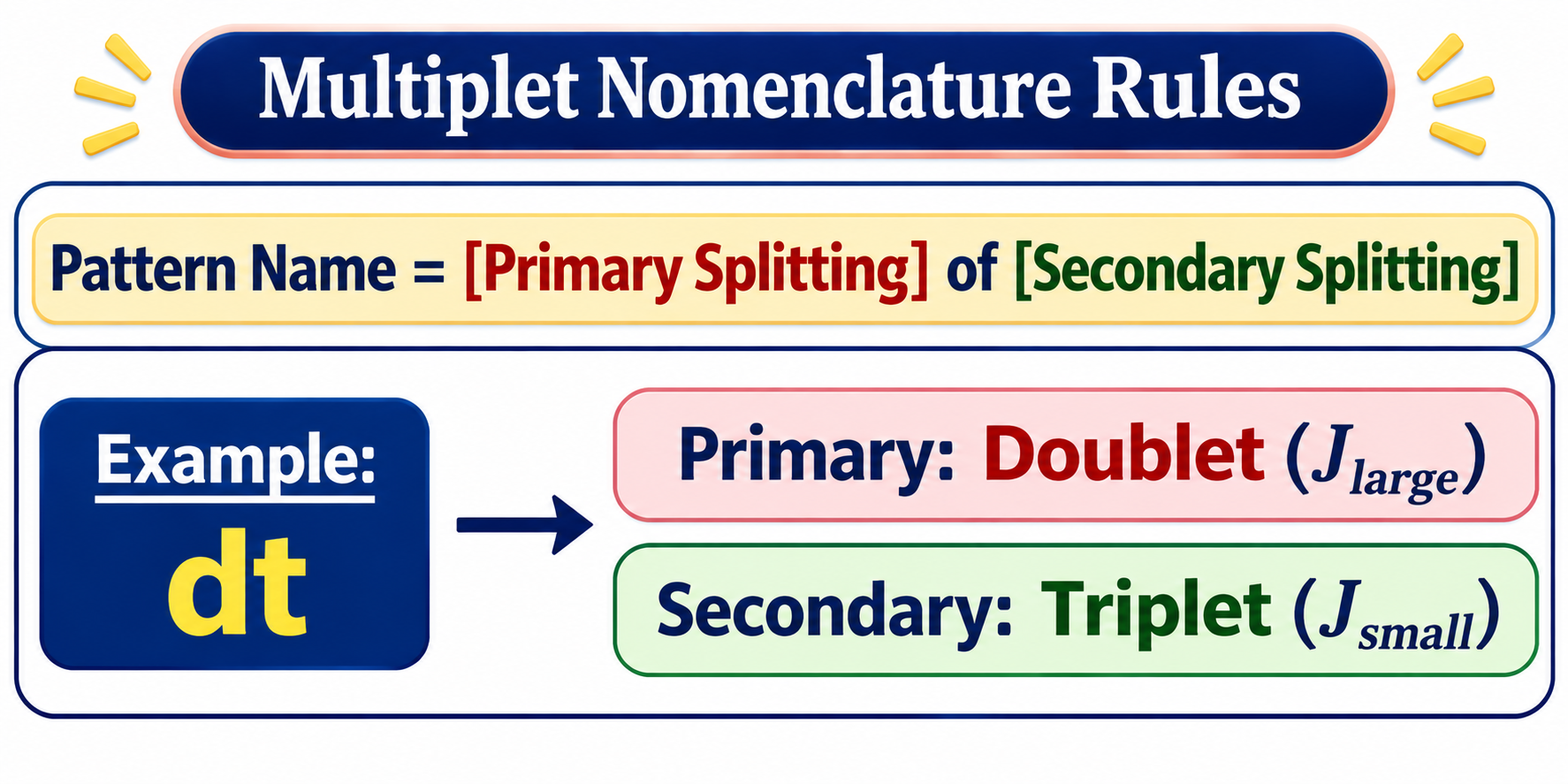
Nomenclature conventions dictate that the largest coupling constant determines the "first name" of the multiplet, while the smallest determines the "last name":
- Doublet of Doublets (dd): Arises from coupling to two non-equivalent protons with distinct coupling constants (J₁ ≠ J₂). Produces a 4-line pattern of equal intensities (1:1:1:1). The smallest J-value is measured between lines 1–2 (or 3–4); the largest J-value is measured between lines 1–3 (or 2–4).
- Doublet of Triplets (dt): Consists of six lines arranged as two 1:2:1 triplets of equal intensity (1:2:1:1:2:1). Results from coupling to one proton with a larger J-value and two equivalent protons with a smaller J-value.
- Triplet of Doublets (td): Consists of six lines arranged as three doublets in a 1:2:1 intensity ratio (1:1:2:2:1:1). Results from coupling to two equivalent protons with a larger J-value and one proton with a smaller J-value.
- Doublet of Doublets of Doublets (ddd): Arises from coupling to three non-equivalent protons (J₁ ≠ J₂ ≠ J₃), generating an 8-line pattern of equal intensity.
Transition to Second-Order Systems (Δν/J ≤ 3)
Analyzing first order vs second order NMR spectra depends on the ratio of chemical shift separation in Hertz (Δν = |νA - νX|) to the scalar coupling constant (J):
First-Order Criterion: Δν/J ≥ 10
When Δν/J ≥ 10 (weak coupling limit, AX spin system), spectra follow first-order rules: multiplets are centrosymmetric, sub-peak spacings equal J, and intensities follow Pascal's triangle.
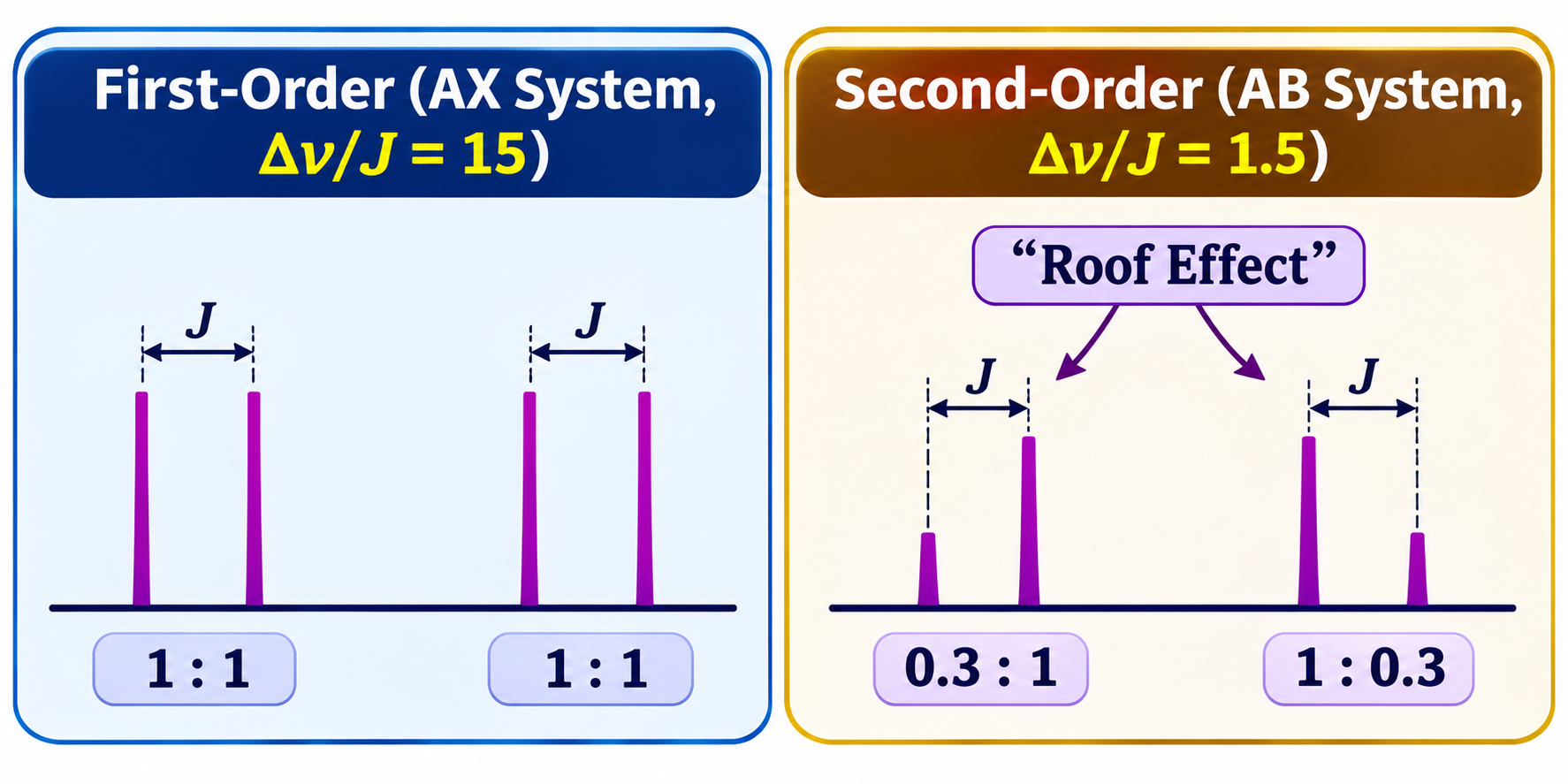
When (Δν/J ≤ 3) (strong coupling limit, (AB) spin system), off-diagonal quantum state mixing distorts the spectrum:
- The "Roof Effect" (Tilting): Inner multiplet lines increase in intensity, while outer lines diminish, causing signals to lean toward their coupling partners.
- Shift Distortion: The geometric centers of the multiplets no longer correspond to the true chemical shifts. True shifts must be calculated as Δν = √((f₁ - f₄)(f₂ - f₃)),
- Coalescence Limit (A₂): As Δν → 0, outer lines vanish entirely, and inner lines collapse into a single uncoupled singlet.
Increasing spectrometer field strength (B0) expands Δν in Hertz while leaving (J) unchanged, successfully converting complex second-order (AB) patterns back into simple first-order (AX) multiplets.
Nuclear Magnetic Resonance Decoupling
Homonuclear and Heteronuclear Decoupling Techniques
NMR decoupling suppresses scalar J-coupling by irradiating the sample with a secondary radiofrequency (rf) field at the resonance frequency of specific coupled nuclei. Continuous excitation forces rapid transitions between α and β spin states, averaging the local field contribution to zero and collapsing split multiplets into clean singlets.
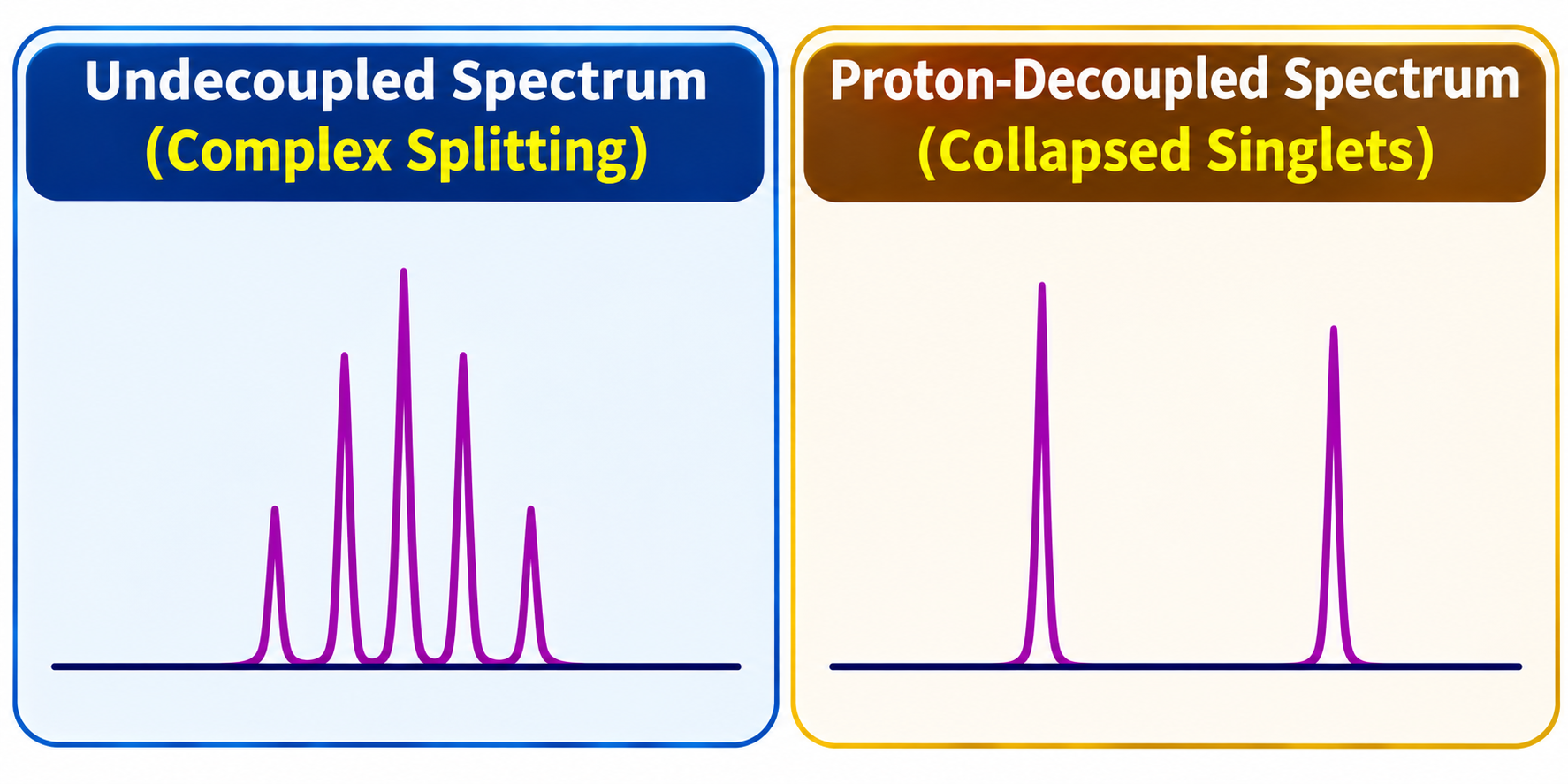
- Homonuclear Decoupling: Irradiates a selected proton signal while observing other protons. Selectively irradiating proton HA collapses the multiplet of its coupling partner HB into a singlet or simpler pattern, confirming direct scalar connectivity.
- Heteronuclear Decoupling: Irradiates a different nuclear isotope while acquiring the spectrum of the target nucleus. In standard ¹³C NMR, broad-band proton decoupling (¹³C{¹H}) eliminates all ¹³C–¹H couplings (¹JH = 125–250 Hz), yielding a single sharp line for each non-equivalent carbon.
- Off-Resonance Decoupling:
Employs weaker rf power positioned slightly off-resonance, retaining residual J-coupling to directly attached protons. Carbon signals appear as multiplets obeying the n+1 rule (-CH₃ as quartets, -CH₂- as triplets, -CH- as doublets, quaternary carbons as singlets), providing carbon hybridization and proton counts.
Practical Applications in Structure Elucidation
Pairing Coupling Partners and Diagnostic Rules in Organic Analysis
Mastering J-values and multiplicity in NMR enables systematic assignment of complex molecular architectures:
- Reciprocal J-Value Matching: Coupled protons must display identical J-values. In complex spectra containing overlapping multiplets, measuring peak separations in Hertz allows unambiguous pairing of coupling partners.
- Distinguishing Isomers: Measuring ³JHH across double bonds differentiates alkene stereoisomers (trans: 12–18 Hz vs cis: 6–12 Hz). In substituted aromatic rings, measuring J-values identifies substitution patterns (ortho: 7–10 Hz, meta: 1–3 Hz, para: 0–1 Hz).
- Reverse Coupling Tree Analysis: Complex multiplets are decoded by systematically subtracting couplings starting with the smallest line separation. Removing each J-value generates a simplified child multiplet until the uncoupled core frequency is isolated.
Through the combined evaluation of chemical shifts, peak integrals, signal multiplicities, and precise coupling constants, proton NMR spectroscopy provides an analytical framework for complete molecular structure determination.
Frequently Asked Questions (FAQs)
Why is the coupling constant J measured in Hertz (Hz) instead of parts per million (ppm)?
The coupling constant (J) is measured in Hertz because it represents a physical energetic interaction between nuclear spins mediated through chemical bonds. Unlike chemical shifts, which are dependent on the external magnetic field strength (B0) and expressed in ppm, J-values are strictly independent of field strength and remain constant in Hertz regardless of whether a 60MHz or 600MHz spectrometer is used.
Does the n+1 rule apply to exchangeable protons like hydroxyl (-OH) or amino (-NH₂) groups?
Typically, no. Protons attached to electronegative heteroatoms (such as oxygen or nitrogen) undergo rapid chemical exchange with trace moisture or acid catalysts in the solution. This rapid exchange decouples them from neighbouring carbon-bound protons, usually resulting in a sharp or broad singlet rather than adhering to the standard n+1 multiplicity rule.
How can you distinguish a true quartet from a doublet of doublets (dd) with similar peak spacings?
While both patterns consist of four distinct lines, their intensity ratios and splitting intervals differ fundamentally. A true quartet arising from the n+1 rule follows binomial Pascal's triangle intensities (1:3:3:1) with identical intervals (J). In contrast, a doublet of doublets (dd) exhibits four equal-intensity lines (1:1:1:1) controlled by two distinct coupling constants (J₁ ≠ J₂) reflecting two different neighbouring magnetic environments.
What causes the "roof effect" in second-order NMR spectra?
The roof effect occurs when the chemical shift separation between two interacting protons (Δν in Hz) approaches the magnitude of their coupling constant (J), violating the first-order approximation (Δν/J ≤ 3). Under this strong coupling regime, the inner sub-peaks of the interacting multiplets increase in height while the outer peaks diminish, tilting towards each other like a sloping roof.
Why do chemically equivalent protons not exhibit spin-spin coupling with each other?
Spin-spin coupling requires a magnetic environment difference where interacting nuclei experience distinct spin states. Because chemically equivalent protons possess identical shielding and resonant frequencies, their mutual scalar interactions produce no net energetic transitions or observable splitting in a first-order ¹H NMR spectrum.

Founder · CrazyForChem
Chemistry Educator | Organic Chemistry Expert | M.Sc. Organic Chemistry
Helping Students & Teachers Master Chemistry. I’m a passionate chemistry educator who loves making chemistry simple, relatable, and fun. With a background in Organic Chemistry, I help students not only understand concepts but also explore the many career paths chemistry can lead to.