Hybridisation of Carbon: A Comprehensive Guide to sp, sp², and sp³ States
Swati Hunge
In the intricate landscape of organic chemistry, the ability of carbon to form millions of stable, diverse compounds is not a matter of chance; it is the result of a fascinating quantum mechanical process that defines the very architecture of life.
As an educator, I tell my students that hybridisation is like mixing colours to get a new shade; you take distinct atomic orbitals with different energy levels and blend them to create a new set of equivalent orbitals that dictate a molecule’s shape and reactivity.
Understanding the hybridisation of carbon is the foundational step for any student aiming to master the logic behind organic reaction mechanisms and molecular architecture. Understanding how these atomic interactions influence electronic effects is crucial for any aspiring chemist.
Table of Contents
What is the Hybridisation of Carbon?
The Concept of Mixing Orbitals
In its essence, hybridisation is a mathematical treatment of wavefunctions. It describes the process by which atomic orbitals of the same or nearly the same energy levels combine or “mix” to create a new set of equivalent “hybrid” orbitals.
Linus Pauling pioneered this concept to explain why certain molecules, like methane (CH₄), exhibit geometries that traditional atomic orbital theory could not account for specifically, i.e., why all four C-H bonds are identical in length and strength despite the valence electrons originating from different subshells. By mixing orbitals, carbon achieves maximum stability and optimal bonding geometry.
Ground State vs Excited State
To understand why this process is necessary, we must examine the electronic configuration of carbon.
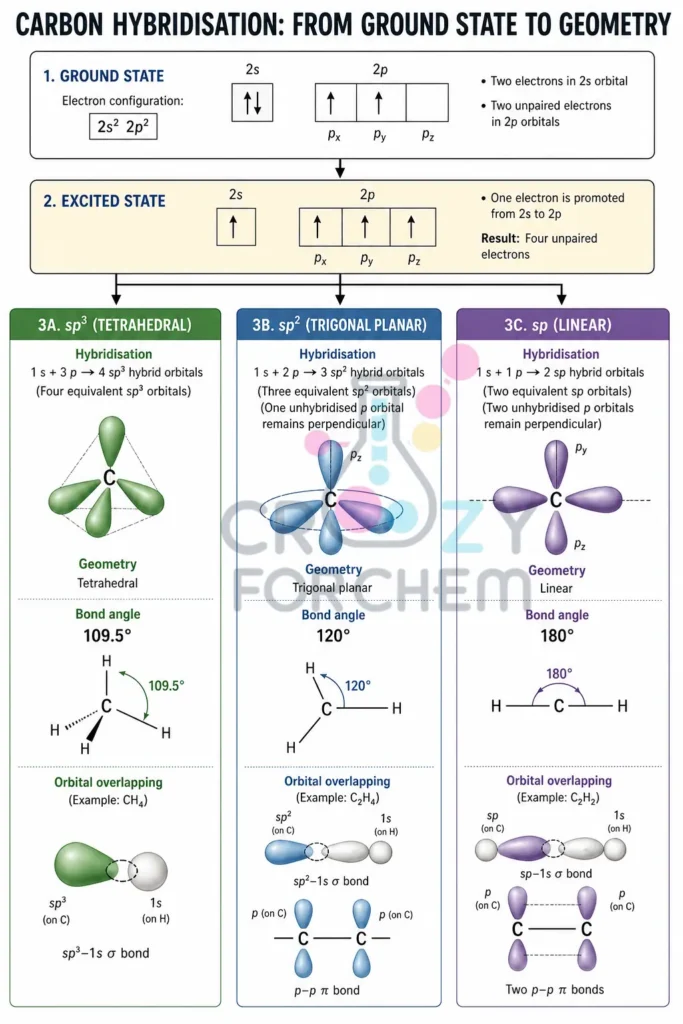
In its ground state, carbon has the configuration 1s² 2s² 2p².
This configuration shows only two unpaired electrons in the 2p subshell, suggesting carbon should only form two covalent bonds to produce unstable molecules like methylene (CH₂).
However, carbon is famously tetravalent in stable organic compounds.
While this excitation seems costly, the resulting bonding stability is closely related to the principles we discuss in our guide on the Inductive effect, where electron density shifts define reactivity.
To achieve this, carbon must enter the excited state of carbon.
A small amount of energy is used to promote one electron from the doubly occupied 2s orbital to the empty 2pz orbital, resulting in four unpaired electrons (1s² 2s¹ 2px¹ 2py¹ 2pz¹) ready for bonding.
While this excitation requires an energy “cost”, the energy released when four stable covalent bonds are formed more than compensates for it, lowering the total potential energy of the resulting molecule.
From ground state to geometry: Visualising how orbital mixing creates the shapes of carbon molecules.
sp³ Hybridisation: The Foundation of Alkanes
Orbital Composition
When a carbon atom is bonded to four other atoms through single sigma (σ) bonds, it undergoes sp3 hybridisation. In this process, the one 2s orbital and all three 2p orbitals in the valence shell mix to form four identical sp³ hybrid orbitals.
Each of these four degenerate orbitals contains one electron and possesses an s-character in bonds of exactly 25%, with the remaining 75% being p-character.
Geometry and Bond Angles
According to Valence Shell Electron Pair Repulsion (VSEPR) theory, these four equivalent orbitals arrange themselves in three-dimensional space to be as far apart as possible to minimise repulsion.
This results in a molecular geometry of carbon known as tetrahedral. In a regular tetrahedron, the characteristic bond angles between these orbitals are 109.5°.
Key Examples
The most common examples of this state are found in saturated hydrocarbons:
Methane (CH₄): The central carbon is sp³ hybridised, forming four identical σ bonds with four hydrogen atoms.
Ethane (C₂H₆): Both carbon atoms are sp³ hybridised, resulting in a tetrahedral arrangement around each centre with a C-C σ bond formed by the overlap of two sp³ orbitals.
sp² Hybridisation: The Chemistry of Double Bonds
Formation of Trigonal Planar Structure
In molecules where carbon forms a double bond, sp2 hybridisation occurs. Here, the 2s orbital mixes with only two of the three available 2p orbitals (typically 2px and 2py).
This creates three equivalent sp² hybrid orbitals, while one 2p orbital remains unhybridised and sits perpendicular to the plane of the hybrid system.
Geometry and Bond Angles
The three sp² orbitals repel each other into a trigonal planar configuration. In this flat, triangular arrangement, the bond angles in organic molecules are approximately 120°.
Significance of the Pi Bond
The unhybridised p orbital is crucial for the formation of a double bond. While the hybrid orbitals form a strong, localised σ bond via head-to-head overlap, the unhybridised p orbitals on adjacent carbons undergo sideways or “parallel” overlap to form a pi (π) bond.
Unlike σ electrons which are tightly bound to the nucleus, pi electrons are less tightly held and more mobile, often participating in delocalisation and participating in delocalisation and resonance, which we have explained in detail as a key force in our Resonance Effect guide.
Key Examples
Ethene (C₂H₄): Each carbon is sp² hybridised, linked by one σ bond and one π bond.
Benzene (C₆H₆): A classic example where all six carbons are sp² hybridised in a planar hexagonal ring, with unhybridised p orbitals forming a cloud of delocalised electrons.
Graphite: This allotrope consists of layers of sp² hybridised carbons arranged in a honeycomb lattice.
sp Hybridisation: Linear Bonding in Alkynes
Creating Linear Orbitals
When carbon forms a triple bond or two consecutive double bonds, it utilises sp hybridisation. In this state, the 2s orbital mixes with only one 2p orbital, resulting in two equivalent sp hybrid orbitals and two unhybridised p orbitals (usually 2py and 2pz).
Geometry and Bond Angles
To achieve maximum separation, the two hybrid orbitals point in exactly opposite directions, creating a linear geometry. The resulting bond angles are 180°.
Key Examples
Ethyne (Acetylene, C₂H₂): The carbons are sp hybridised, linked by one σ bond and two perpendicular π bonds.
Carbon Dioxide (CO₂): The central carbon atom is sp-hybridised, forming two σ bonds and two π bonds with oxygen atoms to maintain a linear shape.
How to Determine Hybridisation: The Steric Number Shortcut
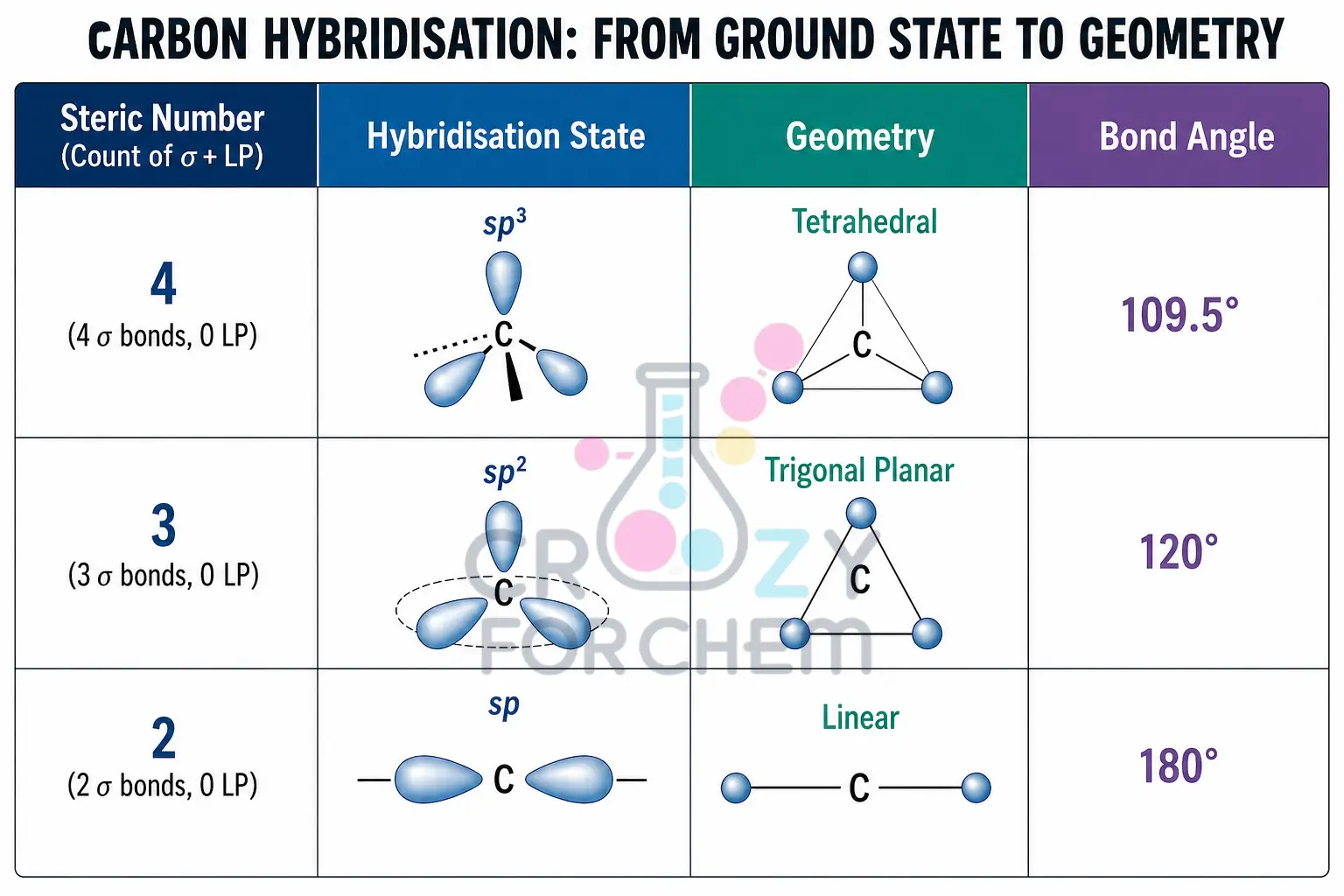
For students, the fastest way to identify the hybridisation of carbon without drawing complex orbital diagrams is by using the steric number shortcut.
Step-by-Step Identification
Count the Sigma (σ) Bonds: Count every single bond and exactly one bond from every multiple bond (double or triple) attached directly to the carbon atom.
Count the Lone Pairs: Add any non-bonding electron pairs residing on that specific carbon.
Sum them up: This total is your steric number.
Quick Lookup Table
Steric Number
Hybridisation
Geometry
Bond Angle
2
sp
Linear
180°
3
sp²
Trigonal Planar
120°
4
sp³
Tetrahedral
109.5°
The arrangement of these orbitals follows the VSEPR theory
Educator’s Insight: “Students often ask me if π-bonds affect hybridisation. Remember, π-bonds are formed by unhybridised p-orbitals, so they are never counted in hybridisation. Only count σ-bonds and lone pairs!”.
Your hybridisation cheat sheet: A quick lookup table connecting steric numbers with molecular shape and angles.
The Role of s-Character in Bond Strength and Length
Bond Strength Trends
The s-character in bonds significantly influences the physical properties of a molecule. Because an s orbital is closer to the nucleus than a p orbital, hybrid orbitals with a higher percentage of s character are held more tightly and are closer to the carbon nucleus.
sp (50% s): These orbitals have the highest s character, resulting in the shortest and strongest bonds.
sp² (33.3% s): These are intermediate in length and strength.
sp³(25% s): These have the least s character, resulting in the longest and weakest bonds.
This explains why a carbon-carbon triple bond (sp) is much stronger and shorter than a carbon-carbon single bond (sp³). Furthermore, a higher s character increases the electronegativity of the carbon atom, which affects the acidity of attached protons.
Common Exceptions and Exam Tricks for JEE & NEET
Hybridisation in Intermediates
A common trap in competitive exams like JEE Organic Chemistry or NEET Organic Chemistry involves short-lived reaction intermediates:
Carbocations (CH₃⁺): Although it appears to have single bonds, the carbon is sp² hybridised because its steric number is 3, leading to a planar shape. To understand why this geometry makes them so reactive, check out our Reaction Intermediates guide.
Carbanions (CH₃⁻): In these species, the lone pair adds to the steric number (3 σ bonds + 1 lone pair = 4), typically making the carbon sp3 hybridised with a pyramidal shape.
The Resonance Factor
Always check for resonance before assigning a state. In molecules like amides or aniline, a lone pair on nitrogen might appear to make it sp³. Still, delocalisation of that lone pair into a π system often forces the atom into an sp² state to allow for necessary p orbital overlap and resonance stabilisation.
Conclusion: Why Understanding Geometry Matters
The hybridisation of carbon is much more than a theoretical exercise; it is the master key to visualising the 3D world of organic molecules.
By mastering the relationship between orbital mixing, molecular geometry of carbon, and bond angles, you gain the ability to predict how a drug will fit into a protein receptor or how a polymer material will behave under stress.
Whether you are identifying a linear alkyne or a tetrahedral alkane, always remember that the unique “mixing of colours” in carbon’s orbitals is what allows for the endless variety of chemical structures that form the basis of our world.
Frequently Asked Questions (FAQs)
How do you determine the hybridisation of carbon?
To determine the hybridisation, calculate the Steric Number by counting the number of sigma (σ) bonds and lone pairs attached to the carbon atom. A steric number of 4 indicates sp³, 3 indicates sp², and 2 indicates sp hybridisation. Note that π bonds are never included in this count.
Why is carbon sp3 hybridised in methane (CH₄)?
Carbon is sp³ hybridised in methane because it forms four identical (σ) bonds with four hydrogen atoms. To achieve this, carbon mixes its 2s and three 2p orbitals to form four equivalent sp³ hybrid orbitals, resulting in a stable tetrahedral geometry with 109.5° bond angles.
What is the difference between sp, sp², and sp³ hybridisation?
The difference lies in the number of orbitals mixed and the resulting geometry: sp³: Mixes 1s + 3p; creates 4 orbitals; Tetrahedral shape (109.5°). sp²: Mixes 1s + 2p; creates 3 orbitals; Trigonal Planar shape (120°). sp: Mixes 1s + 1p; creates 2 orbitals; Linear shape (180°).
Do pi (π) bonds affect the hybridisation state?
No, π bonds do not affect the hybridisation state. the sideways overlap of unhybridised p-orbitals forms π bonds. When calculating hybridisation, you should only count σ bonds and lone pairs (the steric number).
Why is the sp hybrid bond shorter and stronger than sp³?
The sp hybrid orbital has 50% s-character, whereas sp³ has only 25%. Since the s orbital is closer to the nucleus, a higher s-character means the hybrid orbital is held more tightly, resulting in a shorter and stronger bond compared to orbitals with lower s-character.
Looking for career guidance in Chemistry or any other field? Our experienced career counsellor is here to help you sort out your dilemma and decide on a career path.