Aromaticity and Hückel’s Rule: A Complete Guide with Examples
Swati Hunge
In the complex journey of mastering organic reaction mechanisms, few concepts are as rewarding yet potentially confusing as the study of Aromaticity and Hückel’s Rule.
In my years of teaching organic chemistry, I’ve found that students often get lost in the algebra of 4n+2; remember, the formula doesn’t tell you what the molecule is, it tells you if the molecule fits the stable pattern.
Understanding how to correctly classify cyclic systems is essential for predicting aromatic stability and reactivity patterns in both academic exams and laboratory synthesis.
What is Aromaticity and Hückel’s Rule?
Aromaticity is a special stability in cyclic organic molecules. Hückel’s Rule states that a molecule is aromatic if it is:
Cyclic (ring structure)
Planar (flat, sp² atoms)
Fully conjugated (continuous p-orbitals)
Has 4n+2 π electrons (2, 6, 10, 14…)
If all four criteria are met → Aromatic
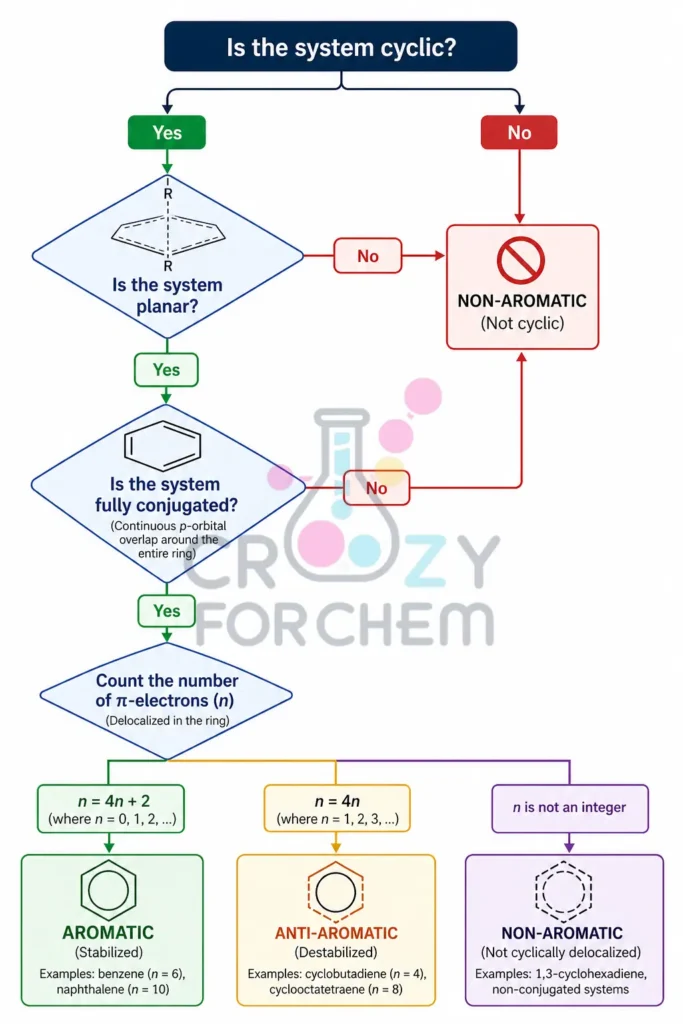
If cyclic + planar + conjugated but 4n electrons → Anti-aromatic
If any criterion fails → Non-aromatic
Table of Contents
What is Aromaticity in Organic Chemistry?
Beyond the Fragrance
Historically, the term “aromatic” originated from the pleasant “aroma” of certain natural substances like cinnamon bark, wintergreen leaves, and vanilla beans.
However, in modern chemistry, the adjective describes a specific type of thermodynamic and chemical stability found in certain cyclic molecules.
Aromatic compounds (also known as arenes) are defined by their unique electronic structures, where a uniform distribution of electrons around a ring makes them far less reactive than their aliphatic counterparts.
The Stability Bonus
The most striking feature of aromaticity is the “resonance energy” or stabilisation bonus. This extra stability is the energy difference between the aromatic compound and its hypothetical, localised non-aromatic counterpart.
For example, benzene is an extraordinary 36 kcal/mol more stable than would be predicted for a hypothetical, localised 1,3,5-cyclohexatriene.
This aromatic stability means that these compounds prefer substitution reactions over addition reactions, as substitution allows the molecule to maintain its stable, delocalised electron cloud.
While adding hydrogen to cyclohexene releases 28.6 kcal/mol, adding hydrogen to benzene (which contains three formal double bonds) releases only 49.8 kcal/mol instead of the expected 85.8 kcal/mol.
This 36 kcal/mol “missing” energy represents the resonance energy provided by aromaticity.
The 4 Essential Criteria for Aromaticity
Identifying aromatic compounds requires a systematic check of four rigid structural and electronic rules. It is an “all or nothing” situation; if any single condition is violated, the molecule cannot be aromatic.
1. Cyclic Structure
The molecule must possess a closed loop or ring of atoms. Linear systems, even if they have alternating double bonds like (Z)-1,3,5-hexatriene, can never be aromatic because they lack the continuous cyclic path for electrons.
2. Planar Geometry
The ring must be flat (planar) to allow for the parallel alignment, usually requiring atoms to be sp² hybridised.
This alignment is vital because it enables the effective “sideways” overlap required for electron delocalisation above and below the plane of the ring.
If a ring is too large or bulky, it may twist into a non-planar shape to relieve strain, losing its aromatic character.
3. Full Conjugation
Every atom in the ring must have an available p-orbital.
This means there can be no sp³ hybridised atoms in the cyclic path, as a saturated carbon with four sigma bonds lacks the unhybridised p-orbital needed to participate in the “pi-cloud”.
Conjugation must be continuous all the way around the loop.
4. Hückel’s Rule (4n+2)
The final hurdle is that the molecule must have a specific number of π electrons, exactly 4n+2.
Proposed by Erich Hückel in 1931, this rule ensures that all bonding molecular orbitals are completely filled with paired electrons, creating a “closed shell” of stability similar to the noble gases.
Hückel’s Rule extends beyond small rings. Annulenes, monocyclic conjugated hydrocarbons, follow the same principle at scale. [18]Annulene, with 18 π electrons (n=4), is a well-documented aromatic compound confirmed by NMR ring current data, proving the rule holds for large rings too.
Decoding Hückel’s Rule: What does (4n+2) actually mean?
The Magic Series
To apply Aromaticity and Hückel’s Rule correctly, the pi electron count of the conjugated system must be determined accurately; each double bond contributes 2 π electrons, and lone pairs in p-orbitals also count.
If that total matches a number in the sequence 2, 6, 10, 14, 18, 22…, then the molecule has the capacity for aromaticity. These are often called “Hückel numbers”.
The ‘n’ Misconception
A common student mistake is trying to find “n” within the physical structure of the molecule, such as counting the number of rings.
In reality, n is just a whole number integer (0, 1, 2, 3…) used in the algebraic formula to generate the series.
For n=0, 4(0)+2 = 2 π electrons.
For n=1, 4(1)+2 = 6 π electrons.
For n=2, 4(2)+2 = 10 π electrons.
Aromatic vs Anti-aromatic vs Non-aromatic: The Decision Tree
Using a systematic approach is the best method for identifying aromatic compounds and distinguishing them from their unstable or non-aromatic cousins.
Classification
Structural Requirements
π Electron Count
Stability Profile
Aromatic
Cyclic, Planar, Fully Conjugated
4n+2
Exceptionally Stable
Anti-aromatic
Cyclic, Planar, Fully Conjugated
4n
Unusually Unstable
Non-aromatic
Fails Cyclic, Planar, or Conjugated criteria
Any
Normal Aliphatic Stability
Aromatic Compounds
These meet all four criteria. Benzene aromaticity is the classic benchmark with 6 π electrons (n=1), it satisfies all four criteria and is 36 kcal/mol more stable than a hypothetical non-aromatic equivalent.
Other examples include naphthalene (10) and anthracene (14).. They are lower in energy than their open-chain polyene counterparts.
Anti-aromatic Compounds
Molecules that are cyclic, planar, and fully conjugated but possess 4n π electrons (4, 8, 12…) are classified as anti-aromatic.
These are highly reactive and unstable because delocalisation in these systems actually increases electronic energy. Cyclobutadiene (4π) is the quintessential example.
Non-aromatic Compounds
If a molecule fails even one of the structural prerequisites (cyclic, planar, conjugated), it is simply non-aromatic. Their stability is roughly equal to an open-chain polyene with the same number of carbons.
For instance, cyclooctatetraene looks anti-aromatic on paper (8π), but it adopts a non-planar tub shape to avoid the instability of anti-aromaticity, making it non-aromatic instead.
A systematic approach to classifying cyclic aromatic compounds.
Tricky Cases: Ions and Heterocycles
Aromatic Ions
Hückel’s Rule applies equally to charged species.
Cyclopentadienyl anion: Non-aromatic cyclopentadiene becomes aromatic upon losing a proton because the resulting lone pair resides in a p-orbital, creating a 6π system (n=1). This explains why cyclopentadiene is unusually acidic (pKa ≈ 15-16).
Tropylium cation: The cycloheptatrienyl cation is aromatic with 6π electrons and an empty p-orbital at the positive charge, explaining why cycloheptatrienyl bromide is an ionic, water-soluble salt.
Heterocyclic Aromatics
Heterocyclic aromatics contain atoms other than carbon, such as nitrogen, oxygen, or sulphur, within the ring.
The “Lone Pair” Rule
A major point of confusion in Aromaticity and Hückel’s Rule is when to count lone pairs as π electrons.
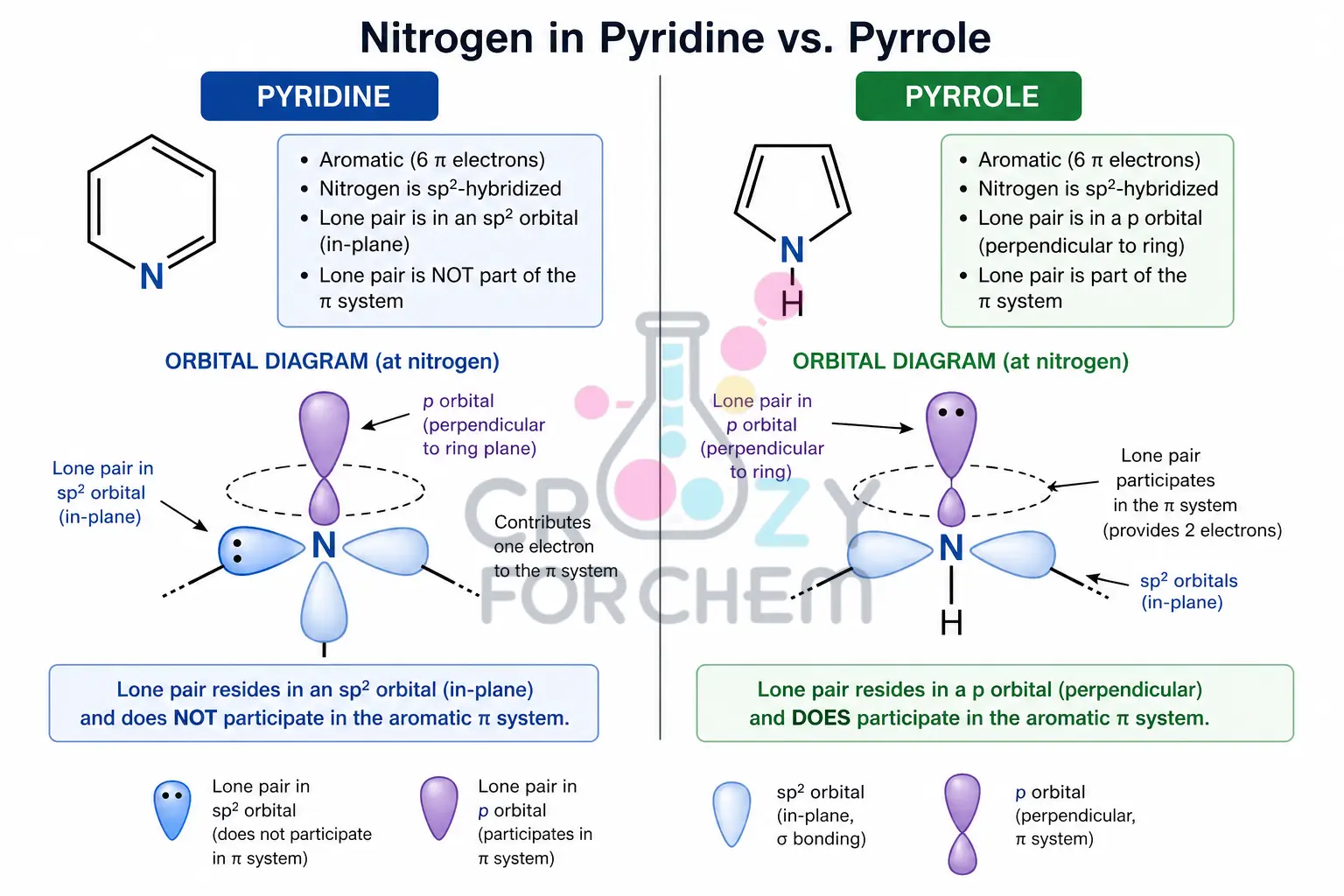
Ignore them if the atom is already participating in a double bond within the ring, as in Pyridine. In these cases, the lone pair sits in an sp² orbital perpendicular to the pi-system.
Count them if the lone pair is required to complete the conjugated system and can sit in a p-orbital, as in Pyrrole or Furan.
The comparison between pyrrole and pyridine is the most commonly tested case in exams: pyridine’s nitrogen lone pair is in an sp² orbital (not counted), while pyrrole’s lone pair is in a p-orbital (counted), giving both molecules exactly 6 π electrons despite different nitrogen behaviour.
Educator’s Tip: “Remember, each atom can contribute a maximum of one p-orbital and two electrons to the aromatic system. Even if oxygen has two lone pairs (as in furan), only one can align with the ring’s pi-cloud; the other is ignored!”.
Understanding the lone pair rule in Pyridine and Pyrrole.
Advanced Tools for Identification
The Frost Circle Method
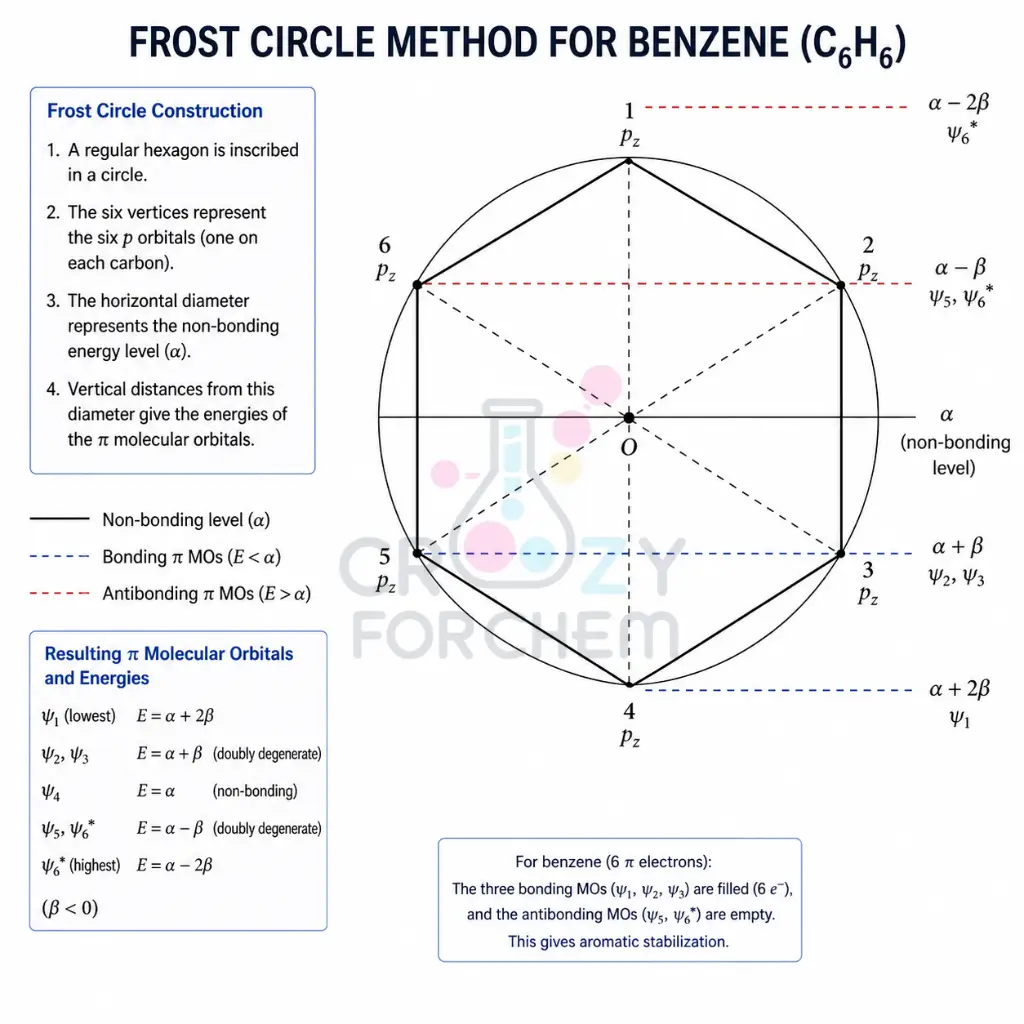
The Frost circle method is a geometric mnemonic used to visualise molecular orbital energy levels.
Draw a circle and inscribe the ring’s polygon inside it with a point pointing down.
Each vertex touching the circle represents an orbital energy level.
Fill these levels with available π electrons according to Hund’s rule. If all bonding orbitals are filled (below the horizontal diameter) and no electrons are in non-bonding or anti-bonding levels, the molecule satisfies Hückel’s Rule.
NMR Evidence
Ring current NMR is the physical proof of aromaticity. In a magnetic field, the delocalised π electrons circulate and generate an induced field that deshields aromatic protons, pushing their chemical shifts to 7.0–8.0 ppm.
This ring current NMR effect is absent in non-aromatic systems, making it a definitive diagnostic tool. In a magnetic field, delocalised electrons circulate, creating an induced field that “deshields” aromatic protons.
This shifts their signals to high chemical shifts, typically between 7.0 and 8.0 ppm. Non-aromatic alkenes usually appear much lower, around 4.5–5.0 ppm.
Visualising orbital energy levels using the Frost Circle method.
Conclusion: Why Classification Matters in Synthesis
Mastering Aromaticity and Hückel’s Rule is far more than an academic exercise.
It allows chemists to understand the fundamental stability of DNA bases (adenine, guanine, cytosine, and thymine are all aromatic), design new synthetic drugs, and predict the outcome of Organic Reaction Mechanisms.
By using the 4 criteria checklist and applying the 4n+2 rule examples correctly, you gain the expertise needed to navigate the vast landscape of organic synthesis with precision and confidence.
As an educator, I tell my students that once you recognise the “magic” in these stable rings, you stop memorising reactions and start seeing the underlying logic of chemical architecture.
Frequently Asked Questions
Q1: What are the four criteria for aromaticity?
To be classified as aromatic, a compound must strictly satisfy four conditions: Cyclic: It must have a closed ring of atoms. Planar: The ring must be flat to allow p-orbital overlap. Fully Conjugated: Every atom in the ring must possess an unhybridised p-orbital. Hückel’s Rule: The ring must contain exactly 4n+2 π electrons (where n = 0, 1, 2…).
Q2: What is the difference between anti-aromatic and non-aromatic compounds?
Anti-aromatic compounds satisfy the first three criteria (cyclic, planar, conjugated) but possess 4n π electrons, making them exceptionally unstable. Non-aromatic compounds are those that fail any of the first three structural criteria (e.g., they are non-planar or have an sp³ atom in the ring), resulting in stability similar to regular open-chain alkenes.
Q3: How do you count lone pairs in Hückel’s Rule?
In heterocyclic aromatics, a lone pair is only counted as part of the π electron cloud if it is contained within a p-orbital that is parallel to the other p-orbitals in the ring. For example, in Pyrrole, the nitrogen lone pair is counted (6π), but in Pyridine, the nitrogen is already double-bonded, so its lone pair is ignored (6π).
Q4: Does ‘n’ in Hückel’s Rule (4n+2) represent the number of rings?
No, the variable ‘n‘ is simply an algebraic integer (0, 1, 2, 3…) used to calculate the stable series of electrons (2, 6, 10, 14, etc.). It does not correspond to the physical number of rings or carbon atoms in the molecule.
Q5: What is the Frost circle method used for?
The Frost circle is a geometric mnemonic used to determine the relative energy levels of molecular orbitals in conjugated cyclic systems. It helps chemists visualise whether a molecule has a “closed shell” of bonding electrons, confirming its aromatic stability according to Hückel’s Rule.
Is benzene aromatic or anti-aromatic?
Benzene is aromatic. It has 6 π electrons (4n+2, where n=1), is cyclic, planar, and fully conjugated, satisfying all four criteria for aromaticity.
What is the difference between aromatic and non-aromatic compounds?
Aromatic compounds meet all 4 criteria, including 4n+2 π electrons and gain exceptional stability. Non-aromatic compounds fail at least one structural criterion (cyclic, planar, or conjugated) and have normal alkene-like stability.
Looking for career guidance in Chemistry or any other field? Our experienced career counsellor is here to help you sort out your dilemma and decide on a career path.