In the pharmaceutical and manufacturing industries of 2026, the role of a quality control chemist stands as the final “guardian of safety”.
While researchers focus on innovation, the role of a quality control chemist is to ensure that every vaccine, tablet, or chemical batch meets stringent global standards before reaching the consumer.
This role is fundamental to safeguarding public health and maintaining the integrity of the organisation.
At a Glance: 2026 Career Snapshot
- Core Purpose: Ensuring product safety, efficacy, and quality standards through rigorous testing.
- Recession-Proof Sector: Essential demand in pharmaceuticals, healthcare, and FMCG.
- 2026 Salary Range: INR 4 – 7 LPA (India entry-level) / $74,702 (global average).
- Education: Typically requires a bachelor’s degree in chemistry or a related science.
| Region | Entry-Level Salary (Per Annum) | Mid-Level / Senior (Per Annum) |
| India | ₹400,000 – ₹750,000 | ₹12,00,000 – ₹18,00,000 |
| Global (USA/UK) | $74,000 – $82,000 | $110,000 – $145,000 |
Table of Contents
The Gatekeepers of Integrity: What is Quality Control?
Quality Control is the process of evaluating the developed product itself to detect errors. It is a reactive function that focuses on finding defects in the final output.
The role of a Quality Control Chemist involves the analytical testing of raw materials, in-process samples, and finished products to ensure they meet stringent safety and regulatory standards (like USP or IP). As the ‘final guardian’ in manufacturing, a QC chemist uses instrumentation like HPLC and GC to detect defects before products reach the consumer.
QC vs. QA (Quality Assurance)
It is vital to understand the hierarchy: QC is a function of QA. While Quality Assurance (QA) is the broader, proactive process of designing systems to prevent quality problems, Quality Control (QC) is the specific testing arm that detects them. In short, QA focuses on the process, while QC focuses on the product.
Key Responsibilities and the Role of a Quality Control Chemist in 2026
A typical day for a QC Chemist is varied and challenging, involving a mix of hands-on laboratory testing and meticulous documentation.
- Raw Material and In-Process Testing: Chemists collect and perform chemical analyses on raw materials and intermediate products to ensure consistency during the manufacturing process.
- Finished Product Verification: Final goods are subjected to extensive chemical analysis against global Pharmacopoeia (IP/BP/USP) standards to verify they meet all safety specifications.
- Method Transfer & Stability Testing: QC labs receive validated methods from R&D and monitor how products behave over time under various environmental conditions, such as high humidity or heat.
Technical Mastery: Tools and Instrumentation in 2026
Modern laboratories are highly sophisticated, and the role of a quality control chemist now requires expertise in both analytical hardware, like HPLC, and digital data management systems. Without this technical mastery, the core objective of the role, maintaining batch-to-batch consistency, cannot be achieved.
Advanced Analytical Hardware
In 2026, high-level proficiency in HPLC (High-Performance Liquid Chromatography) and gas chromatography (GC) remains the gold standard. Additionally, chemists use dissolution testing, Malvern particle size analysis, and Karl Fischer (KF) titration.
Data Integrity (ALCOA+)
Digital data integrity is now a mandatory skill. Professionals must follow the ALCOA+ principles (Attributable, Legible, Contemporaneous, Original, and Accurate). Mastery of software like Empower 3, Chromeleon, and LIMS (Laboratory Information Management Systems) is essential for “right-first-time” documentation.
Managing Deviations (OOS & OOT)
When a test result falls outside of established limits, the QC chemist participates in an Out of Specification (OOS) or Out of Trend (OOT) investigation to identify the root cause of the deviation.
Pro-Tip: Navigating the OOS (Out of Specification) Workflow
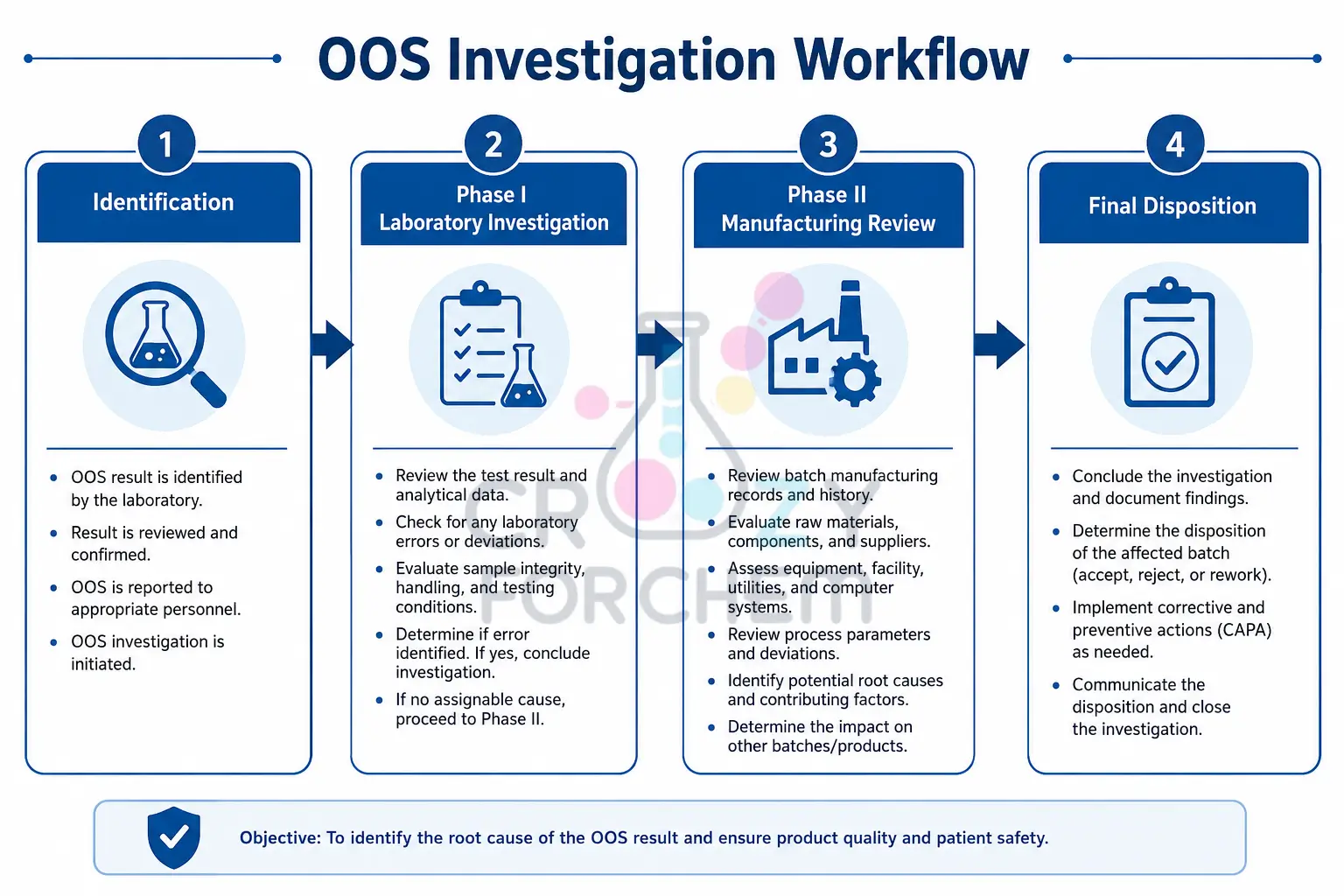
When a batch fails to meet established limits, the QC chemist’s technical expertise is truly tested. The investigation typically follows a structured three-phase approach:
- Phase I: Laboratory Investigation – Assessing potential ‘lab errors’ such as analyst miscalculation, incorrect dilution, or instrument malfunction.
- Phase II: Full-Scale Investigation – If no lab error is found, the focus shifts to the manufacturing process to identify the root cause (e.g., raw material variance or equipment failure).
- Phase III: Retesting & Disposition – Conducting rigorous resampling under strict protocols to decide whether the batch must be rejected or can be salvaged.
The OOS Investigation Process:
- Identify: Recognise a result outside the pharmacopoeial limits.
- Phase I (Lab Investigation): Check for analyst errors, calculation mistakes, or instrument drift.
- Phase II (Manufacturing Review): Investigate the production process if no lab error is found.
- Conclusion: Determine if the batch is to be rejected or if a re-test is scientifically justified.
Essential Skills for an Analytical QC Chemist
To excel in a modern laboratory, a chemist must move beyond basic theory and master practical analytical applications.
- Method Validation: Understanding how to verify that an analytical procedure is suitable for its intended use, focusing on accuracy, precision, and specificity.
- Instrument Calibration: Ensuring that equipment like pH meters and HPLC systems provide reliable data through regular, documented verification.
- Analytical Troubleshooting: The ability to identify and resolve ‘system suitability’ failures or baseline drifts during an analysis.
Compliance Framework: The Legal Backbone of QC
The QC laboratory operates under strict regulatory frameworks to ensure consumer protection.
- Adherence to cGMP and GLP: All activities must strictly comply with current Good Manufacturing Practices (cGMP) and Good Laboratory Practices (GLP).
- Audits and Documentation: Chemists maintain meticulous, audit-ready records of all tests and calibrations to prepare for inspections by regulatory bodies such as the FDA or the MHRA.
The ‘Audit-Ready’ Checklist: Essential Documentation
In a regulatory environment, the motto is: “If it isn’t documented, it didn’t happen.” To ensure the laboratory is always prepared for an inspection (FDA, MHRA, or WHO), a QC Chemist must maintain the following records with 100% accuracy:
Document Type What it Covers Key Compliance Factor Analytical Worksheets Raw data, weights, and calculations for every test. Precision & Legibility Instrument Logbooks Usage history, cleaning records, and daily checks. Contemporaneous Entry Calibration Records Periodic verification of HPLC, balances, and pH meters. Traceability SOP Training Records Proof that the analyst is qualified to perform the test. Training Compliance
Education, Skills, and Career Progression
Education Pathways
Approximately 81% of QC roles require a bachelor’s degree in chemistry or pharmaceutical science. About 16% of professionals hold a master’s degree, which is often beneficial for advancing into supervisory roles.
Professional Ethics
Scientific Integrity: The Core of Quality Control
Beyond technical skills, a QC chemist must possess unwavering ethical standards. In the face of production deadlines, the pressure to “pass” a batch can be high, but scientific honesty is non-negotiable.
“In Quality Control, your signature is your bond. If you did not see the peak, it did not happen. If you did not weigh the sample correctly, the result does not exist. Integrity is the foundation upon which patient safety is built.”
This commitment to data integrity ensures that the laboratory’s output remains beyond reproach during stringent regulatory audits.
A critical soft skill for a QC chemist is the ability to “stand your ground”. You must have a strong sense of ethics to act correctly when a product batch fails to meet specifications, even under production pressure.
Career Ladders
The career path typically starts as a QC Analyst, progressing to senior analyst or quality manager or transitioning into related fields like quality assurance (QA) or regulatory affairs (RA).
Key Soft Skills for QC Professionals
- Attention to Detail: In QC, a single decimal point error can lead to a batch failure. Meticulousness in weighing and pipetting is vital.
- Critical Thinking: When a result is ‘Out of Trend’, a chemist must logically evaluate the environment, the instrument, and the sample to find the cause.
Expert Insight: In 2026, the transition from manual documentation to LIMS (Laboratory Information Management Systems) is the biggest shift. A candidate who knows how to navigate digital compliance is 2x more likely to get hired.
Conclusion: Why the role of a Quality Control Chemist is a Strategic Career Choice
Quality control remains a recession-proof career because the global need for safe medicines is constant. By serving as the final barrier between a product and the public, the role of a quality control chemist is indispensable for ensuring scientific advancement and consumer protection.
Frequently Asked Questions
-
What is the main difference between QC and QA in the pharmaceutical industry?
Ans: The primary difference lies in their focus: quality control (QC) is a reactive process that involves testing the final product to detect defects. In contrast, Quality Assurance (QA) is a proactive, process-oriented function that designs systems (like SOPs and audits) to prevent those defects from occurring in the first place.
-
What is the average salary of a QC chemist in 2026?
Ans: In 2026, an entry-level QC chemist’s salary in India typically ranges from INR 4 to 7.5 LPA. In global markets like the UK or USA, the average national salary for a Quality Control professional is approximately $74,700 – $82,000, depending on expertise in advanced instrumentation like HPLC and GC.
-
Which analytical instruments are essential for a QC Chemist to master?
Ans: To be competitive in 2026, a QC Chemist must have high-level proficiency in High-Performance Liquid Chromatography (HPLC) and Gas Chromatography (GC). Additionally, knowledge of UV-Vis Spectroscopy, Karl Fischer (KF) Titrators, and Dissolution apparatus is mandatory for routine pharmaceutical testing.
-
Can I get a Quality Control (QC) job with only a B.Sc. in Chemistry?
Ans: Yes. Over 80% of entry-level QC Chemist positions require only a Bachelor’s degree (B.Sc. Chemistry or B.Pharma). It is considered one of the most stable and accessible entry points for chemistry graduates, with many professionals later pursuing an M.Sc. or certifications to move into Quality Assurance or Regulatory Affairs.
-
What are OOS and OOT in a Quality Control laboratory?
Ans: OOS (Out of Specification) refers to a test result that falls outside the legally established limits set by pharmacopoeias (USP/BP). OOT (Out of Trend) refers to a result that is within limits but shows an unusual pattern compared to previous batches. Both require a formal investigation to ensure data integrity and product safety.
Top Interview Questions for a Quality Control Chemist
- How do you handle an OOS result? (Focus on following SOPs and not discarding data).
- Explain the principle of HPLC in simple terms.
- What is the difference between calibration and validation?
- What are the ALCOA+ principles in data integrity?