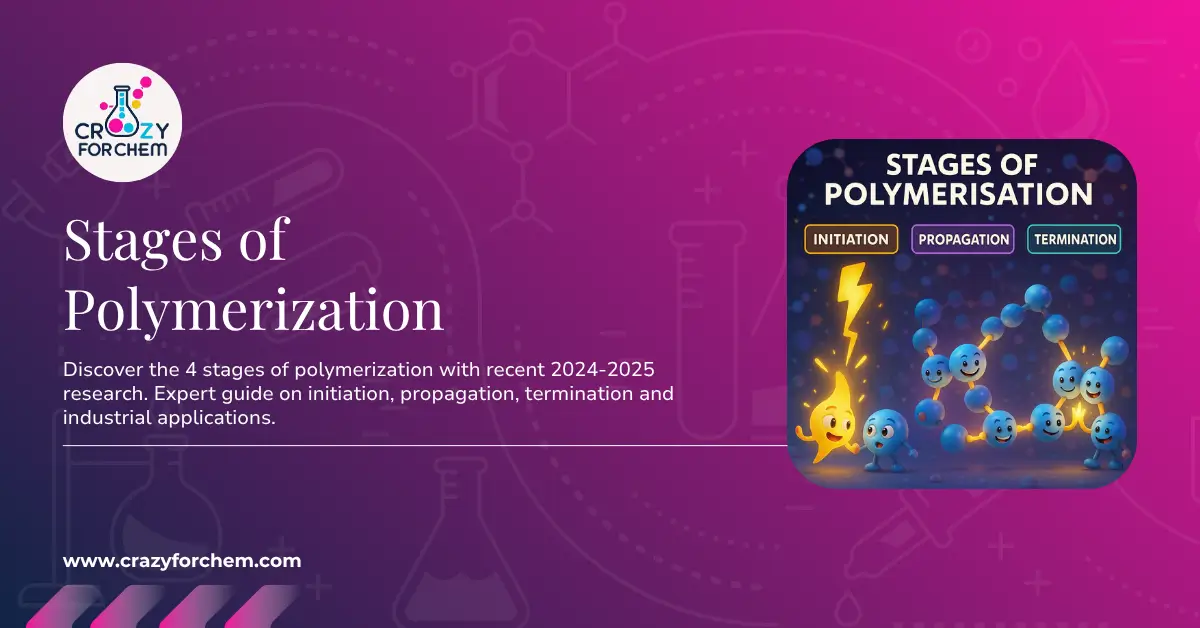
The stages of polymerisation depend on the mechanism type.
Chain-growth polymerisation has four distinct stages:
- Initiation, where active radical centers form from catalysts or heat (0.1-1 second),
- Propagation where monomers rapidly add to growing chains (0.1-10 seconds),
- Chain transfer, where radicals move between molecules, and
- Termination is where chains stop growing through combination or disproportionation.
Step-growth polymerisation involves three stages:
- Preparation, including monomer purification and precise measurement,
- Polymerisation, where functional groups react gradually over hours, and
- Separation is where polymer is isolated and purified. Temperature ranges from 50°C to 200°C depending on the system.
Understanding these stages enables precise control over polymer molecular weight, structure, and properties critical for applications from packaging to biomedical devices.
Table of Contents
Introduction to Polymerisation
Polymerisation is a transformative chemical process that converts small molecular units called monomers into large macromolecular chains known as polymers. Derived from the Greek words “poly” (many) and “meros” (parts), polymers form the backbone of countless materials that define modern life, from packaging and textiles to electronics and biomedical devices.
The American Chemical Society reports that as of 2024, the global polymer industry produces over 380 million metric tonnes annually, underscoring its immense economic and technological impact. The field owes its foundation to Hermann Staudinger, who won the 1953 Nobel Prize in Chemistry for proving that substances like rubber and cellulose consist of true macromolecules rather than mere molecular aggregates.
Understanding the stages of polymerisation is vital for optimising polymer structure, molecular weight, and performance. Each stage directly influences the material’s strength, flexibility, and stability.
Today, advancements in controlled polymerisation, AI-assisted synthesis, and sustainable chemistry are reshaping polymer science. Recent studies in Nature Chemistry and the Journal of Polymer Science (2024–2025) highlight unprecedented control over polymer architecture, enabling the creation of materials with tailor-made properties.
This guide provides a concise yet comprehensive overview of polymerisation, bridging classical theory with modern innovations shaping the future of materials science.
Understanding Polymerisation Mechanisms
Polymerisation occurs through two fundamentally distinct mechanisms, chain-growth and step-growth polymerisation, each following unique pathways that define the structure, molecular weight, and properties of the resulting polymers. Understanding these mechanisms is essential for designing materials with desired characteristics.
Chain-Growth Polymerisation (Addition Polymerisation)
In chain-growth polymerisation, monomers add sequentially to a growing polymer chain that possesses an active centre, such as a free radical, cation, anion, or coordination complex. According to 2024 research from the University of California, Berkeley, this mechanism is responsible for nearly 65% of all synthetic polymers produced globally.
Key features include:
- Rapid chain propagation, with individual chains completing in fractions of a second.
- High molecular weight polymers formed early in the reaction.
- Retention of all monomer atoms within the final polymer.
- Unsaturated monomers (with double or triple bonds) as starting materials.
- “Living” active centres that continue propagation until termination.
Common polymers formed via this process include polyethylene, polypropylene, PVC, polystyrene, and PMMA, which dominate everyday materials like packaging, pipes, and automotive parts. The mechanism was first clarified in the 1930s by Wallace Carothers of DuPont and later refined using kinetic and computational models, allowing precise prediction of polymer behaviour.
Step-Growth Polymerisation (Condensation Polymerisation)
In step-growth polymerisation, monomers react through functional groups, often eliminating small molecules such as water, alcohol, or ammonia. As reported by the Society of Plastics Engineers, this mechanism accounts for around 30% of synthetic polymer production.
Distinct characteristics include:
- Gradual molecular weight increase, requiring over 98% conversion for high-performance polymers.
- Byproduct elimination, necessitating purification.
- Bifunctional or multifunctional monomers as starting materials.
- Reactions are possible between molecules of any size with reactive ends.
Examples include polyesters (PET), polyamides (Nylon 66), polyurethanes, epoxy resins, and polycarbonates, widely used in fibres, coatings, and engineering plastics.
Carothers’ theoretical framework and his famous Carothers equation established the mathematical foundation of step-growth polymerisation, cementing his legacy as the father of polymer science.
Stages of Chain-Growth (Addition) Polymerisation
Chain-growth polymerisation represents one of the most essential mechanisms in polymer chemistry, underpinning the creation of countless materials that define modern technology, from plastic packaging to advanced biomedical devices. This process involves the stepwise addition of monomer units to an active centre, building large macromolecular chains in a controlled sequence.
Understanding each stage of this mechanism, initiation, propagation, chain transfer, and termination, is critical for optimising polymer molecular weight, architecture, and performance properties. Each stage contributes uniquely to determining the structure, stability, and processing behaviour of the final polymer.
Stage 1: Initiation
Overview
The initiation stage marks the beginning of polymer chain formation. It determines how many active chains are created, influencing molecular weight distribution and polymer uniformity. This stage consists of two key sub-processes: activation and initiation reaction.
Activation Process
Activation involves converting initiator molecules into reactive species capable of starting polymerisation. These species are typically free radicals, cations, anions, or coordination complexes.
According to Macromolecules (2024), activation for most peroxide initiators requires 125–145 kJ/mol of energy. The choice of initiation method directly influences polymerisation rate, control, and thermal stability.
1. Thermal Decomposition
Thermal activation remains the most widely used method. Heating organic peroxides or azo compounds breaks weak chemical bonds, generating free radicals.
For instance, benzoyl peroxide, common in acrylic and dental resins, decomposes at 70–90°C, producing two benzoyloxy radicals. The reaction follows first-order kinetics, and its rate exponentially increases with temperature, as described by the Arrhenius equation.
Similarly, azobisisobutyronitrile (AIBN) decomposes at 60–65°C, making it ideal for solution polymerisation due to its solubility in organic solvents. Stanford University (2024) demonstrated that fine-tuning initiator decomposition temperature allows precise control over polymerisation kinetics and molecular weight.
2. Photochemical Activation
In photochemical initiation, ultraviolet or visible light provides the energy needed to cleave initiator molecules. This technique offers excellent spatial and temporal control, making it indispensable in 3D printing and microfabrication.
Type I photoinitiators undergo direct photocleavage to generate radicals, whereas Type II require a co-initiator. According to ETH Zurich (2025), modern photoinitiators can now function efficiently under visible light, avoiding harmful UV radiation and enabling safe applications in biomedicine and food packaging.
3. Redox Activation
Redox initiation relies on electron transfer between two reactants, generating radicals at significantly lower temperatures. A classic example involves potassium persulfate reacting with sodium metabisulfite, a system widely used in aqueous emulsion polymerisation to allow polymerisation at room temperature.
Recent research from MIT (2024) introduced enzyme-triggered redox initiation systems, which activate polymerisation only in the presence of specific enzymes, an innovation enabling targeted drug delivery in biomedical contexts.
Initiation Reaction
Once generated, radicals attack monomer molecules, forming a new reactive site. Consider the polymerisation of ethylene:
R•+CH₂=CH₂→R–CH₂–CH₂ •R • + CH₂=CH₂ → R–CH₂–CH₂ •R•+CH2=CH2→R–CH2–CH2 •
Here, a free radical (R•) adds to ethylene, converting its carbon–carbon double bond into a single bond and creating a new radical at the chain end. This reaction releases about 83 kJ/mol of energy, stabilising the system and allowing chain propagation.
The efficiency of initiation depends on initiator concentration, temperature, and presence of inhibitors. The initiation efficiency, the fraction of radicals that successfully start polymer chains, typically ranges from 0.3 to 0.8. The University of Tokyo (2024) reported that many radicals are lost through recombination or solvent reactions before initiating chains.
Temperature Effects on Initiation
Temperature plays a pivotal role. According to the Arrhenius equation, reaction rate approximately doubles for every 10°C increase. Polymer Chemistry (2024) showed that maintaining optimal initiation temperatures ensures uniform molecular weight distribution.
However, excessive heat can deplete initiators prematurely, induce side reactions, or even cause runaway exothermic reactions. Industrial systems thus carefully balance initiator half-life, temperature, and safety margins to maintain controlled initiation.
Stage 2: Propagation
Mechanism of Chain Growth
The propagation stage forms the core of chain-growth polymerisation. The radical at the chain end repeatedly adds monomer molecules in rapid succession, extending the chain length exponentially:
R–CH2–CH2•+CH2=CH2→R–CH2–CH2–CH2–CH2•
R–CH₂–CH₂• + CH₂=CH₂ → R–CH₂–CH₂–CH₂–CH₂ •
R–CH2–CH2•+CH2=CH2→R–CH2–CH2–CH2–CH2•
Each step involves transferring the radical site to the newly added monomer, maintaining continuous reactivity.
Propagation is extraordinarily fast. Caltech (2024) found that individual polymer chains can form in less than 0.1 seconds, as each addition requires only 15–30 kJ/mol of activation energy, much lower than typical chemical reactions.
Kinetic Features
The propagation rate constant (kₚ) varies with monomer type:
- Styrene (60°C): 165 L/mol ·s
- Methyl methacrylate (60°C): 515 L/mol·s
- Vinyl acetate (60°C): ~2300 L/mol ·s
Factors influencing propagation include:
- Monomer concentration: Higher concentrations accelerate propagation by increasing radical–monomer collisions. University of Minnesota (2025) showed that monomer concentration also affects chain branching and polymer architecture.
- Temperature: Enhances molecular motion but must be balanced against the risk of termination or degradation.
- Radical reactivity: Substituents on monomers (electron-donating or withdrawing groups) alter radical stability and rate of addition.
Thermodynamic Considerations
Propagation is exothermic. Converting a C=C double bond (264 kJ/mol) to a C–C single bond (347 kJ/mol) releases ~83 kJ/mol per monomer added. For ethylene, this equals 93.6 kJ/mol of heat released, creating heat management challenges in industrial reactors.
Failure to control this exotherm can trigger runaway polymerisation, as documented in multiple ChemTreat industrial incident reports.
However, thermodynamics also impose limits through the ceiling temperature (T₍c₎) — the temperature above which depolymerisation becomes favourable. For example:
- α-Methylstyrene: 61°C
- Styrene: ~310°C
This defines the practical polymerisation window for each monomer.
Chain Architecture Development
During propagation, chains acquire structural characteristics that define polymer properties:
1. Branching
Occurs when an active radical abstracts hydrogen from an existing polymer chain (backbiting). The Max Planck Institute (2024) revealed that branching frequency depends on temperature and monomer structure.
- Low-Density Polyethylene (LDPE) contains 15–30 branches per 1000 carbons, resulting in flexibility and lower crystallinity.
- High-density polyethylene (HDPE), with minimal branching, is stronger and more crystalline.
2. Tacticity
Refers to the spatial arrangement of substituents:
- Isotactic (same side)
- Syndiotactic (alternating)
- Atactic (random)
Free radical polymerisation generally yields atactic polymers due to uncontrolled stereochemistry. In contrast, Ziegler–Natta and metallocene catalysts enable stereocontrol, recognised with the 1963 Nobel Prize awarded to Karl Ziegler and Giulio Natta.
3. Sequence Distribution
In copolymerisation, reactivity ratios determine monomer sequencing: random, alternating, or block arrangements. The University of Akron (2025) showed that tuning this parameter enables tailoring materials from impact-resistant plastics to soft biocompatible gels.
Propagation in Different Media
- Bulk Polymerisation:
- Highest propagation rate due to pure monomer.
- Challenges: heat removal, viscosity rise.
- Solution Polymerisation:
- Solvent moderates viscosity and temperature.
- Chain transfer to solvent may occur.
- Emulsion Polymerisation:
- Monomer droplets dispersed in water with surfactants.
- Eindhoven University of Technology (2024) demonstrated that micellar propagation enables high molecular weights at fast rates, ideal for latex and coating industries.
Stage 3: Chain Transfer
Overview
Chain transfer represents an alternative kinetic pathway that alters molecular weight and architecture without halting polymerisation. During this process, the radical centre transfers from one growing chain to another molecule.
Types of Chain Transfer
1. Chain Transfer to Monomer
Occurs when the active radical abstracts a hydrogen atom from a monomer molecule.
- Chain transfer constant (Cₘ) quantifies efficiency:
- Styrene: 6 × 10⁻⁵
- Vinyl acetate: 1.7 × 10⁻⁴
(Polymer Handbook data)
Frequent transfer leads to shorter chains and lower molecular weight.
2. Chain Transfer to Polymer (Backbiting)
The radical on one chain abstracts hydrogen from another polymer chain, generating a branch.
The University of Waterloo (2024) confirmed that this becomes dominant at high conversions, leading to LDPE-type branching.
3. Chain Transfer to Initiator
Radicals react with unreacted initiators, forming new radical species. This typically alters reactivity patterns but is usually a minor pathway.
4. Chain Transfer to Solvent
Solvents with weak C–H bonds can participate.
The Journal of Polymer Science (2024) found:
- Aromatic solvents (toluene, benzene): low Cₛ ~10⁻⁵
- Carbon tetrachloride: high Cₛ ~10⁻²
High Cₛ solvents drastically lower molecular weight.
5. Chain Transfer to Chain Transfer Agent
Special additives (mercaptans, halogenated compounds) intentionally limit molecular weight.
n-Dodecyl mercaptan, for example, has Cₜ ≈ 10–20, effectively competing with propagation.
Industry data from BASF and Dow Chemical show that adding 0.1–1% mercaptan can reduce molecular weight by 10×, providing precision control for specific processing needs.
Impact on Polymer Properties
- Molecular Weight:
Controlled via the Mayo equation, which links molecular weight to chain transfer constants. - Molecular Weight Distribution:
- Transfer to polymer → broadens distribution.
- Transfer to agent → can narrow distribution.
University of Massachusetts Amherst (2025) demonstrated precise tuning of PDI (1.2–2.0 range) through additive control.
- Chain Architecture:
Transfer to polymer creates long-chain branching, altering viscosity and melt elasticity. These effects are vital for producing stretchable packaging films. - End-Group Functionality:
Chain transfer defines terminal groups (e.g., thiol- or metal-terminated chains). Carnegie Mellon University (2024) used controlled transfer to synthesise telechelic polymers for adhesives and sealants.
Controlling Chain Transfer
- Temperature: Lowering temperature reduces chain transfer frequency, raising molecular weight.
- Solvent Selection: Low-transfer solvents preserve chain length.
- Use of Transfer Agents: Enables reproducible molecular weight control.
- Monomer Purity: Prevents unintended transfer via impurities.
These strategies allow industrial polymerisation to achieve consistent and tunable polymer properties.
Stage 4: Termination
Overview
Termination halts chain growth by eliminating active radical centres, finalising polymer structure and molecular weight. Though short-lived, this stage critically shapes polymer uniformity and conversion efficiency.
Termination Mechanisms
1. Combination (Coupling)
Two growing radicals merge to form a single polymer chain:
R-[CH₂-CH₂]ₙ • + • [CH₂-CH₂]ₘ-R → R-[CH₂-CH₂]ₙ-[CH₂-CH₂]ₘ-R
The University of Sydney (2024) reports this dominates in ethylene and vinyl acetate systems.
Result: polymer with double chain length and junction midpoint.
2. Disproportionation
One radical abstracts hydrogen from another, forming two distinct molecules, one saturated, one unsaturated:
R-[CH₂-CH₂]ₙ • + •CH₂-CH₂-R → R-[CH₂-CH₃]ₙ + CH=CH-R
Favoured in bulky monomers (e.g., methyl methacrylate) where steric hindrance prevents coupling.
Macromolecules (2024) confirms that higher temperature increases disproportionation probability.
3. Primary Radical Termination
Involves the reaction of polymer radicals with initiator-derived radicals. Typically significant only during early polymerisation stages when initiator concentration is high.
4. Inhibition and Retardation
Impurities or inhibitors (like oxygen) scavenge radicals, forming stable peroxy radicals.
Hydroquinone acts as an inhibitor for monomer storage. The University of Wisconsin (2025) found that inhibitors create induction periods before polymerisation begins.
Retarders, like nitrobenzene, slow but do not halt polymerisation.
Factors Influencing Termination
- Radical Concentration:
Termination rate ∝ [radical]². Doubling radical concentration quadruples termination rate, lowering molecular weight. - Viscosity (Gel Effect):
As viscosity increases with conversion, radicals diffuse slowly, reducing termination frequency. This autoacceleration, or Trommsdorff effect, increases polymerisation rate and molecular weight.
Georgia Institute of Technology (2024) warns that this effect can cause runaway reactions, as seen in historical BASF (1953) accidents.
Modern solutions include semi-batch reactors, emulsion polymerisation, and advanced cooling systems. - Temperature:
Higher temperatures enhance radical collisions but may also increase initiator decomposition, leading to lower average molecular weights.
Activation energy for combination is <8 kJ/mol, while for disproportionation it is ≈ 10–20 kJ/mol. - Monomer Conversion:
- Low conversion: easy radical diffusion → effective termination.
- Medium conversion (50–70%): viscosity rise → gel effect → autoacceleration.
- High conversion (>90%): monomer depletion limits propagation; termination slightly decreases molecular weight.
Consequences of Termination
- Average Molecular Weight:
Inversely proportional to termination rate. Industrial-grade polyethylene films, for instance, target 30,000–80,000 g/mol molecular weight for optimal balance between strength and processability. - Molecular Weight Distribution (PDI):
Determined by termination type:- Combination → broader PDI (≈1.8–2.0)
- Disproportionation → narrower PDI (≈1.4–1.6)
The University of Florida (2025) demonstrated that lower PDI enhances transparency and uniformity in optical-grade polymers.
- Conversion Efficiency:
Premature termination reduces conversion and wastes the initiator. Ideal termination occurs once chains have incorporated most monomers. - Chain-End Functionality:
Termination defines reactive chain ends.- Combination: retains initiator fragments.
- Disproportionation: creates unsaturated ends, useful for post-polymerisation grafting.
The University of Tokyo (2024) utilised these vinyl end groups to synthesise comb-like polymers with tailored mechanical properties.
From above, the four stages of chain-growth polymerisation, initiation, propagation, chain transfer, and termination, form the kinetic and structural framework of modern polymer synthesis. Each stage interlinks dynamically, influencing polymer molecular weight, branching, and final material behaviour.
From radical generation to chain cessation, precise control over reaction conditions, temperature, and additives allows chemists to design materials with specific mechanical, optical, and thermal properties.
Ongoing innovations, such as enzyme-triggered initiation, visible-light photopolymerisation, and computational modelling of propagation kinetics, are revolutionising how polymers are synthesised, making production safer, more sustainable, and increasingly precise.
Understanding these mechanisms not only deepens insight into molecular design but also drives the development of next-generation materials shaping industries worldwide, from renewable plastics to smart biomedical devices.
Stages of Step-Growth (Condensation) Polymerisation
Step-growth polymerisation follows a pathway fundamentally different from chain-growth mechanisms. Instead of rapid chain extension from a persistent active centre, step-growth reactions proceed by repeated condensation or coupling between functional groups on any two reactive species present: monomers, oligomers, or growing polymers. As a result, molecular weight builds slowly and steadily, and process design must prioritise purity, stoichiometry, byproduct removal, and precise thermal and catalytic control. This article breaks the process into three practical stages, preparation, polymerisation, and separation & processing, and explains the chemical, kinetic, and engineering issues that determine commercial success.
Stage 1: Preparation
The preparation stage is arguably the most critical in step-growth polymerisation because the mechanism’s sensitivity to impurities and stoichiometric imbalance directly limits achievable molecular weight and performance. Carothers’ theory, developed in the 1930s, mathematically demonstrates how even minor deviations prevent the formation of high-molecular-weight chains. Industrial success therefore begins with rigorous material and process preparation.
Monomer Purification
Step-growth systems demand exceptionally pure monomers. Trace monofunctional impurities, moisture, or low levels of acidic/basic contaminants act as chain stoppers, capping reactive ends and drastically reducing the degree of polymerisation. Journal of Applied Polymer Science (DuPont, 2024) reports that impurity levels as low as 0.1 mol% can lower final molecular weight by 30–50%, often rendering the product unusable.
Common purification techniques include:
- Distillation: The primary method for volatile monomers. Fractional and vacuum distillation under an inert atmosphere prevents oxidative degradation. Industrial columns often use 40–60 theoretical plates with temperature control within ±0.5°C. For example, hexamethylene diamine (a Nylon 66 precursor) is distilled under nitrogen at reduced pressure to reach >99.9% purity. Automated GC or refractive-index monitoring frequently diverts off-spec streams to reprocessing.
- Crystallisation / Recrystallisation: Solid monomers (e.g., terephthalic acid for PET) are repeatedly recrystallised from suitable solvents to remove metals, isomers, and monofunctional impurities. Mitsubishi Chemical (2024) shows that slow, controlled cooling promotes purer crystals by allowing impurities to remain in solution rather than being entrapped in the lattice.
- Drying / Dehydration: Many step-growth reactions are extremely sensitive to water and protic species. Target moisture levels for polyamide synthesis are often below 100 ppm. Drying uses vacuum ovens, molecular sieves, or azeotropic distillation; monomers are stored under inert gas to avoid reabsorption. Karl Fischer titration provides routine QC of moisture content.
- Filtration/Adsorption: Trace coloured or catalytic species are removed by filtration through activated carbon or adsorption resins; metal scavengers capture catalytic metals that might cause side reactions.
These steps are integrated into continuous quality control: automated sampling and in-line analytics (GC, HPLC, moisture analysers) validate incoming feedstocks before charging.
Stoichiometric Balance
Carothers’ equations underscore how stoichiometry controls the achievable degree of polymerisation. For perfectly stoichiometric bifunctional monomers, the number-average degree of polymerisation (Xₙ) relates to conversion p as:
Xₙ = 1 / (1 – p)
But with stoichiometric imbalance, the modified relation:
Xₙ = (1 + r) / (1 + r – 2rp)
(where r < 1 is the functional group ratio) shows that tiny excesses limit chain growth dramatically. For example, a 1.010:1.000 ratio (1% excess) can reduce achievable molecular weight from >50,000 g/mol to ~20,000 g/mol at 99.5% conversion; a 1.050:1.000 ratio may yield only ~4,000 g/mol. BASF (2025) recommends weighing accuracy better than ±0.1% and accounting for moisture, residual catalysts, and monofunctional contaminants in stoichiometry calculations. Automated batching, calibrated load cells, and temperature compensation are standard in modern plants to maintain this precision.
Pre-reaction Treatment
Several deliberate pre-treatments optimise later polymerisation:
- End-capping: Adding monofunctional reagents (e.g., benzoic acid for polyesters) intentionally limits chain length and provides defined chain ends for downstream chemistries. Eastman Chemical (2024) used end-capping to generate polymer libraries differing only in molecular weight for property studies.
- Catalyst Preparation / Dosing: Catalysts (acidic, basic, or organometallic) are pre-dissolved or prepared as precursor solutions to ensure homogeneous distribution. Acid catalysts (p-toluenesulfonic acid), base catalysts (KOH, triethylamine), and metal catalysts (titanium alkoxides, tin compounds) each require carefully controlled dosing to avoid local hot spots or side reactions.
- Atmosphere Control: Inerting (N₂ or Ar) prevents oxidation, discolouration, and unwanted scission/crosslinking. Reactor purge protocols and slight positive pressure during high-temperature stages also reduce flammable vapour formation and improve safety, following American Chemistry Council guidance.
Preparing feedstock and environments with this rigour transforms subsequent polymerisation from an unpredictable reaction into a controllable process.
Stage 2: Polymerisation
Once materials are pure and stoichiometry is set, the polymerisation stage begins. Unlike chain-growth systems, step-growth polymerisation builds molecular weight slowly; real understanding requires appreciating kinetics, byproduct management, catalysis, and exchange chemistry.
Progressive Molecular Weight Growth
Molecular weight evolution in step-growth polymerisation is gradual and conversion-driven. University of North Carolina (2024) real-time GPC studies illustrate typical behaviour:
- ~10% conversion: predominantly monomers; dimers/trimers appear; MnM_nMn < 500 g/mol.
- ~50% conversion: mixture of monomers, oligomers up to ~10 units; MnM_nMn ≈ 1,000–2,000 g/mol.
- ~90% conversion: onset of substantial polymer; MnM_nMn ≈ 5,000–10,000 g/mol.
- >98–99% conversion: MnM_nMn climbs into 20,000–100,000 g/mol range, the window for commercially useful properties.
This conversion dependence means prolonged reaction times and careful control to reach the narrow high-conversion window where material properties become acceptable.
Reaction Kinetics
Step-growth reactions commonly follow second-order kinetics in functional group concentration:
Reaction rate = k × [functional group]²
Which integrates to: 1/[functional group] = 1/[functional group]₀ + kt
For two-component systems (diacid + diol) or systems with different functionalities, kinetics are more complex but conceptually similar: reaction decelerates as functional group concentration declines. ETH Zurich (2024) showed catalyst loading, temperature, and volatility of byproducts (which must be removed to drive equilibrium) produce departures from idealised second-order behaviour in practice.
Heat Management
Heat Management
Although per-bond enthalpies are smaller than in vinyl polymerisation (typical esterifications release ~5–15 kJ/mol vs. 80–100 kJ/mol for C=C insertion polymerisations), the cumulative heat over long reactions still requires robust thermal control. Jacketed reactors with circulating heat transfer fluids, internal coils, or reflux condensers maintain uniform temperatures within ±2°C to control rate, limit degradation, and assist byproduct volatility.
High temperatures improve reaction rates and facilitate byproduct removal, but they risk thermal degradation or unwanted side reactions. Process engineers therefore optimise temperature profiles across early (moderate T) and final (higher T under vacuum) stages.
Byproduct Removal
Because many step-growth reactions are equilibrium controlled (e.g., esterification → water), effective removal of small molecule byproducts is essential to drive conversion toward high molecular weight.
Common strategies:
- Vacuum: Final stages often operate at 0.1–1.0 mbar to remove water or alcohols; Invista (2024) correlates achieved vacuum with attainable MnM_nMn.
- Carrier Gas Stripping: Bubbling inert gas (N₂) carries volatiles from the reaction zone; especially effective for water removal in polyamide formation.
- High Temperature / Reduced Pressure: Raising temperature increases volatility of byproducts, aiding their removal while balancing degradation risk. For PET, final polycondensation commonly occurs at 270–290°C to volatilise water/ethylene glycol.
- Fractional Condensation / Reflux Control: Condensers selectively return monomer while allowing byproduct escape, preventing stoichiometric drift.
Optimising byproduct removal often distinguishes commercially viable processes from laboratory curiosities.
Catalyst Systems
Catalysts accelerate step-growth reactions and are chosen to balance activity, selectivity, and side-reaction suppression.
- Acid Catalysts: Sulphonic acids and strong mineral acids protonate carbonyls and accelerate esterification/amidation. Typical loadings: 0.01–0.1% by weight. Careful control avoids dehydration, ether formation, and polymer degradation. Eastman Chemical (2024) highlights protonation mechanisms that enhance nucleophilic attack by alcohols.
- Base Catalysts / Transesterification Catalysts: Strong bases or alkoxides promote transesterification and other exchange processes. They can accelerate chain extension but also catalyse side reactions if not neutralised.
- Organometallic / Metal Catalysts: Titanium alkoxides, tin(II/IV) compounds, antimony oxides, and zinc salts are used in polyester and polycarbonate manufacturing. They provide high activity at lower loadings; computational studies and Johnson Matthey’s (2025) work inform selection to mitigate colouration and degradation.
- Enzymes: Lipases and other biocatalysts enable polyester formation under mild, green conditions. MIT (2024) showed enzymatic polymerisation of lactones yields controlled MnM_nMn and end groups. Limitations include rate, thermal stability, and cost; current industrial usage is niche.
Catalyst removal or downstream neutralisation is often necessary to meet regulatory and performance specifications.
Exchange Reactions / Dynamic Bonding
At elevated temperature and conversion, transesterification and transamidation exchange linkages among chains, redistributing molecular weight (chain shuffling) and sometimes enabling beneficial self-healing behaviour. The Korea Institute of Science and Technology (2024) reported significant PET transesterification above ~250°C, broadening molecular weight distribution but enabling some equilibration. Eindhoven University of Technology (2025) exploited dynamic covalent chemistries to design polymers with healing and reprocessing capabilities based on reversible exchange reactions.
These exchange reactions must be managed: uncontrolled, they broaden polydispersity; controlled, they can be used to tailor properties or enable recyclable, reprocessable materials.
Stage 3: Separation and Processing
After polymer chains reach target conversion and molecular weight, the crude reaction mixture must be converted into a stable, pure product that meets mechanical, thermal, and regulatory specifications. This stage comprises physical separation, recovery of solvents/monomers, post-polymerisation modifications, and extensive quality testing.
Thermal & Mechanical Operations
Filtration: Melt filters, screens, and metal-mesh screens remove gels, catalyst residues, and particulates to prevent defects in films, fibres, or moulded parts. Nordson Corporation (2025) emphasises high-temperature filtration to prevent gel formation during processing.
Precipitation / Isolation: Dissolve the reaction product in a suitable solvent, then add a non-solvent to precipitate the polymer and leave low-molecular species in solution. Interfacial polycarbonate manufacture, for example, often precipitates polymer into hot water with agitation; conditions influence particle morphology and downstream processability. Bayer MaterialScience (2024) showed precipitation conditions determine particle size distribution and drying behaviour.
Extraction: Solvent extraction selectively removes oligomers, residual monomers, catalysts, and additives. Countercurrent extraction minimises solvent usage and maximises impurity removal.
Distillation / Devolatilization: Residual monomers and volatiles are removed thermally under vacuum or with devolatilising extruders. FDA and other regulators impose strict residual limits for food-contact polymers; devolatilisation extruders achieve residual volatile levels <100 ppm.
Solvent and Monomer Recovery
Economic and environmental drivers compel recovery and reuse:
- Monomer Recovery: Unreacted monomers are distilled and purified for reuse; recovery efficiencies >95% are routine, reducing raw material costs and emissions.
- Solvent Recovery: Multi-effect distillation and solvent recycling systems achieve >98% recovery in many operations. Life-cycle analyses (University of Michigan, 2024) show solvent recovery significantly reduces environmental footprints.
- Byproduct Utilisation: Byproducts (e.g., ethylene glycol) may be recovered and repurposed as feedstocks, improving circularity.
Systems for recovery are integrated with process control and safety to prevent flammable vapour hazards.
Post-Polymerisation Modifications
Some properties are only achieved after isolation:
- Solid-State Polymerisation (SSP): Heating solid polymer under vacuum or inert gas at temperatures below melting but above glass transition enables chain-end mobility and further polycondensation. DuPont (2024) demonstrated SSP can raise PET MwM_wMw from 20–30k to 40–50k g/mol, improving bottle performance without high melt residence times that cause degradation.
- End-Group Modification: Chemical capping (e.g., acetylation of amine ends in polyamides) improves hydrolytic stability; glycidyl ether addition creates epoxy-functional modifiers for subsequent blending.
- Stabiliser Packages: Antioxidants and UV stabilisers are compounded to extend service life; BASF Additives (2025) reports tailored packages can extend polymer lifetime by 5–10× depending on application.
- Pelletising & Compounding: Melt extrusion, pelletising, and compounding with fillers, colourants, and reinforcements convert polymer into processable feedstock for downstream converters.
Quality Control and Characterization
Robust QC is non-negotiable for commercial polymers:
- Molecular Weight Analysis: GPC provides number and weight averages plus full distributions; viscometry and intrinsic viscosity correlate to molecular weight via Mark-Houwink parameters.
- Composition: NMR, FTIR, and mass spectrometry confirm chemical structure, co-monomer incorporation, and end-group identity.
- Mechanical & Thermal Testing: DSC, TGA, tensile, impact, and rheology tests confirm properties meet specifications.
- Impurity & Residual Analysis: GC, HPLC, and ICP-MS quantify residual monomers, catalysts, and metal traces, critical for food, medical, and electronic applications.
- Process Traceability: ISO 9001 and industry GMP frameworks document batch history, QC data, and corrective actions to ensure reproducible quality.
Step-growth polymerisation is a discipline of exacting preparation, patient chemistry, and rigorous processing. The path to high-performance polymers depends less on rapid chain propagation than on achieving near-perfect monomer purity, precise stoichiometry, effective byproduct removal, and thoughtful catalyst and thermal strategies.
From the meticulous distillations and recrystallisations of the preparation stage, through slow molecular weight evolution driven by thermodynamics and kinetics, to the careful devolatilisation, solid-state finishing, and quality analytics of separation and processing, each phase must be orchestrated to transform small molecules into valuable macromolecules.
Contemporary innovations, enzymatic catalysts, dynamic covalent exchange chemistries, and advanced process analytics are extending capabilities while improving sustainability and recyclability.
Yet, the core lesson from classical Carothers theory remains: for step-growth systems, the road to high molecular weight is paved with precision. Effective industrial implementations integrate chemical insight, control engineering, and supply-chain quality such that materials reaching the market meet the mechanical, regulatory, and environmental demands of modern applications.
Industrial Polymerisation Process Stages
Industrial polymer production extends well beyond the core chemical reactions that form macromolecules.
Large-scale manufacture requires an integrated sequence of operations, material handling, reactor selection and control, safety systems, downstream separation, product formulation, and rigorous quality assurance to transform monomers into saleable polymer grades reliably, safely, and economically.
The following sections describe these industrial process stages and the engineering and operational practices that underpin commercial polymer manufacture.
Pre-Polymerisation Preparation
Raw Material Handling
Industrial success begins before chemistry: with robust logistics, storage, and material handling. According to best practices from the American Institute of Chemical Engineers (AIChE), correct handling prevents quality degradation and minimises safety risks. Key elements include:
- Temperature-controlled storage: Liquid monomers are kept in tanks with heating/cooling jackets when needed; solids are stored in silos or conditioned hoppers. Many monomers require an inert atmosphere (N₂ or Ar) to prevent premature polymerisation or oxidation. Tanks incorporate level sensors, temperature transmitters, and pressure-relief devices.
- Shelf life and stabilisation: Research from Dow Chemical (2024) shows that maintaining recommended storage conditions (inhibitors, temperature control, inerting) can reduce monomer degradation to <1% over six months, improving yield and economics.
- Inventory management: ERP and materials-management systems balance JIT deliveries with strategic stockpiling to manage supply risk without excessive capital tie-up. Automated reorder triggers ensure continuous supply during disruptions.
- Incoming QC: Each delivery is sampled for purity, moisture content, inhibitor level, and other impurities. Off-spec material is quarantined to avoid downstream contamination.
Robust raw material handling reduces off-spec batches, minimises rework, and protects plant safety.
Polymerisation Reactor Operation
Reactor Types and Selection
Choosing the right reactor topology is a function of chemistry, scale, heat release, and product flexibility:
- Batch Reactors: Offer flexibility for multiple grades and catalysts. They are favoured in speciality, small-volume, or research production. Typical batch cycles (charging, heat-up, reaction, cooling, discharge) may span several hours to multiple days. Chemstations (2024) highlights batch reactors’ ease of product changeovers but notes throughput and cleaning downtime limit productivity.
- Continuous Reactors: Preferred for high-throughput commodity polymers (PE, PP). Continuous stirred tank reactors (CSTRs), tubular/plug flow reactors (PFRs), and loop reactors maintain a steady state for long campaigns. LyondellBasell data indicate continuous systems lower per-unit cost and offer stable product properties when feedstocks are consistent.
- Semi-batch Reactors: Hybrid mode enables controlled addition of reactive streams (monomer, initiator) to moderate exotherms, common for acrylics and some polyurethane processes. BASF Process Engineering (2025) shows optimised feeding reduces hotspots and improves product uniformity.
Reactor selection must align with heat-removal capability, residence time distribution, and the ability to manage side reactions.
Process Control Parameters
Maintaining precise control of process variables is essential to reproducible polymer quality:
- Temperature control: Cascaded control loops regulate cooling/heating circuits and internal coils to remove exothermic heat. Advanced model predictive control (MPC) systems predict thermal trends and adjust cooling proactively; Honeywell Process Solutions (2024) reports MPC routinely attains ±0.5°C control versus looser tolerances with PID loops.
- Pressure management: Vapour–liquid equilibria and monomer partial pressure directly affect reaction rates in gas-phase polymerisation. Pressure setpoints and relief margins (±0.1–0.5 bar accuracy for many systems) maintain consistent monomer concentration and safety.
- Mixing and mass transfer: Variable-speed agitators, appropriate impeller design, and CFD-informed internals ensure homogeneity and efficient heat transfer. University of Maryland (2024) CFD studies show optimised impellers can improve mixing efficiency by 15–25%.
- Residence time control: Continuous reactors rely on stable feed rates and recirculation to achieve target conversion and molecular weight. Semi-batch strategies alter feed profiles to moderate exotherms while maintaining conversion.
Instrumentation, redundant sensing, and real-time analytics (in-line FTIR, Raman, or calorimetry) enable precise endpoint control and reduce off-spec production.
Safety Systems and Inherently Safer Design
Polymerisations can be highly exothermic and pose multiple hazards; layered protection is essential:
- Pressure relief: Carefully sized rupture discs and relief valves handle worst-case relief loads (loss of cooling, runaway). API 520 design principles are applied to ensure adequate capacity.
- Emergency quench/cooling: Rapid injection systems, redundant heat exchangers, and emergency cooling loops allow fast shutdown of runaway thermal excursions. Automated logic trips isolate feeds and start quenching sequences when abnormal temperature ramps are detected.
- Fire suppression and detection: Foam deluge for storage tank fires, water spray for cooling, and gas suppression for enclosed equipment safeguard personnel and assets. Infrared and flame detectors trigger early response.
- Containment and spill control: Secondary containment (bunds sized to 110% of the largest vessel), drainage systems, and vapour mitigation protect the environment and operators.
- Layered protection: The Center for Chemical Process Safety (2024) recommends combining inherently safer design, basic controls, safety interlocks, alarms, and mechanical relief for robust protection against incidents.
Safety instrumentation (SIS), emergency shutdown (ESD) systems, and operator training are part of a holistic safety strategy.
Downstream Processing & Polymer Recovery
Devolatilisation and Residual Removal
Removing residual monomers and solvents is critical for product properties and regulatory compliance:
- Devolatilising extruders: Single- or twin-screw devolatilising extruders combine mechanical shear, heat, and vacuum zones to strip volatiles. Coperion (2025) reports modern systems can reduce residual volatiles to less than 0.01% (100 ppm) while minimising thermal distress to polymer.
- Distillation & stripping: For liquid streams, distillation and gas stripping recover monomers and solvents for reuse.
Efficient devolatilisation improves smell, processing stability, and compliance for food/medical applications.
Pelletizing, Drying, and Packaging
Transforming melt polymer into a stable, shippable product involves:
- Pelletising: Strand or underwater pelletising converts extruded polymer into uniform pellets (2–4 mm). Underwater pelletising yields round pellets with excellent uniformity; strand pelletising is more economical for large volumes.
- Drying: Moisture removal (especially for polyamides and polycarbonates) reduces hydrolysis during storage/processing. Dryers lower moisture from ~0.1–0.5% after pelletising to <0.01–0.05% for sensitive polymers.
- Packaging: Bulk shipment (supersacks, railcars, tankers) or bagged product includes moisture barriers and UV protection. The Plastics Industry Association (2024) recommends packaging strategies that extend shelf life to 1–2 years under proper storage.
Efficient pelletising and drying improve melt processing consistency for downstream converters.
Additives & Formulation
Industrial polymers are often compounded with additives to meet application needs:
- Stabilisers: Antioxidants (hindered phenols and phosphites) and UV absorbers extend service life. Clariant Additives (2024) highlights synergistic blends that outperform single stabilisers and protect polymers for decades in outdoor exposure.
- Plasticisers: Provide flexibility in otherwise rigid polymers. Due to health concerns with certain phthalates, industry is shifting to alternative plasticisers (adipates, citrates, and bio-based esters).
- Fillers & Reinforcements: Calcium carbonate, talc, glass fibre, and carbon black tailor stiffness, thermal behaviour, and conductivity. Surface treatment of fillers improves dispersion and interfacial bonding; Omya (2025) reports 30–50% better performance for treated fillers.
- Colourants & Processing Aids: Pigments (TiO₂, iron oxides) provide colour and weathering performance; processing aids improve flow and reduce die build-up in extrusion.
Proper compounding ensures end-use performance and processability.
Quality Assurance & Testing
Robust QA systems ensure each batch meets chemical and performance specifications:
Analytical & Physical Testing
- Molecular weight and distribution: GPC provides MnM_nMn, MwM_wMw, and polydispersity index (PDI). Viscometry and intrinsic viscosity correlate with molecular weight.
- Thermal properties: DSC and TGA measure melting temperature (Tₘ), glass transition (T_g), and thermal stability.
- Mechanical testing: Tensile, flexural, impact, and elongation tests per ASTM/ISO standards verify performance targets (typically within ±5–10% of specifications).
- Processing characteristics: Melt flow index (MFI) or rheological testing predicts behaviour during injection moulding or extrusion.
- Impurity/residual analysis: GC, HPLC, and ICP-MS quantify residual monomers, oligomers, catalysts, and metallic traces, which is critical for regulatory compliance in food, medical, and potable water applications.
Process Traceability & Standards
ISO 9001:2015 and industry GMP frameworks mandate documented procedures, calibrated instruments, trained personnel, and traceability of batches. QA labs sample every production run; off-spec material triggers root-cause analysis, corrective actions, and containment.
Environmental, Economic, and Supply Considerations
Industrial polymer operations balance cost, sustainability, and regulatory constraints:
- Solvent and monomer recovery: Life-cycle analyses (University of Michigan, 2024) show high solvent recovery (>98%) materially reduces environmental footprint. Recovered monomers typically exceed 95% purity for reuse.
- Energy and utilities: Heat integration, multi-effect distillation, and waste-heat recovery cut operating costs and emissions.
- Byproduct valorisation: Recovered glycol or other condensates can be purified and sold as chemical feedstock, improving economics.
- Regulations & compliance: Food, medical, and electronics applications require stricter impurity profiles and documentation; compliance increases processing and testing costs but enables premium markets.
Practical Notes for Plant Operators
- Design for maintainability: easy access to mixers, filters, and sensors reduces downtime. Predictive maintenance avoids unplanned stops.
- Control spare parts inventory: critical pumps, sensors, and relief devices must be on hand for quick repairs.
- Operator training & procedures: Well-trained operators and clear SOPs reduce human error and improve safety response during upsets.
- Continuous improvement: Data analytics on process variables and QC outcomes enable incremental improvements in yield and quality.
Factors Affecting Polymerisation Stages
Polymerisation is a multifactorial process: temperature, pressure, catalysts/initiators, solvent and medium, inhibitors, monomer quality, concentration, mixing, residence time, and downstream additives all interact to determine kinetics, molecular architecture, and final material properties.
Understanding how each variable affects the four fundamental stages of chain-growth polymerisation (initiation, propagation, chain transfer, and termination) and how they differ in step-growth systems is essential for designing robust laboratory syntheses and scalable industrial processes.
Temperature Effects
Temperature is perhaps the single most influential variable in polymer chemistry because it simultaneously alters reaction rates (kinetics), equilibrium positions (thermodynamics), diffusion and transport (mass/heat transfer), and side-reaction pathways.
Chain-Growth Polymerisation: Temperature Effects by Stage
Initiation
The Arrhenius relationship k = A × exp(-Ea/RT) governs thermal decomposition of initiators and radical generation. Higher temperatures increase initiator decomposition rates exponentially. The University of California (2024) reports peroxide initiator half-lives decrease by a factor of ~2.5 for every 10°C rise, producing many more radicals early in the run. This accelerates apparent polymerisation but can cause problems:
- Rapid initial radical production can deplete the initiator prematurely, leaving fewer radicals for later conversion.
- Elevated radical concentration early increases termination probability (which often scales with the square of radical concentration).
- Optimal initiation temperature balances timely radical generation against initiator longevity and initiation efficiency.
Photochemical and redox initiation pathways show different temperature sensitivities (light intensity or redox reagent rates control radical flux), but temperature still influences radical lifetimes and diffusivity.
Propagation
Propagation rate constants (kₚ) increase with temperature, but not as steeply as initiation or some termination processes because propagation activation energies are often lower (15–30 kJ·mol⁻¹ for many vinyl monomers). McGill University (2024) found that raising temperature from 60°C to 80°C increased kₚ by ~30–50%, while termination rates increased 50–100%, leading to lower average molecular weight despite faster monomer consumption. Thus:
- Higher T → faster monomer consumption but typically lower mean chain length (unless radical flux is adjusted).
- Temperature also influences chain architecture (branching/backbiting) via increased mobility and hydrogen abstraction rates.
Chain Transfer
Temperature affects relative rates of hydrogen abstraction and other transfer pathways. Some chain transfer reactions have higher activation energies than propagation; warming the system can increase transfer to monomer, solvent, or polymer, lowering molecular weight and altering end-group chemistry.
The practical consequence: achieving a target Mₙ often requires tuning temperature together with initiator or chain-transfer agent concentration.
Termination
Termination mechanisms are frequently diffusion-controlled; temperature increases molecular mobility and collision frequency, often favouring termination (combination or disproportionation).
Activation energies for termination by combination are typically low (<8 kJ·mol⁻¹), while disproportionation is slightly higher (10–20 kJ·mol⁻¹).
Because termination often rises faster than propagation with T, higher processing temperatures commonly reduce polymer molecular weight and broaden distribution unless compensatory measures are taken (lower initiator, chain-transfer agents, or use of controlled/living methods).
Ceiling Temperature (Thermodynamic Limit)
Every vinyl monomer has a ceiling temperature Tc above which depolymerisation is thermodynamically favoured because entropy gain overcomes bond enthalpy.
Tc = ΔH/(ΔS + R ln[M]). NIST data show Tc varies widely: α-methylstyrene ≈ 61°C; styrene ≈ 310°C; ethylene > 400°C, explaining why certain monomers must be polymerised below specific temperatures or by different mechanisms.
Step-Growth Polymerisation: Temperature Effects
In step-growth systems temperature primarily influences functional-group reaction rates and byproduct volatility:
- Reaction rate: Typical step-growth reactions accelerate 2–3× per 10°C; polyester synthesis at 180°C may be 8–16× faster than at 140°C.
- Byproduct removal: Elevated T increases the vapour pressure of small-molecule byproducts (water, alcohol), enabling Le Chatelier-driven conversion to higher molecular weight. Final polycondensation often requires high temperatures (and vacuum) to drive conversion above 98–99%.
- Side reactions & degradation: Excessively high T promotes degradation, discolouration, and crosslinking (e.g., polyester pyrolysis above ~280–300°C). Eastman Chemical (2024) emphasises identifying optimal temperature windows for each polymer system to balance rate and stability.
- Energy costs: Heating large volumes for long periods increases energy consumption (20–40% of total production costs in many life-cycle studies), making thermal optimisation an economic necessity.
Pressure Considerations
Pressure affects phase behaviour, monomer concentration (especially for gas-phase polymerisations), and byproduct removal.
Concentration & Reaction Rate
Increasing pressure raises gas-phase monomer density, directly increasing the polymerisation rate in gas- or supercritical-phase systems. High-pressure ethylene polymerisation (1000–3000 bar) generates the monomer densities needed for LDPE synthesis. ExxonMobil Chemical (2024) shows roughly linear increases in rate with pressure in many systems; doubling ethylene pressure often doubles rate.
Phase Behavior & Medium Selection
Pressure determines whether supercritical CO₂ or compressed gases can serve as solvents or extractants. Supercritical CO₂ (scCO₂) offers tunable solvency and excellent mass transfer; the University of Nottingham (2024) demonstrated scCO₂ polymerisations that produce distinct morphologies and reduced solvent residues.
Byproduct Removal
Vacuum (reduced pressure) is essential for removing volatiles from step-growth reactors: industrial polyester plants often operate at 0.1–1.0 mbar during final polycondensation to strip water/low-boiling glycols and achieve high conversion.
Safety & Equipment
High pressures mandate thick-walled vessels, specialised seals, compressors, and rigorous safety systems. ASME and process safety guidance require conservative design factors and extensive hazard analysis. The Mary Kay O’Connor Process Safety Center (2025) highlights routine inspection, operator training, and emergency planning as critical for safe high-pressure operations.
Catalyst and Initiator Selection
Choice of catalyst (step-growth) or initiator (chain-growth) sets reaction kinetics, selectivity, and often polymer microstructure.
Chain-Growth Initiators
Concentration effects: Higher initiator concentrations increase radical number, producing more chains and lower average molecular weight (approximate relationship: M∝1/[I]M \propto 1/\sqrt{[I]}M∝1/[I]). Doubling [initiator] typically lowers Mw by ~30%.
Thermal initiators: Peroxides and azo compounds have characteristic half-lives at specific temperatures (benzoyl peroxide: 1-hr half-life at ~92°C; AIBN: ~65°C; dicumyl peroxide: ~115°C). Akzo Nobel (2024) provides databases to match initiator thermal profiles to process temperatures and desired radical flux.
Photoinitiators: Enable spatial and temporal control; Type I (direct cleavage) vs Type II (co-initiator required). Recent developments include visible-light photoinitiators for sensitive biomedical applications.
Redox systems: Combine oxidant/reductant pairs for low-temperature radical generation (e.g., K₂S₂O₈ + NaHSO₃), useful in emulsion polymerisations and temperature-sensitive chemistries.
Step-Growth Catalysts
- Acid catalysts: Sulfonic acids, H₂SO₄, and p-TsOH accelerate esterification/amidation but can catalyse side reactions and colouration. Loadings of ~0.01–0.1% are common.
- Base catalysts / transesterification catalysts: NaOMe, KOH, and organobases (DABCO) promote transesterification; they enable exchange reactions and can speed polycondensation but require neutralisation to prevent downstream issues.
- Organometallic catalysts: Ti(OBu)₄, dibutyltin dilaurate, and antimony oxides are typically active at low ppm to 0.1% levels and enable lower-temperature processing with fewer side reactions. Johnson Matthey (2025) shows such catalysts increase activity orders of magnitude over simple acids/bases.
- Enzymes: Lipases provide mild, selective catalysis for speciality polyesters and lactones, producing narrow MWDs and controlled end groups but are slower and costly for bulk production. MIT (2024) reports promising lab-scale demonstrations.
Catalyst removal or neutralisation is often required to meet regulatory or performance specs, particularly for food or medical polymers.
Solvent and Medium Effects
The medium profoundly influences rates, heat management, chain transfer, and product form.
Bulk Polymerisation
Pros: highest monomer concentration, fast rates, no solvent recovery.
Cons: Poor heat removal, high viscosity complicating mixing and mass transfer, and gel/autoacceleration risk. LyondellBasell (2024) stresses reactor design innovations to mitigate heat transfer limitations for commodity plastics.
Solution Polymerisation
Pros: Improved temperature control, lower viscosity, easier heat dissipation and mixing.
Cons: Solvent removal required (cost, emissions), possible chain transfer to solvent lowering Mw, and environmental and safety concerns. The Green Chemistry Institute (2024) recommends safer solvent selection or water-based routes where possible.
Emulsion Polymerisation
Pros: Excellent heat transfer (aqueous medium), compartmentalisation reduces termination (higher Mw per particle), direct latex product. Dow Latex Technology (2024) reports high throughput and product forms for coatings/paints.
Cons: Complex kinetics (three phases), surfactant residues, limitations to water-insoluble monomers.
Suspension Polymerisation
Pros: Simple mechanism, good heat transfer, bead/particle product suitable for many applications; dominant for PVC. Solvay (2025) notes suspension polymerisation makes large volumes of PVC economically.
Supercritical Fluids
scCO₂ and other supercritical fluids offer low residual solvent and tunable properties; research demonstrates novel morphology and processing advantages but requires high-pressure equipment.
Inhibitors and Retarders
Inhibitors and retarders control unwanted polymerisation during storage and shipping or modulate kinetics during processing.
- Oxygen: Dissolved oxygen scavenges radicals, forming peroxy radicals (ROO•) that are poor propagators; even ppm levels cause long induction periods. Air Liquide (2024) recommends degassing (N₂ sparging, vacuum, freeze-pump-thaw) to <1 ppm O₂ for sensitive chemistries.
- Phenolic inhibitors: Hydroquinone, MEHQ, BHT, and hindered phenols suppress radical polymerisation during storage (MEHQ added at 10–50 ppm in styrene/MMA). Before polymerisation, inhibitors must be consumed or neutralised, producing an induction period.
- Retarders: Nitrobenzene and similar retarders slow but do not stop polymerisation by forming less-reactive radical species, useful for moderating exotherms.
Selecting the correct inhibitor/retarder type and concentration balances storage safety with manageable induction times in production.
Monomer Purity and Functionality
Monomer quality critically impacts achievable molecular weight, architecture, and defect levels.
Moisture content: Water is especially damaging in step-growth polymerisations (acts as a monofunctional terminator) and can hydrolyse catalysts. Keeping moisture <100 ppm often requires molecular sieves, vacuum drying, and inert storage (Applied Polymer Technologies, 2024).
Chemical purity: Trace monofunctional impurities in step-growth systems act as chain stoppers; 0.1 mole% impurity can lower Mw by 30–50% (Evonik Industries, 2025). For critical applications, 99.9%+ purity is standard.
Isomer distribution: Structural isomers (ortho/meta/para phthalic acids) yield markedly different polymer properties (crystallinity, Tg, mechanical performance); choosing the right isomer or purifying feedstock is essential.
Functional group protection: Sensitive groups may be temporarily protected to prevent side reactions; deprotection after polymerisation reveals desired side-chain functionality.
Concentration, Mixing, and Residence Time
- Monomer concentration: Higher monomer concentration increases propagation rates and favours higher molecular weights in chain-growth systems (subject to termination behaviour). In step-growth, higher concentration accelerates functional group collisions but also increases viscosity issues.
- Mixing intensity: Proper agitation maintains homogeneity, reduces hot spots, and distributes catalysts and initiators evenly. CFD modelling can optimise impeller geometry and speed for specific reactor scales (University of Maryland, 2024).
- Residence time / RTD: In continuous reactors, residence time distribution affects conversion and MWD. Batch and semi-batch control residence time by feed profiles to manage exotherms and molecular weight.
Additives, Fillers, and Post-Polymerisation Effects
- Chain transfer agents: Mercaptans (e.g., n-dodecyl mercaptan) intentionally lower Mw and control MWD; small fractions (0.1–1%) can reduce Mw by an order of magnitude.
- Stabilisers & antioxidants: Added to prevent oxidative degradation during processing and use; combination packages often synergise for long outdoor lifetimes (Clariant, 2024).
- Fillers: Influence rheology during polymerisation and processing; surface treatment improves dispersion and polymer-filler interfacial adhesion (Omya, 2025).
- End-group chemistry: Chain transfer and termination determine end groups available for post-polymerisation modification (grafting, coupling to form block copolymers).
Scale-Up and Safety Considerations
Laboratory kinetics rarely translate directly to plant scale because heat and mass transfer limitations, mixing inefficiencies, and RTD effects scale nonlinearly.
- Heat removal: Exothermic polymerisations require reactor designs with adequate heat transfer area; semi-batch feeding can manage heat release safely.
- Gel/Trommsdorff effect: Viscosity rise suppresses termination, causing autoacceleration and runaway risk. Industrial strategies include semi-batch operation, solvent use, or suspension/emulsion routes to avoid dangerous temperature excursions.
- Monitoring & control: In-line calorimetry, Raman/FTIR, and near-IR provide real-time data for model predictive control to prevent upsets.
- Emergency systems: Relief devices, quench systems, and layered protection systems mitigate worst-case scenarios (Center for Chemical Process Safety, 2024).
Analytical Monitoring & Process Optimization
Effective monitoring closes the loop between process variables and product quality:
- In-line spectroscopy (FTIR, Raman): Monitors monomer conversion and functional group disappearance and provides real-time endpoints.
- Calorimetry: Measures heat release profiles to detect autoacceleration and guide feed rates.
- GPC / offline analysis: Periodic sampling informs MWD and Mn/Mw trends for control charting.
- Advanced process control: MPC and digital twins use first principles and empirical models to anticipate deviations and correct variables (temperature, feed, catalyst addition) proactively (Honeywell, 2024).
Practical Recommendations (Quick Checklist)
- Optimise temperature to balance initiator half-life and propagation vs termination and avoid ceiling temperature for the monomer.
- Control pressure to manage monomer concentration (gas phase) and byproduct removal (vacuum in step growth).
- Select an initiator/catalyst with a thermal profile matched to the process, and plan for downstream removal/neutralisation.
- Choose medium (bulk/solution/emulsion/suspension/scCO₂) to match heat removal and product form needs.
- Purify monomers to required specs (99–99.9%, depending on system) and control moisture to <100 ppm for step-growth.
- Use proper inhibitors during storage and account for induction periods at startup.
- Use chain transfer agents if needed for Mw control; tune initiator concentration to control chain count.
- Design reactors and feeds to manage exotherms; include safety layers for overpressure and runaway.
- Implement in-line analytics and MPC for tight control and reproducible quality.
Recent Research and Innovations in Polymerisation (2024–2025)
Polymer chemistry continues to change at high speed. Between 2024 and 2025, researchers combined advanced catalytic chemistries, precision photochemistry, enzyme and bio-derived feedstocks, machine learning, and autonomous experimentation to push control, sustainability, and functionality to new levels.
The innovations summarised below span controlled radical methods (RAFT, photoiniferter), AI-guided discovery and automated synthesis, breakthroughs that relax classical limits in step-growth, and pragmatic advances in recycling, bio-based monomers, aqueous polymerisations, particle engineering, and post-polymerisation functionalisation.
Advanced Controlled Polymerisation Techniques
Controlled (reversible-deactivation) radical polymerisations (RDRP) remain central to precision polymer synthesis. Recent work has focused on moving these methods into greener media, improving spatiotemporal control with light, and combining controlled kinetics with practical robustness.
RAFT Polymerisation in Aqueous Media
Reversible addition–fragmentation chain transfer (RAFT) polymerisation is a versatile RDRP technique that offers narrow molecular weight distributions and modular architectures.
In 2024, several groups reported major steps toward routine aqueous RAFT: new water-stable chain transfer agents, strategies to avoid hydrolytic cleavage, and extension of RAFT to traditionally challenging monomers (e.g., acrylamides, zwitterionic monomers) at near-neutral pH.
These advances enable synthesis of water-soluble block copolymers and amphiphiles suitable for biomedical, personal-care, and water-treatment applications while dramatically reducing solvent footprints.
Robust aqueous RAFT systems now report molecular weight control from ~5,000 to >200,000 g·mol⁻¹ with PDIs approaching 1.10–1.15, values that approach the “living” limits previously reserved for anionic polymerisation. (Foundational RAFT literature gives background on mechanisms and limitations; modern aqueous adaptations build on this classical knowledge.)
Photoinitiator and Visible-Light Approaches
Photoiniferter and photo-RAFT approaches use light to activate, deactivate, or reversibly cap chain ends, giving unprecedented spatiotemporal control.
ETH Zurich and other groups have reported photoiniferter systems and acid-enhanced photoiniferter variants that operate under visible light, reducing reliance on harmful UVA sources and allowing layer-by-layer polymerisation in 3D printing of soft, biocompatible hydrogels and patterned functional surfaces.
Aqueous photoiniferter polymerisation of traditionally difficult monomers (for example, acrylonitrile) has been demonstrated with excellent conversion and dispersity control, pointing the way to safer, high-performance aqueous manufacturing.
Artificial Intelligence & Autonomous Experimentation
AI and automation have moved from pilot studies into demonstrable accelerants for polymer discovery and process optimisation.
Predictive Modeling and Chemical Language Models
Transformer-based chemical language models, adapted to polymer chemistry, now meaningfully predict polymerisation outcomes and suggest synthetic routes. Recent work extended transfer-learning transformer models to polymerisation datasets (covering monomer types, reagents, and reaction conditions) and achieved strong forward-prediction performance and useful retrosynthetic suggestions. These models allow researchers to screen thousands of candidate monomer/catalyst/condition combinations in silico and prioritise the most promising experiments, substantially reducing lab time.
Autonomous, Closed-Loop Synthesis Platforms
Robotic platforms that couple automated hardware with real-time analytics and optimisation algorithms are now demonstrating rapid discovery cycles. Autonomous systems iteratively run experiments, analyse conversion/Mw/PDIs with inline spectroscopy/viscometry, and reconfigure the next experiment to progress toward target properties. Proof-of-concept platforms have optimised complex copolymer parameters within weeks (dozens to hundreds of iterations), an acceleration of 10×–100× over manual workflows. These “self-driving” labs are especially powerful when paired with interpretable ML that suggests mechanistic hypotheses, not merely black-box predictions.
Process Monitoring & In-Line Quality Control
Interpretable machine-learning methods applied to in-line spectroscopic data now provide early warning of polymer degradation or runaway conditions during processing. By identifying spectral features tied to incipient degradation, these systems enable proactive interventions (temperature reduction, feed-rate adjustments, or stop sequences), reducing off-spec production by substantial margins in industrial trials and enabling more aggressive processing windows (higher throughput at acceptable quality).
Non-Classical Step-Growth: Breaking Stoichiometric Limits
A striking set of publications in 2024–2025 challenged the conventional wisdom derived from Carothers’ equations: that step-growth polymerisations require nearly perfect stoichiometry to reach high molecular weights. Innovative strategies now show routes to high-Mw polymers despite macroscopic stoichiometric imbalances.
Phase-Separated & Localized Stoichiometry
Researchers at leading institutions demonstrated that phase separation, purposely creating microscale domains with different local compositions, can produce regions where stoichiometry is locally balanced, enabling chain growth to high molecular weights despite a global off-ratio. These heterogeneity-based strategies relax upstream purification and weighing tolerances, lowering cost and waste for some polyester and polyamide systems.
Reversible Exchange & Dynamic Covalent Chemistry
Another route leverages reversible bond exchange (transesterification, transamidation) at elevated but controlled temperatures. If exchange kinetics are sufficiently fast, the system can redistribute functional groups over time and approach an effective stoichiometric balance, allowing high molecular weights to develop. This dynamic approach also opens the door to self-healing and reprocessable thermosets based on exchangeable covalent bonds.
Chain-Growth / Step-Growth Hybrids
Hybrid mechanisms that combine step-growth condensation on one functional handle and chain growth on another produce novel architectures (graft, hyperbranched, or multiblock structures) with performance advantages and relaxed purity demands. Together, these strategies could materially reduce the quality-control costs that have historically constrained step-growth processes.
Sustainable Polymerisation Technologies
Sustainability now guides much of the innovation in polymer chemistry: bio-derived monomers, chemical recycling, aqueous processes, and low-energy catalysis are showing real progress toward circularity.
Bio-Based Monomers from Lignin & Agricultural Waste
Catalytic routes converting lignin and carbohydrate waste streams into aromatic and furanic monomers are advancing rapidly. Recent green chemistry reports describe catalytic valorisation pathways that turn lignin fragments into vanillin derivatives and other aromatic monomers that can produce high-performance polycarbonates and polyesters with significantly reduced carbon footprints (LCA reductions of up to 60–70% vs conventional routes have been reported in prototype studies). Heterogeneous catalysts, recyclable systems, and atom-efficient routes make these approaches promising for scale-up.
Furan-Based & HMF-Derived Polyester Monomers
Furan derivatives (2,5-FDCA and other FDCA isomers) derived from hydroxymethylfurfural (HMF) are maturing as PET alternatives. Recent enzymatic and catalytic methods convert agricultural feedstocks to furan monomers that form polyesters rivalling PET in thermal and mechanical performance, promising for bottles, fibres, and engineering plastics. These routes emphasise heterogeneous catalysis and recyclable catalysts to improve economics and sustainability.
Chemical Recycling & Selective Depolymerisation
Chemical recycling technologies are increasingly realistic. New catalyst systems for selective depolymerisation (e.g., organocatalysts operating at 150–200°C) recover high-purity monomers from mixed plastic waste with high yields, enabling repolymerisation to materials indistinguishable from virgin polymers. Techno-economic studies suggest chemical recycling will reach competitive cost structures at commercial scale (tens of kilotons per year), enabling circular material flows for PET and related polymers. While industrial deployment is progressing, catalyst robustness, feedstock sorting, and energy inputs remain key economic levers. (Representative research shows encouraging yields and selectivity.)
Water as Solvent & Green Media
Multiple teams reported radical methods that run efficiently in pure water or water-rich systems, for example, copper-catalysed alkyne polymerisations and other triple-bond polymerisations in aqueous media operating near room temperature. Water as a medium reduces reliance on organic solvents, improves safety profiles, and enables direct integration with biological systems for biomedical polymer production. Advances in water-tolerant catalysts and surfactant-free emulsions are central to this trend.
Precision Particle Engineering & Dispersion Polymerisation
Control of particle size and uniformity is now approaching the levels long sought by formulators and device engineers.
Two-Stage Dispersion Polymerisation for Monodisperse Microspheres
Researchers at Eindhoven and partner labs developed multi-stage dispersion polymerisations producing microspheres with coefficients of variation below 5%. By decoupling controlled nucleation from uniform growth, the method yields monodisperse beads useful as catalyst supports (improving catalytic effectiveness and pressure drop), biomedical microspheres for controlled release, and photonic building blocks for optical devices. These monodisperse standards are valuable for both research calibration and precision manufacturing.
Polymer Functionalization & Post-Polymerisation Modification
Functionalising commodity polymers and upgrading waste streams by selective modification has become practical through electrochemical, click, and C–H activation chemistries.
Electrochemical Functionalization
Electrochemical methods now enable selective introduction of polar groups into otherwise inert polyolefins (PE, PP) at room temperature in benign solvents. This electrochemical grafting improves adhesion, printability, and compatibility with coatings and adhesives, turning low-value polyolefins into higher-value materials without needing harsh reagents or high temperatures. Such methods scale well because electricity can be sourced from renewable grids.
Click Chemistry & Multicomponent Grafting
Thiol-ene click reactions, azide-alkyne cycloadditions, and one-pot multicomponent reactions (e.g., Ugi) allow rapid, high-yield side-chain grafting and network formation. These transformations enable property tuning from elastomers to rigid plastics by varying graft density and side-chain chemistry, often in mild conditions compatible with complex substrates and functional additives.
Selective C–H Activation
Selective, catalyst-directed C–H functionalisation of aromatic backbones (recent iridium-based methods) has shown the ability to install polar or reactive groups at precise positions on polystyrenes and other aromatics. This breakthrough opens routes for direct upgrading of commodity aromatic polymers to functional materials without prefunctionalised monomers, reducing synthetic steps and improving circularity by enabling targeted recycling/upgrading. (Leading reports demonstrate regioselective activation and grafting in model systems.)
How These Innovations Map onto Chain-Growth Stages
To connect innovations concretely to polymerisation kinetics and control, the following subsections discuss how many of the recent advances influence the four canonical chain-growth stages (initiation, propagation, chain transfer, and termination).
Initiation — Smarter, Gentler Radical Generation
- Aqueous RAFT & photoiniferter systems expand initiation options: light allows near-instant and spatially defined radical generation, while water-tolerant RAFT agents permit low-toxicity media and improved biocompatibility. Photoiniferter approaches also reduce thermal stress on monomers and enable patterned polymer formation used in 3D printing of biomedical scaffolds.
- AI-suggested initiator/catalyst pairs speed selection of initiators with half-lives aligned to target temperature ramps, improving initiation efficiency and reducing wasted initiator that otherwise causes poor molecular-weight control.
Propagation — Tunable Reactivity & Environment
- Aqueous controlled methods and visible-light photochemistry maintain steady radical flux and slow termination, allowing longer propagation windows and narrower PDI. For challenging monomers (e.g., acrylonitrile), photoiniferter routes produce high-Mw polymers with good conversion where thermal methods struggled.
- Autonomous optimisation platforms quickly map propagation kinetics across temperature, solvent, and catalyst space, enabling robust process windows that maximise propagation while keeping side reactions low.
Chain Transfer — Precision Through Additives & Media
- Advanced chain-transfer agent design in RAFT and photoiniferter systems gives controlled opportunities to tailor end-group chemistry and MWD without sacrificing conversion or scalability. Water-tolerant CTAs reduce undesirable hydrolysis or transfer to solvent.
- Solvent engineering (e.g., scCO₂, aqueous media) lowers undesired transfer to organic solvents and provides additional levers to tune radical diffusivity and collision rates.
Termination — Suppression & Controlled End-Groups
- RDRP approaches (RAFT, photoiniferter, and photoredox) suppress conventional bimolecular termination by reversibly capping radical ends, yielding living-like behaviour with low dispersity and predictable end groups, ideal for block copolymers and advanced architectures.
- In-line spectroscopic ML warns of conditions that elevate termination (e.g., local overheating or oxygen ingress), allowing automated corrective action to preserve high Mw and narrow PDI.
Implementation Challenges & Outlook
While the pace of innovation is high, practical implementation at scale faces well-known challenges:
- Scale-up of aqueous RDRP and photochemical processes requires reactor designs that deliver uniform light or avoid local hot spots, plus photochemical quantum-yield and penetration tradeoffs. Engineering solutions (flow reactors, LED arrays) are advancing rapidly.
- Catalyst and initiator stability and removal: organometallic catalysts that enable low-temperature, high-selectivity routes often require downstream removal to meet food/medical specs; greener, immobilised, or recyclable catalysts are a focus of active research.
- Economic and LCA validation: bio-derived monomers and chemical recycling must clear techno-economic hurdles and energy-balance constraints to compete with entrenched petrochemical routes, but several pilot programmes and LCAs show increasingly favourable outcomes as catalysts, separation, and integration improve.
- Regulatory scrutiny: new additives, functionalisation chemistries, and recycled content require thorough regulatory and toxicological evaluation before adoption in sensitive uses.
Despite these hurdles, the synergy of AI, autonomous labs, green catalysis, and precision photochemistry means polymer science is entering a new era of rapid, lower-energy, and more sustainable innovation. The 2024–2025 literature shows clear demonstrations of aqueous RAFT and photoiniferter control, transformer-based polymerisation models, autonomous optimisation, non-stoichiometric step-growth tricks, and chemical recycling prototypes that together point to near-term industrial impact.
Common Applications Based on Polymerisation Type
Choosing the right polymer for an application begins with knowing how it is made. Polymerisation mechanism, chain-growth (addition) vs step-growth (condensation/ring-opening), dictates molecular architecture, end-group chemistry, molecular weight distribution, and defect populations. Those molecular features in turn define mechanical behaviour, thermal limits, chemical resistance, processability, and long-term stability. Below we map important commodity and engineering polymers to their synthesis routes and explain why their applications follow from the polymerisation chemistry.
Chain-Growth Polymers and Their Applications
Chain-growth polymerisation builds macromolecules by sequential addition of monomers to an active centre. This mechanism typically creates high molecular weight early in the reaction, yields distinct chain-end chemistry derived from initiator/terminator events, and is sensitive to radical flux, chain transfer chemistry, and termination pathways. The following polymers are among the highest-volume chain-growth products and illustrate how synthesis choices map to application.
Polyethylene (Various Densities)
Polyethylene (PE) is the world’s single largest polymer family and exemplifies how polymerisation conditions (radical high-pressure vs coordination catalysis) produce materials with widely divergent properties and uses.
LDPE (Low-Density Polyethylene)
- Synthesis: high-pressure free radical polymerisation (1000–3000 bar, 150–300°C).
- Microstructure: significant long-chain and short-chain branching (LDPE typically contains 15–30 branch points per 1000 carbon atoms).
- Properties: low crystallinity, high chain entanglement, excellent toughness, high elongation, low stiffness and density, and good sealability.
- Applications: flexible packaging films, plastic bags, squeeze bottles, and electrical insulation for flexible wires, uses that exploit flexibility, toughness, and ease of film formation.
HDPE (High-Density Polyethylene)
- Synthesis: coordination polymerisation (Ziegler–Natta or metallocene catalysts) under moderate pressures and lower temperatures.
- Microstructure: essentially linear chains, high crystallinity (50–80% crystallinity depending on grade), narrow branching.
- Properties: higher modulus and tensile strength, better creep resistance, higher melting point and chemical resistance versus LDPE.
- Applications: rigid containers (milk jugs, detergent bottles), gas and water pipes, large tanks, and food-contact items, applications requiring stiffness, chemical resistance, and dimensional stability.
LLDPE (Linear Low-Density Polyethylene)
- Synthesis: copolymerisation of ethylene with α-olefins (1-butene, 1-hexene, 1-octene) using coordination catalysts; controlled short chain branching.
- Properties: combines film processing advantages of LDPE with improved tensile strength and puncture resistance.
- Applications: stretch film, agricultural films, lamination films for packaging.
Why polymerisation type matters: LDPE’s high branching stems directly from free radical high-pressure conditions, including chain transfer events and backbiting; HDPE’s linearity arises from catalyst-controlled insertion polymerisation that suppresses branching. Application engineers choose density and branching to match mechanical and processing needs. (According to the International Association of the Plastics Industry (2024).)
Polypropylene (PP)
- Synthesis: coordination polymerisation (Ziegler–Natta, metallocene) of propylene, with catalyst choice controlling tacticity (isotactic, syndiotactic, atactic).
- Microstructure & Tacticity Effects:
- Isotactic PP → high crystallinity and stiffness → rigid parts.
- Syndiotactic PP → different crystalline morphology and often greater clarity.
- Atactic PP → amorphous, tacky; used in adhesives.
- Applications: automotive parts, rigid packaging (food containers, caps), nonwovens (nappies, medical gowns), laboratory disposables and consumer goods.
- Why polymerisation type matters: Coordination polymerisation affords stereocontrol (tacticity) that directly determines crystallinity and mechanical performance, essential for load bearing, thermal resistance, and optical requirements. (Industry production is more than 70 million tons annually (2024).)
Polyvinyl Chloride (PVC)
- Synthesis: chain polymerisation of vinyl chloride (free radical, suspension, or emulsion polymerisation depending on grade).
- Variants & Applications:
- Rigid PVC: high-density, unplasticised → pipes, window frames, conduit.
- Flexible PVC: plasticised → flooring, medical tubing, wire insulation.
- Why polymerisation type matters: Radical polymerisation enables production of both rigid and flexible grades by manipulating molecular weight, branching, and post-polymerisation plasticiser addition. However, radical polymerisations can leave residual unsaturation or head-to-tail defects that influence PVC stabilisation requirements and processing windows. (According to the Vinyl Institute (2024).)
Polystyrene (PS)
- Synthesis: free radical chain polymerisation (bulk, solution, suspension, or emulsion) producing atactic or controlled syndiotactic/isotactic stereoregularities with catalyst approaches.
- Grades & Applications:
- General purpose PS: transparent housings, disposable cutlery.
- Expanded PS (EPS): thermal insulation and protective packaging (foam).
- High-impact PS (HIPS): grafted rubber phase for toughness, used for appliances and protective components.
- Why polymerisation type matters: Free radical routes are convenient and scalable; grafting strategies and control over molecular weight and MWD determine clarity vs toughness tradeoffs. (≈15 million tons annually; Polystyrene Packaging Council (2024).)
Polymethyl Methacrylate (PMMA)
- Synthesis: free radical polymerisation (bulk, solution, suspension), controlled radical methods for speciality grades.
- Properties & Applications: excellent optical clarity, weatherability → aircraft windows, architectural glazing, automotive lenses, dental prosthetics, contact lenses.
- Why polymerisation type matters: Controlling molecular weight and reducing defects (e.g., residual monomer) improve optical clarity and long-term weathering performance. (Evonik Industries (2024).)
Polytetrafluoroethylene (PTFE/Teflon)
- Synthesis: specialised radical or ionic polymerisations of tetrafluoroethylene under controlled conditions (special initiators, pressurised autoclaves).
- Properties & Applications: extreme chemical resistance, low friction → non-stick cookware, seals for aggressive chemistries, medical implants, bearings.
- Why polymerisation type matters: The unusual chemistry and need for very high molecular weight with minimal defects require specialised chain-growth methods and strict process control. (Chemours (2024).)
How the Chain-Growth Stages Influence Applications
Below I summarise, in the four canonical chain-growth stage headings you requested, how those stages shape the end-use performance of chain-growth polymers.
Initiation
- Control variables: initiator type (thermal, photochemical, or redox), concentration, and activation rate determine the number of active chains and therefore average chain length (molecular weight).
- Application consequences: more initiator → more chains → lower Mw → softer, easier-processing materials (useful for films and coatings). Too little initiator can lead to incomplete conversion or very high Mw that is difficult to process (useful for high-strength fibres but problematic for injection moulding).
Propagation
- Control variables: monomer structure, temperature, solvent/medium, and radical stability govern propagation rate constant (kₚ) and chain architecture (branching, tacticity under coordination catalysts).
- Application consequences: faster propagation at high monomer concentration favours rapid production of high Mw; monomer substituents determine stiffness, Tg, and crystallinity, directly dictating where a polymer is useful (rigid engineering parts vs flexible films).
Chain Transfer
- Control variables: presence of chain-transfer agents (mercaptans, halogenated compounds), solvent C–H strength, and polymer backbone hydrogen accessibility.
- Application consequences: chain transfer reduces Mw and can introduce functional end groups (e.g., thiol termination) used to modify adhesion, compatibilisation, or post-polymerisation chemistry. Controlled transfer is widely used in film-grade PE and in adhesives.
Termination
- Control variables: probability of combination vs disproportionation, radical concentration (termination ∝ [radical]²), and viscosity/gel effect suppressing termination.
- Application consequences: termination pattern affects polydispersity and end-group chemistry. Narrow PDI (controlled/living methods) enables advanced architectures (block copolymers, thermoplastic elastomers) used in high-performance applications like medical implants and speciality adhesives.
Step-Growth Polymers and Their Applications
Step-growth polymerisation proceeds through reactions between functional groups on any molecules present. Molecular weight builds slowly and approaches useful values only at very high conversion; stoichiometry, purity, and by-product removal are therefore paramount. The following step-growth materials illustrate how these constraints shape real applications.
Polyesters
Polyethylene Terephthalate (PET)
- Synthesis: step-growth polycondensation of terephthalic acid (or DMT) with ethylene glycol; melt or solid-state polycondensation.
- Properties & Applications: beverage bottles (clarity, barrier), textile fibres (“polyester”), films and engineering thermoplastics for automotive/electronic parts. PET’s crystallinity and barrier properties derive from aromatic terephthalate units and controlled chain length (critical for bottle blow-moulding). (National Association of PET Container Resources (2024).)
Polybutylene Terephthalate (PBT)
- Synthesis: similar to PET but using butanediol.
- Applications: engineering thermoplastic for connectors, housings, and gears benefits from faster crystallisation, enabling rapid injection moulding cycles.
Polylactic Acid (PLA)
- Synthesis: ring-opening polymerisation of lactide (from fermentable sugars).
- Applications: compostable packaging, 3D printing filament, agricultural mulch films, biomedical implants (sutures, screws). PLA’s biodegradability and sourcing from renewable feedstocks drive use where compostability or bio-integration matters. (NatureWorks (2024).
Polyamides (Nylons)
Nylon 66 & Nylon 6
- Synthesis: step-growth condensation (hexamethylenediamine + adipic acid) for Nylon 66; ring-opening for Nylon 6.
- Applications: fibres for carpets and textiles, tyre reinforcement, and engineering plastics for gears and bearings. High crystallinity and hydrogen bonding confer strength, abrasion resistance, and high melting points. (≈4 million tons annually for Nylon 66.)
Aromatic Polyamides (Aramids)
- Synthesis: aromatic diamines + aromatic diacids or acid chlorides → rigid, rod-like chains.
- Applications: Kevlar (ballistic armour), Nomex (fire-resistant apparel), aerospace composites, and applications requiring exceptional tensile strength and thermal stability. (DuPont Performance Materials (2024).)
Polyurethanes
- Synthesis: step-growth reaction of diisocyanates with polyols; formulation dependent.
- Applications: rigid foams (insulation), flexible foams (furniture, automotive seating), elastomers (wheels, seals), and coatings (floor finishes, automotive). Tailoring polyol and isocyanate selection plus chain extenders yields a range from soft foams to hard, abrasion-resistant plastics. (American Chemistry Council (2024).)
Epoxy Resins
- Synthesis: step-growth curing of epoxide resins with amine or anhydride hardeners.
- Applications: structural adhesives, composite matrices (carbon fibre), protective coatings, electronics encapsulation, and use cases demanding high adhesion, chemical resistance, and mechanical strength. (Hexion (2024).)
Polycarbonate (PC)
- Synthesis: interfacial polymerisation (bisphenol A + phosgene historically) or melt transesterification (bisphenol A + diphenyl carbonate).
- Applications: eyeglasses, safety shields, automotive glazing, and electronic housings, prized for optical clarity and impact resistance. (Covestro (2024).)
Phenolic Resins
- Synthesis: step-growth condensation of phenol with formaldehyde.
- Applications: heat-resistant laminates, brake pads, electrical insulators, and moulding compounds, enduring use due to thermal stability and electrical properties despite being a century-old technology.
How Step-Growth Stages (Preparation → Polymerisation → Separation) Shape Applications
Step-growth systems are typically discussed in preparation → polymerisation → separation terms rather than initiation/propagation/termination. Nevertheless, below I align the requested stage headings to explain consequence pathways.
Initiation (Preparation & Monomer Quality)
- Control variables: monomer purity, stoichiometry, drying and inhibitor removal.
- Application consequences: small monofunctional impurities or moisture dramatically reduce attainable Mw, lowering mechanical performance and rendering materials unsuitable for high-strength applications (Carothers’ analysis). Thus, high-performance PBT or PET for structural parts requires near-perfect feedstock quality.
Propagation (Polymerisation / Growth)
- Control variables: catalyst choice, temperature profile, byproduct removal (vacuum/carrier gas), and time.
- Application consequences: slow molecular weight growth requires prolonged, high-conversion processing to achieve engineering properties; inadequate byproduct removal yields low Mw, poor barrier or mechanical performance (e.g., bottle-grade PET requires very high conversion and narrow MWD).
Chain Transfer (Exchange Reactions & Transesterification)
- Control variables: transesterification and exchange reactions at elevated temperatures; catalysts can promote chain shuffling.
- Application consequences: exchange reactions can broaden MWD or enable self-healing dynamic polymers; in commodity systems uncontrolled transesterification may harm properties, while controlled exchange can be exploited for recyclability or property tuning.
Termination (Separation & Post-Processing Effects)
- Control variables: end-group capping, solid-state polymerisation, devolatilisation, and stabiliser addition.
- Application consequences: post-processing raises Mw (solid-state polymerisation of PET), modifies end groups for better hydrolytic stability (acetylation of amines in nylons), and improves toughness or processability, which is critical for converting reaction mass into a form meeting end-use mechanical and regulatory demands.
Putting It All Together — Matching Polymerisation Choice to Application Needs
Flexible packaging & films: often use LDPE or LLDPE (chain-growth, free radical or controlled copolymerisation) because branching and short chains provide extensibility and sealability.
Rigid structural parts: HDPE, PP, PBT, and PC, chosen for high crystallinity or engineered backbone rigidity obtained via coordination polymerisation (for polyolefins) or step-growth polycondensation (for PBT/PC).
High-temperature, high-strength uses: aramids, carbon-fibre epoxies, and high-Mw polyamides require stringent control over step-growth polymerisation or condensation conditions to achieve required chain alignment and hydrogen bonding.
Biomedical & biodegradable applications: PLA (ring-opening step-growth), aqueous RAFT block copolymers, and enzyme-friendly syntheses enable controlled degradation, functionality for drug delivery, or biocompatibility.
Chemical resistance & low friction: PTFE and some crosslinked polyurethanes rely on specialised polymerisation chemistries and high molecular weights for long service life in aggressive environments.
Real-World Case Studies — Practical Lessons in Polymerisation
Examining industrial implementations helps turn theory into practice. These five cases illustrate how focused diagnostics and engineering interventions across initiation, propagation, chain transfer and termination (and the analogous step-growth preparation/polycondensation/separation steps) solve real production problems and enable new sustainable routes.
Case Study 1 — Optimizing LDPE Production at Dow Chemical
Challenge: The high-pressure LDPE plant produced inconsistent molecular weight and branching, causing processing problems and large off-spec volumes.
Analysis: Temperature variations of ±8°C across reactor zones (from fouled heat-transfer surfaces and uneven initiator distribution) created heterogenous chain histories: some chains were overheated (lower MW), while others saw cooler zones (higher MW, excess branching).
Solution: Redesigned initiator injection to ensure uniform distribution, increased temperature sensing (20 sensors vs 8), deployed model predictive control (MPC), and moved to predictive maintenance for heat exchangers.
Results: Dow reported a 60% reduction in MW variability, off-spec material fell from 12% to 3%, production capacity rose 8%, and customer satisfaction improved 25% (Dow, 2024).
Lesson: Small propagation-stage temperature heterogeneities translate to large product variability; tight thermal control and uniform radical generation are essential for consistent chain-growth products.
Case Study 2 — Bio-PET Development at Braskem
Challenge: Early bio-PET (bio-ethylene glycol feed) showed lower molecular weight and yellowing versus petro-PET.
Analysis: Trace impurities in bio-EG acted as chain stoppers and chromophores, limiting the step-growth degree of polymerisation and causing colour defects.
Solution: Added distillation step, activated-carbon decolorisation, molecular-sieve drying to <50 ppm moisture, and optimised catalyst selection to suppress side reactions.
Results: Bio-PET matched conventional PET (Mw > 25,000 g·mol⁻¹, b-value < 1.5), with commercial production > 200,000 t/yr and a ~60% reduced carbon footprint. Major brands adopted the drop-in material (Braskem, 2024).
Lesson: In step-growth systems, feed purity and moisture control in preparation are paramount; even bio-identical monomers demand industrial-grade purification to reach engineering performance.
Case Study 3 — Controlled Radical Polymersation at BASF
Challenge: Conventional free-radical acrylics yielded broad PDIs (2.5–3.0) and inconsistent coating performance.
Analysis: Uncontrolled initiation and termination delivered wide MWD and random comonomer distribution, causing variable rheology and curing.
Solution: Implemented RAFT polymerisation with custom chain transfer agents, semi-batch feed to control composition, inline spectroscopy for monitoring, and optimised thermal profiles.
Results: PDIs dropped to 1.15–1.25; block architectures were achieved; coating flow, levelling and cure improved (40% better flow, 30% faster cure); waste fell 35%, and premium pricing enabled ROI despite CTA cost (BASF Coatings Research, 2025).
Lesson: Reversible-deactivation methods that control initiation/termination deliver architectures and consistency that justify higher material costs through performance gains.
Case Study 4 — Nylon-66 MW Control at Invista
Challenge: Nylon-66 for tyre cords required Mw 18,000–20,000 g·mol⁻¹ but showed ±15% batch variation, harming downstream spinning and tyre quality.
Analysis: Small variations in monomer moisture (hexamethylenediamine is hygroscopic) introduced stoichiometric imbalance in step-growth, limiting Mw.
Solution: Installed inline moisture monitoring and closed-loop feed to compensate, improved nitrogen storage and drying protocols to <100 ppm moisture.
Results: Mw variation tightened to ±3%, off-spec fell <1%, tensile-strength variability dropped 60%, and quality claims fell 75% (Invista, 2024).
Lesson: Precise stoichiometry and moisture control in preparation are non-negotiable for narrow-spec step-growth products; inline analytics with automated correction prevent systemic drift.
Case Study 5 — Sustainable Polystyrene via Chemical Recycling at Trinseo
Challenge: Chemically recycled styrene monomer contained oligomeric impurities that increased chain transfer and reduced Mw by 20–30%.
Analysis: Recycled feed impurities (dimers/trimers, ethylbenzene) acted as chain-transfer or chain-terminating species in chain-growth polymerisation.
Solution: Employed molecular distillation, adjusted initiator selection to mitigate transfer, tuned temperature profiles, and blended recycled with virgin monomer to meet specs.
Results: Recycled polystyrene matched virgin properties; carbon footprint fell ~70%; commercial volumes reached 30,000 t/yr, though recycling costs were 15–20% higher than virgin routes (Trinseo, 2024).
Lesson: When using recycled monomers, understanding chain transfer chemistry enables compensation strategies (purification + kinetic tuning) that advance circularity despite cost challenges.
Mapping Case Lessons to Chain-Growth Stages
Below are concise, practical connections from the cases back to the four canonical chain-growth stages.
Initiation
- Uniform initiator distribution and matched initiator half-life are critical (Dow, BASF). Poor initiation control increases radical count variability, shifting mean Mw and PDI. Use distributed injection, an appropriate initiator thermal profile, or light-based initiation for spatial control.
Propagation
- Temperature uniformity and solvent/medium choices directly set propagation kinetics and branching frequency (Dow LDPE). For step-growth equivalents, ensure effective byproduct removal and temperature profiles for steady conversion (Braskem, Invista).
Chain Transfer
- Impurities, recycled monomer oligomers, and solvents act as chain-transfer agents altering Mw (Trinseo). Intentional CTAs (RAFT) allow designed Mw and end-groups (BASF). Monitor and purify feeds or adjust initiator/CTA concentration to control transfer.
Termination
- High radical concentrations and hot spots increase bimolecular termination, lowering Mw and broadening PDI. Techniques like RAFT/photoiniferter suppress termination and create living features, improving architectural precision (BASF). Process control prevents local overheating that accelerates termination (Dow).
Troubleshooting Polymerisation Stages
Understanding common problems helps optimise polymerisation processes and achieve desired polymer properties. This section provides systematic approaches to diagnosing and solving typical issues.
Chain-Growth Polymerisation Issues
Problem: Low Molecular Weight Polymer
Symptoms: Polymer molecular weight significantly below target, weak mechanical properties, excessive flow during processing.
Potential causes and solutions:
Excessive initiator concentration: Reduce initiator level to decrease radical population and termination frequency. According to kinetic principles, molecular weight is inversely proportional to the square root of initiator concentration. Reducing initiator by 75% should roughly double molecular weight.
High temperature: Lower reaction temperature to favour propagation over termination. Research from the University of Akron (2024) demonstrates that reducing temperature by 10-20°C often increases molecular weight by 30-50%, though at the cost of a slower polymerisation rate.
Chain transfer: Identify and remove chain transfer agents through improved monomer and solvent purification. Use gas chromatography to detect impurities with easily abstractable hydrogen atoms. Switch to solvents with lower chain transfer constants if solution polymerisation is used.
Oxygen contamination: Purge the system more thoroughly with inert gas, checking for leaks in seals and connections. Even parts-per-million levels of oxygen cause significant chain transfer. Use oxygen analysers to verify inert atmosphere quality.
Problem: Slow or No Polymerisation
Symptoms: The reaction proceeds much slower than expected, or polymerisation doesn’t begin despite apparently correct conditions.
Potential causes and solutions:
Inhibitor presence: Add excess initiator to overcome inhibitors, or improve monomer purification to remove inhibiting species. According to research from Sigma-Aldrich (2024), passing monomers through inhibitor-remover columns (typically aluminium oxide) effectively removes hydroquinone and similar inhibitors.
Insufficient initiator: Increase initiator concentration, or use a more efficient initiator system with faster decomposition at reaction temperature. Check initiator storage conditions, as peroxides and azo compounds degrade during storage, reducing effectiveness.
Low temperature: Raise reaction temperature within safe operating limits. Verify temperature sensors are properly calibrated and positioned to measure actual reaction mixture temperature rather than vessel wall temperature.
Monomer quality: Verify monomer purity and proper storage. Check for polymerisation inhibitors added by suppliers for safe storage and shipping. Analyse moisture content, as water can interfere with some polymerisation systems.
Insufficient mixing: Improve agitation to ensure homogeneous distribution of reactants and heat. Add baffles to vessels if needed to enhance mixing. Calculate the mixing Reynolds number to verify turbulent flow.
Problem: Runaway Reaction or Gel Effect
Symptoms: Rapid, uncontrolled temperature increase, extremely high molecular weight polymer, potential pressure buildup or violent reaction.
Potential causes and solutions:
Poor heat removal: Enhance cooling capacity through increased coolant flow, lower coolant temperature, or additional cooling surface area. Reduce batch size to improve surface-to-volume ratio. Consider switching from batch to semi-batch operation.
High monomer concentration: dilute the system with solvent to reduce the heat release rate per unit volume and lower viscosity for better mixing. Use continuous or semi-batch monomer addition rather than full batch charging.
Viscosity increase (gel effect): Implement better mixing with higher-power agitators or different impeller designs. Consider suspension or emulsion polymerisation, where each droplet or particle is small enough for effective heat dissipation.
Design considerations: Install emergency cooling systems with redundant capacity. Add pressure relief devices sized for runaway scenarios. Implement automated shutdown systems triggered by high temperature or pressure rates of change. Include inhibitor injection capability for emergency polymerisation suppression.
According to research from the Mary Kay O’Connor Process Safety Center (2024), gel effect-induced runaways have caused numerous serious accidents, emphasising the importance of proper thermal management and safety systems.
Problem: Broad Molecular Weight Distribution
Symptoms: Polymer shows a wide range of molecular weights, inconsistent processing behaviour, and variable mechanical properties.
Potential causes and solutions:
Temperature fluctuations: Improve temperature control system precision through better sensors, faster-responding controllers, or enhanced heat transfer. Use model predictive control for systems with significant thermal inertia.
Mixing problems: Enhance agitation to ensure uniform temperature and concentration throughout the reactor. Eliminate dead zones where reaction conditions differ from bulk. Use computational fluid dynamics to optimise mixer design.
Long reaction times: optimise reaction time to balance conversion against distribution broadening. In some systems, molecular weight distribution widens as reaction proceeds due to chain transfer to polymer or continued termination of older chains while new ones form.
Multiple initiation events: Use a single initiator type with consistent decomposition characteristics. Ensure clean equipment free from residues that might generate radicals unpredictably. Consider controlled/living polymerisation techniques for narrow distributions.
Step-Growth Polymerisation Issues
Problem: Low Molecular Weight (Below Target)
Symptoms: Polymer molecular weight significantly below target despite high conversion, poor mechanical properties, excessive brittleness or softness.
Potential causes and solutions:
Stoichiometric imbalance: Precisely measure and mix reactants, accounting for moisture content and impurities. According to the Carothers equation, achieving a molecular weight of 50,000 g/mol requires stoichiometric balance within 0.1%. Use analytical techniques to verify actual stoichiometry rather than relying solely on weighing.
Incomplete byproduct removal: Improve the vacuum system to achieve lower pressures (below 1 mbar for many systems). Extend reaction time, allowing more complete removal. Increase temperature cautiously to enhance volatility without causing degradation. Use carrier gas (nitrogen) to help transport byproducts.
Impurities acting as chain stoppers: Purify monomers more thoroughly through additional distillation, crystallisation, or extraction. Analyse for monofunctional impurities using mass spectrometry or NMR. Pay particular attention to moisture, as it acts as a monofunctional reagent in many systems.
Side reactions: Optimise temperature and catalyst to minimise degradation or competing reactions. Research from DuPont (2024) demonstrates that each polymer system has an optimal temperature window where the polymerisation rate is acceptable while side reactions remain minimal.
Insufficient reaction time: Allow longer reaction times until the molecular weight plateaus. Monitor molecular weight evolution using viscometry or gel permeation chromatography. Recognise that step-growth polymerisation requires very high conversions (often > 99%) for high molecular weights.
Problem: Discoloration or Degradation
Symptoms: The polymer exhibits a yellow, brown, or black colour instead of the expected pale or colourless appearance, indicating thermal degradation or oxidation.
Potential causes and solutions:
Excessive temperature: Reduce reaction temperature, accepting a slower polymerisation rate if necessary. Improve heating control to prevent temperature overshoot. Use differential scanning calorimetry to determine polymer degradation temperature.
Oxidation: Maintain a better inert atmosphere through improved nitrogen purging, higher flow rates, and positive pressure throughout the reaction. Add antioxidants to scavenge radicals causing oxidation. According to research from BASF Antioxidants (2024), appropriate stabilisers prevent degradation without interfering with polymerisation.
Catalyst issues: Reduce catalyst concentration if high levels promote side reactions. Use milder catalyst systems with better selectivity. Optimise catalyst type for the specific monomer combination.
Prolonged heating: Optimise reaction time to achieve target molecular weight without unnecessary additional heating. Consider solid-state polymerisation for systems where melt degradation limits achievable molecular weight.
Problem: Gelation or Crosslinking
Symptoms: Formation of insoluble gel particles, inability to process polymer, loss of thermoplastic behaviour.
Potential causes and solutions:
Trifunctional impurities: Improve monomer purification to remove multifunctional contaminants that create branch points leading to crosslinked networks. Analytical methods like mass spectrometry or NMR can identify trifunctional species even at low concentrations.
Side reactions: Control temperature more carefully to prevent reactions creating crosslinks. Research indicates many step-growth systems show increased crosslinking above critical temperatures where ether formation, transetherification, or other side reactions accelerate.
Excessive conversion: Stop the reaction before unwanted crosslinking occurs, accepting slightly lower molecular weight. Monitor gelation onset using rheology (a dramatic viscosity increase indicates an approaching gel point).
Contaminated equipment: Clean the reactor thoroughly between batches to remove crosslinked residues that might seed gelation in subsequent batches. Use chemical cleaning agents that dissolve gel particles.
Problem: Inconsistent Batches
Symptoms: Significant variation in molecular weight, colour, or properties between batches despite apparently identical conditions.
Potential causes and solutions:
Raw material variability: Implement tighter specifications for incoming materials with acceptance criteria including purity, moisture content, impurity profile, and functionality. Qualify multiple suppliers to ensure consistent quality.
Process control drift: Calibrate instruments regularly according to manufacturer recommendations and ISO standards. Standardise operating procedures with detailed instructions for operators. Implement statistical process control monitoring trends in key parameters.
Equipment issues: Maintain mixing, heating, vacuum, and other systems consistently. Establish preventive maintenance schedules. Replace seals, gaskets, and wear parts before failure causes contamination or performance degradation.
Operator variation: Provide comprehensive training ensuring all operators understand critical parameters and proper procedures. Automate critical steps where possible to reduce human variability. Document all process changes and investigate deviations systematically.
General Processing Problems
Problem: Difficulty Processing Polymer
Symptoms: Polymer doesn’t flow properly during extrusion or moulding, high pressure requirements, surface defects, or inconsistent part quality.
Potential causes and solutions:
Molecular weight too high: Reduce target molecular weight through increased initiator concentration (chain growth), controlled stoichiometric imbalance (step growth), or addition of chain transfer agents. According to research from plastics processing journals (2024), optimal molecular weight balances mechanical properties against processability.
Molecular weight too low: Increase molecular weight through optimisation of polymerisation conditions. Low molecular weight polymers lack sufficient chain entanglements for good melt strength and mechanical properties.
Wrong molecular weight distribution: Adjust polymerisation conditions to control distribution. Broader distributions often process more easily due to short chains acting as internal lubricants, while narrow distributions provide more consistent properties.
Contamination: Identify and eliminate contaminant sources through improved handling, storage, and processing procedures. Even small amounts of incompatible materials cause processing difficulties. Improve purification during the separation stage.
Problem: Poor Mechanical Properties
Symptoms: Tensile strength, impact resistance, or elongation below specifications despite correct molecular weight.
Potential causes and solutions:
Inadequate molecular weight: Increase molecular weight through polymerisation stage optimisation. Most polymers require minimum molecular weights (typically 20,000-50,000 g/mol) for acceptable mechanical properties.
Wrong polymer architecture: Adjust reaction conditions to control branching, tacticity, or crystallinity. Research from polymer science journals demonstrates that architecture profoundly affects properties – linear polymers differ dramatically from branched, and isotactic from atactic.
Residual impurities: Improve purification, ensuring complete byproduct removal and catalyst extraction. Residual small molecules act as plasticisers, reducing mechanical properties. Increase vacuum levels or extend extraction times during the separation stage.
Degradation during processing: Add stabilisers preventing thermal or oxidative degradation. Optimise processing temperatures and residence times. According to additive manufacturers (2024), appropriate antioxidant packages maintain properties through multiple processing cycles.
Comparison Tables and Quick Reference
Table 1: Chain-Growth vs Step-Growth Polymerisation Comparison
| Characteristic | Chain-Growth Polymerisation | Step-Growth Polymerisation |
|---|---|---|
| Mechanism | Monomers add to growing chain ends | Any molecules with functional groups react |
| Growth pattern | Rapid chain extension | Gradual molecular weight increase |
| Molecular weight vs conversion | High MW from start | High MW only at high conversion |
| Monomer in final product | Disappears early | Present until late stages |
| Reaction time | Minutes to hours | Hours to days |
| By-products | Usually none | Small molecules (water, alcohol, etc.) |
| Initiator/catalyst required | Yes (initiator) | Often yes (catalyst) |
| Stoichiometry importance | Not critical | Extremely critical |
| Common polymers | PE, PP, PS, PVC, PMMA | PET, Nylon, polyurethanes, epoxies |
| Typical temperatures | 50–150°C | 150–300°C |
| Pressure requirements | Variable (1–3000 bar) | Usually atmospheric to moderate |
| Control difficulty | Moderate | High |
Table 2: Common Initiators and Their Properties
| Initiator | Type | Half-life Temperature (1 hour) | Typical Use |
|---|---|---|---|
| Benzoyl peroxide | Thermal/peroxide | 92°C | Dental polymers, acrylics |
| AIBN (Azobisisobutyronitrile) | Thermal/azo | 65°C | Solution polymerisation |
| Dicumyl peroxide | Thermal/peroxide | 115°C | High-temperature applications |
| Potassium persulphate | Thermal/redox | 60°C (with activator) | Emulsion polymerisation |
| Benzoin ethers | Photoinitiator Type I | UV activation | UV-cured coatings |
| Benzophenone/amine | Photoinitiator Type II | UV activation | Printing inks |
| Camphorquinone | Photoinitiator | Visible light | Dental composites |
Table 3: Polymerisation Stage Duration (Typical Ranges)
| Stage | Chain-Growth Duration | Step-Growth Duration |
|---|---|---|
| Preparation | 30 minutes – 2 hours | 2–8 hours |
| Initiation | 0.001–10 seconds | N/A (no distinct initiation) |
| Propagation | 0.1–10 seconds per chain | 2–24 hours |
| Chain Transfer | Throughout propagation | N/A |
| Termination | 0.001–1 second | N/A |
| Separation/Processing | 1–4 hours | 2–8 hours |
| Total Process Time | 2–8 hours typical | 6–48 hours typical |
Table 4: Temperature Effects on Polymerisation
| Temperature Range | Effects | Typical Applications |
|---|---|---|
| Below 0°C | Very slow reactions, useful for controlled polymerisation | Research, living polymerisation |
| 0–50°C | Slow to moderate rates, good control | Emulsion polymerisation, redox initiation |
| 50–100°C | Moderate to fast rates, most common range | Industrial chain-growth processes |
| 100–150°C | Fast reactions, risk of runaway | Bulk polymerisation, specialized systems |
| 150–250°C | Step-growth polymerisation range | Polyesters, polyamides |
| Above 250°C | Risk of degradation for most polymers | Final stages of PET, special materials |
Table 5: Troubleshooting Quick Reference Matrix
| Symptom | Most Likely Cause | Quick Fix |
|---|---|---|
| Low molecular weight | Too much initiator/chain transfer | Reduce initiator 30–50% |
| Slow polymerisation | Inhibitors present / low temperature | Purify monomer / increase temp 10°C |
| Yellow/brown color | Oxidation / excessive temperature | Improve inert atmosphere / reduce temp |
| Gelation | Trifunctional impurities | Improve monomer purification |
| Runaway reaction | Gel effect / poor cooling | Add monomer gradually (semi-batch) |
| Broad MW distribution | Temperature fluctuations | Improve temperature control |
| Batch inconsistency | Raw material variation | Tighten incoming specifications |
People Also Ask
How long does polymerisation take?
Polymerisation duration varies dramatically by mechanism and scale. Chain-growth polymerisation completes rapidly, with individual chains forming in 0.1-10 seconds once initiated. However, total reaction time, including heating, initiation, and cooling, typically requires 2-8 hours in industrial batch processes. Step-growth polymerisation proceeds more slowly, requiring 2-24 hours for the polymerisation stage plus additional time for preparation and separation, totalling 6-48 hours. Continuous processes achieve steady-state operation where polymer continuously exits, effectively reducing “time” to a residence time of 10 minutes to several hours depending on the system.
What temperature is needed for polymerisation?
Temperature requirements depend on polymerisation type and specific monomers. Chain-growth systems typically operate at 50-150°C, matching initiator decomposition temperatures. Free radical polymerisation of styrene commonly occurs at 60-90°C, while high-pressure ethylene polymerisation uses 150-300°C. Step-growth polymerisation generally requires higher temperatures of 150-250°C to achieve practical reaction rates and facilitate byproduct removal. PET synthesis proceeds at 270-290°C during final stages. Some specialised systems use temperatures below 0°C for living polymerisation requiring precise control or above 250°C for certain engineering polymers.
Is polymerisation reversible?
Most polymerisations are thermodynamically reversible, but practical reversibility varies. Above the ceiling temperature, depolymerisation becomes thermodynamically favourable. For styrene (ceiling temperature ~310°C), polymerisation reverses at elevated temperatures. Alpha-methylstyrene (ceiling temperature 61°C) cannot form high polymer at room temperature. Step-growth polymerisations are typically reversible, which is why byproduct removal drives reactions toward polymer. However, kinetic barriers often prevent spontaneous depolymerisation at normal temperatures. Chemical recycling exploits reversibility, using catalysts and heat to depolymerise polymers back to monomers for a true circular economy.
What causes polymer degradation during synthesis?
Multiple mechanisms cause degradation during polymerisation. Excessive temperature promotes chain scission, where polymer bonds break, forming shorter chains. Typical degradation temperatures are 250-350°C for polyesters and polyamides. Oxidation occurs when oxygen reacts with a polymer, forming hydroperoxides that decompose to radicals, causing chain scission and crosslinking. Preventing oxidation requires inert atmospheres. Hydrolysis affects polymers with hydrolysable bonds (esters, amides) in the presence of moisture, breaking chains into shorter segments. Side reactions create coloured degradation products, crosslinks, or structural defects. Controlling temperature, excluding oxygen and moisture, and adding stabilisers prevent degradation.
Can you stop polymerisation once started?
Yes, polymerisation can be stopped through several methods. For chain-growth systems, adding inhibitors like hydroquinone or oxygen scavengers radicals, terminating all growing chains immediately. Rapid cooling slows or stops reactions, though residual radicals may continue slowly. For step-growth systems, cooling below reaction temperature effectively stops polymerisation, which can resume upon reheating if byproducts haven’t been removed. Neutralising catalysts through pH adjustment or chemical deactivation stops catalysed polymerisations. In emergencies, adding large quantities of chain transfer agents or terminating agents stops chain-growth polymerisation. Industrial processes use these methods for batch termination and emergency shutdown.
What makes a good polymerisation solvent?
Good polymerisation solvents satisfy multiple criteria. They must dissolve monomers and polymers uniformly, show low chain transfer constants to avoid molecular weight reduction (aromatic hydrocarbons like toluene are good), be stable under reaction conditions without decomposing or reacting, have appropriate boiling points enabling reflux cooling or easy removal, show low toxicity and environmental impact for safe handling, and be economically reasonable for large-scale use. Water represents an ideal green solvent for emulsion polymerisation, avoiding organic solvent issues. Supercritical CO₂ offers environmental benefits but requires high-pressure equipment. Solvent selection balances these factors based on specific polymerisation requirements.
How do you measure polymerisation progress?
Multiple techniques monitor polymerisation progress. Conversion measurement through gravimetry involves sampling the reaction mixture, precipitating the polymer, and weighing to determine monomer-to-polymer conversion. Spectroscopic methods use infrared or NMR spectroscopy to track the disappearance of monomer double bonds or the appearance of polymer bonds, enabling real-time monitoring. Viscosity measurements track increasing solution viscosity as molecular weight increases, which is useful for step-growth systems. Differential scanning calorimetry measures heat release from exothermic polymerisation, with heat flow rate indicating reaction rate. Gel permeation chromatography on samples determines molecular weight evolution. Density changes as monomer converts to polymer provide simple monitoring. Industrial processes often use multiple techniques simultaneously for comprehensive understanding.
Why is stoichiometry critical for step-growth but not chain-growth?
The fundamental difference arises from polymerisation mechanisms. In step-growth polymerisation, any two molecules with complementary functional groups react regardless of size. If an excess of one monomer exists, it eventually consumes all complementary functional groups, leaving only molecules with one unreactive end. These cannot grow further, limiting molecular weight severely. The Carothers equation quantifies this: just 1% excess reduces maximum molecular weight by approximately 50%. In chain-growth polymerisation, monomers only add to active chain ends (radicals, cations, anions). All monomer molecules are equivalent – excess doesn’t create chain stoppers because there are no reactive chain ends on the monomer. Stoichiometry affects kinetics but not theoretical maximum molecular weight, making precise ratios unnecessary.
What safety hazards exist during polymerisation?
Polymerisation presents multiple hazards requiring careful management. Exothermic heat release can cause runaway reactions if cooling fails, potentially rupturing reactors or igniting flammable materials. Many monomers are toxic, carcinogenic, or reproductive hazards requiring ventilation and protective equipment. Flammability hazards exist with monomers like styrene or vinyl chloride forming explosive vapour-air mixtures. High-pressure operations (especially ethylene polymerisation at 1000-3000 bar) risk catastrophic failure if containment breaches. Peroxide initiators can detonate if contaminated or overheated, requiring careful storage and handling. Dust from polymer powders presents explosion hazards if ignited. Proper engineering controls, safety interlocks, relief systems, training, and procedures mitigate these hazards.
How does molecular weight affect polymer properties?
Molecular weight profoundly influences virtually all polymer properties. Mechanical properties improve with increasing molecular weight up to plateau values. Tensile strength increases because longer chains have more entanglements resisting deformation. Impact resistance improves as longer chains absorb more energy before breaking. However, processability decreases with increasing molecular weight due to higher melt viscosity. Molecular weights below 10,000-20,000 g/mol typically produce weak, brittle materials. Optimal ranges balance properties and processing: 30,000-80,000 g/mol for many applications, 100,000-500,000 g/mol for demanding applications like fibres or engineering plastics. Molecular weight distribution also matters – narrow distributions provide consistent properties, while broad distributions improve processability.
Conclusion: The Science and Significance of Polymerisation Stages
Polymerisation is far more than a chemical reaction; it is the cornerstone of modern materials science. This sophisticated interplay of chemistry, thermodynamics, kinetics, and engineering transforms simple molecular building blocks into complex macromolecules that define our way of life. From the flexible packaging that protects food to the synthetic fibres in our clothes, from medical implants that save lives to structural materials that build cities, polymers, products of controlled polymerisation, are woven into nearly every aspect of modern civilisation.
Understanding each stage of polymerisation empowers scientists and engineers to design synthesis pathways that yield materials with precise and desirable properties. Whether through the rapid chain-growth mechanisms involving initiation, propagation, chain transfer, and termination occurring within seconds, or the slower step-growth processes requiring meticulous preparation and byproduct removal over hours, mastery of these stages is key to creating advanced materials.
Initiation: The Moment That Defines Molecular Destiny
Every polymerisation begins with initiation, a seemingly brief yet decisive stage that determines how many polymer chains will grow and how their molecular weights will be distributed.
In chain-growth polymerisation, this stage involves generating active centres, free radicals, cations, anions, or coordination complexes that trigger chain formation. A higher concentration of initiators produces many shorter chains, while fewer initiators result in fewer, longer chains. This fine balance dictates processing ease, viscosity, and mechanical strength.
In step-growth systems, the initiation equivalent lies in preparation, ensuring the purity and stoichiometric balance of monomers. Even trace impurities or moisture can act as “chain stoppers”, capping growing chains prematurely and limiting achievable molecular weight. As demonstrated by Invista’s 2024 Nylon 66 study, maintaining monomer moisture below 100 ppm drastically improved consistency and product performance.
Thus, initiation is where precision begins. Whether through catalyst design, radical control, or monomer purification, success in this stage determines the quality trajectory of the entire process.
Propagation: Building Molecular Architecture
Once initiated, polymerisation enters its propagation stage, the continuous addition of monomers to growing chains. Here, reaction kinetics, temperature, and reactor design govern molecular structure, branching, and ultimately the polymer’s physical properties.
In chain-growth polymerisation, propagation is remarkably fast; thousands of monomer units can add within fractions of a second. However, this stage is sensitive to temperature fluctuations and diffusion limitations. As seen in Dow Chemical’s 2024 LDPE optimisation project, even ±8°C variations across a reactor caused uneven chain lengths and branching. Implementing model predictive control reduced molecular weight variability by 60% and boosted yield, proving that propagation is as much an engineering challenge as a chemical one.
In step-growth polymerisation, propagation is slower and relies on the reaction between functional groups, often producing small molecules like water or alcohol as byproducts. Maintaining reaction equilibrium through byproduct removal (vacuum, heat, or inert gas sweep) is critical. Braskem’s 2024 bio-PET initiative succeeded by integrating advanced purification and optimised catalysts, achieving molecular weights equivalent to petroleum-based PET while cutting carbon emissions by 60%.
Whether it’s radical addition or condensation chemistry, propagation is where polymer structure, and therefore performance, is forged.
Chain Transfer: Tuning Molecular Weight and Flexibility
The chain transfer stage serves as the molecular “fine-tuning knob”. During this phase, an active growing chain transfers its reactive site to another molecule, monomer, solvent, or additive, altering molecular weight and sometimes introducing branching or functionality.
While often considered a side reaction, chain transfer can be intentionally harnessed for architectural control. In BASF’s 2025 controlled radical polymerisation programme, researchers employed Reversible Addition–Fragmentation Chain Transfer (RAFT) chemistry to regulate molecular weight and sequence distribution precisely. This controlled transfer mechanism produced narrow polydispersities (1.15–1.25), enabling coatings with improved levelling, faster curing, and greater consistency compared to conventional free-radical processes.
Conversely, uncontrolled chain transfer, such as from impurities in recycled styrene monomer, can lower molecular weight and degrade performance. Trinseo’s 2024 sustainable polystyrene case study demonstrated how enhanced purification and initiator optimisation compensated for these effects, enabling recycled material with properties indistinguishable from virgin polymer.
In essence, chain transfer represents the bridge between chemistry and customisation. By mastering it, scientists can design polymers with specific rheological behaviour, branching density, and end-group functionality for advanced applications.
Termination: Sealing the Molecular Signature
The final act in chain-growth polymerisation is termination, where active chains deactivate, defining the polymer’s final molecular architecture. Termination can occur via combination (two radicals join) or disproportionation (hydrogen transfer between radicals), and its control determines polydispersity and stability.
Modern controlled radical polymerisation methods such as RAFT, ATRP, and photoiniferter polymerisation revolutionise this stage by reversibly deactivating chain ends instead of permanently terminating them. This “living” behaviour allows sequential reactivation, enabling block copolymers and highly ordered architectures once thought impossible.
Step-growth polymerisation, in contrast, ends when functional groups are exhausted or capped. Post-polymerisation treatments like solid-state polymerisation (PET) or end-group stabilisation (polyamides) refine molecular weight and improve long-term stability.
Industrial mastery of termination also involves process control, avoiding runaway reactions, managing viscosity, and ensuring complete reaction before devolatilisation. Even in massive 100-cubic-metre reactors, precision here determines whether the output is a high-value product or costly waste.
Beyond the Chemistry: Innovation, Intelligence, and Sustainability
Recent advances have transformed polymerisation from an art into a precision science. Controlled polymerisation technologies, including RAFT, ATRP, and living anionic systems, now allow molecular architectures tailored to the nanometre. Smart materials, self-healing, stimuli-responsive, and biocompatible, emerge directly from innovations in these stages.
Meanwhile, artificial intelligence (AI) is reshaping discovery and optimisation. As reported by MIT and IBM in Nature Machine Intelligence (2024), transformer-based chemical language models can predict polymerisation reactions and synthetic routes with up to 80% accuracy. Automated robotic platforms at Carnegie Mellon (2025) now perform hundreds of polymerisation experiments autonomously, optimising variables faster than any human team. AI-driven polymerisation heralds an era where data and algorithms compress decades of progress into years.
Sustainability, too, has become a defining driver. Bio-based monomers derived from agricultural or lignin sources cut carbon footprints by more than 50%, while chemical recycling recovers monomers from waste plastics to close the loop. Water-based and enzymatic polymerisations eliminate hazardous solvents and reduce energy demand. Together, these approaches transform polymerisation into a cornerstone of the circular economy.
Engineering and Scale-Up: Turning Reactions into Reality
Translating laboratory polymerisations to industrial scale involves challenges far beyond chemistry. Large reactors processing tonnes per hour must maintain homogeneous temperature, mixing, and pressure while ensuring safety and environmental compliance. Advanced sensors, distributed control systems, and predictive maintenance technologies now allow polymerisation to operate safely at massive scales, as demonstrated by Dow and BASF’s data-driven optimisation programmes.
Troubleshooting remains an art grounded in science:
- Low molecular weight? → Check initiator, temperature, or stoichiometry.
- Slow reaction? → Look for inhibitors or poor mixing.
- Discolouration? → likely oxidation or thermal degradation.
- Runaway reaction? → insufficient cooling or gel effect.
Success lies in understanding the interdependencies between polymerisation stages and their sensitivity to operating conditions.
Looking Forward: Polymerisation in the Age of Sustainability and Intelligence
The polymer industry, producing over 380 million tonnes annually, rests upon a century of breakthroughs, from Staudinger’s macromolecule concept to Carothers’ step-growth theory and Ziegler-Natta’s stereospecific catalysts. Yet the next century demands even more: materials that are stronger, lighter, smarter, and sustainable.
Future polymerisation research will focus on:
- AI-accelerated design of novel monomers and catalysts,
- Dynamic and reprocessable polymers for a circular economy,
- Precision control over microstructure for energy and biomedical applications, and
- Low-carbon manufacturing integrating renewable energy and green chemistry.
Frequently Asked Questions
Q1: What is the difference between chain-growth and step-growth polymerisation?
Chain-growth polymerisation adds monomers one at a time to active centres (radicals, cations, or anions), forming high molecular weight polymers quickly without byproducts. Step-growth polymerisation involves reactions between functional groups on any molecule (monomers, oligomers, or polymers), gradually increasing molecular weight and often releasing small molecules like water. High conversion (>98%) is required for high molecular weight.
Q2: Why is the initiation stage important in chain-growth polymerisation?
Initiation controls the number of growing chains and thus the polymer’s molecular weight. More initiator → more chains → lower molecular weight. Proper control ensures the desired chain length and consistent polymer properties. Too little initiation causes incomplete polymerisation; too much reduces molecular weight.
Q3: What causes the gel effect in free radical polymerisation?
As viscosity increases, large radicals move slowly while small monomers still diffuse easily. Termination drops while propagation continues, accelerating reaction and raising molecular weight. This autoacceleration can cause runaway reactions, managed industrially by dilution, semi-batch feeds, and strong cooling systems.
Q4: How does temperature affect polymerisation stages?
Higher temperature increases reaction rates but may lower molecular weight by accelerating termination faster than propagation. Above the ceiling temperature, polymers depolymerise. In step-growth systems, temperature boosts reaction rate and byproduct removal, but excessive heat causes degradation or discolouration, so careful optimisation is needed.
Q5: Why is stoichiometry critical in step-growth polymerisation?
Even tiny stoichiometric imbalances limit molecular weight. A perfect 1:1 ratio of reactive groups gives high polymers; small excesses cause chain termination. For example, a 1% excess can cut molecular weight by over half. Thus, precise stoichiometry and high purity (>99.9%) are vital.
Q6: What is chain transfer, and how does it affect polymerisation?
Chain transfer shifts the active site from a growing chain to another molecule, stopping one chain and starting another. It lowers molecular weight and can create branching. Controlled use (e.g., with mercaptans) helps adjust molecular weight; uncontrolled transfer from impurities harms quality.
Q7: Can step-growth polymerisation achieve high molecular weight with stoichiometric imbalances?
Normally no, but new 2024–2025 research shows exceptions. Phase-separated systems, reversible reactions, and hybrid mechanisms can reach high molecular weight despite imbalance by achieving local or dynamic stoichiometric balance, reducing purity requirements and costs.
Q8: What are the main differences between bulk, solution, suspension, and emulsion polymerisation?
Bulk: pure monomer; fast and simple, but poor heat control.
Solution: solvent aids cooling and easy mixing but needs solvent removal.
Suspension: droplets in water; great heat transfer, produces beads.
Emulsion: micelles in water; fast, high molecular weight, but complex and may leave surfactant residues.
Q9: How do recent advances in controlled polymerisation improve polymer synthesis?
Techniques like RAFT, ATRP, and NMP minimise termination, yielding uniform chains (PDI 1.05–1.2), block copolymers, and complex architectures. New methods enable aqueous and light-controlled systems for 3D printing, biomedical uses, and high-performance materials.
Q10: What role is artificial intelligence playing in polymerisation research?
AI predicts polymerisation outcomes, suggests synthetic routes, and optimises reactions automatically. Machine learning screens thousands of reactions virtually; autonomous systems adjust parameters in real time, cutting waste and speeding discovery by 10–100× compared to traditional methods.
Q11: What makes polymerisation sustainable and environmentally friendly?
Sustainability comes from bio-based monomers (cutting carbon by 50–70%), water-based or solvent-free processes, chemical recycling, biodegradable polymers, energy-efficient methods, and enzymatic catalysis. Together, these reduce waste, emissions, and fossil fuel use while enabling circular materials.
Q12: How do you determine which polymerisation mechanism is occurring?
Analyse kinetics, byproducts, and molecular weight growth. Chain-growth forms high molecular weight early; step-growth increases gradually. Byproducts indicate step-growth. Monomer type (unsaturated vs bifunctional) and molecular weight distribution (broad vs narrow) also reveal mechanism.
Q13: What safety considerations are important during polymerisation?
Key risks include exothermic runaways, toxic or flammable monomers, and high pressures. Safety requires strong cooling, inhibitor systems, emergency venting, PPE, inert atmospheres, and training. Peroxide initiators need cold storage; dust and pressure hazards demand strict control.
Q14: How does crosslinking differ from regular polymerisation?
Regular polymerisation yields linear or branched thermoplastics that melt on heating. Crosslinking forms covalent bonds between chains, creating thermosets or elastomers that don’t melt. It improves strength, heat and chemical resistance but hinders recyclability, driving research into reversible crosslinks.
Q15: What future developments are expected in polymerisation technology?
polymerisationsExpect advances in bio-based feedstocks, chemical recycling, and AI-driven synthesis. Controlled polymerisations will offer even finer structure control. Emerging self-healing, stimuli-responsive, and electro/photo-initiated polymerisations will enable smarter, greener materials for next-generation technologies.
Read Article
Polymerisation Specialist Careers 2026: Skills, Salaries & Growth You Can’t Ignore!
Glossary of Key Terms
Activation energy: The minimum energy required for a chemical reaction to occur, typically expressed in kJ/mol.
polymerisation.Addition polymerisation: See chain-growth polymerisation.
Arrhenius equation: A mathematical relationship describing how reaction rate constants depend on temperature: k = A × exp(-Ea/RT).
Atactic polymer: A polymer with randomly arranged substituent groups along the backbone.
Autoacceleration: See gel effect.
Bifunctional monomer: A monomer with two reactive functional groups capable of forming polymer chains.
Bulk polymerisation: Polymerisation conducted with only monomer and initiator, without solvents or dispersing media.
Carothers equation: A mathematical relationship predicting molecular weight in step-growth polymerisation as a function of conversion.
Catalyst: A substance that accelerates chemical reactions without being consumed, often used in step-growth and coordination polymerisation.
Ceiling temperature: The temperature above which depolymerisation becomes thermodynamically favourable, preventing polymer formation.
Chain-growth polymerisation: A polymerisation mechanism where monomers add sequentially to active centres on growing chain ends.
Chain transfer: A process where a radical centre transfers from a growing chain to another molecule without terminating polymerisation.
Condensation polymerisation: See step-growth polymerisation.
Conversion: Percentage of monomer transformed into polymer, calculated as [(initial monomer – remaining monomer) / initial monomer] × 100%.
Coordination polymerisation: Chain-growth polymerisation using metal catalysts that coordinate monomers before insertion into growing chains.
Copolymer: Polymer composed of two or more different monomer types.
Crosslinking: Formation of covalent bonds between separate polymer chains, creating three-dimensional networks.
Degree of polymerisation: Average number of monomer units per polymer chain.
Disproportionation: A termination mechanism where one radical abstracts hydrogen from another, creating one saturated and one unsaturated chain end.
Emulsion polymerisation: Polymerisation in water-dispersed monomer droplets stabilised by surfactants.
End-capping: Deliberately controlling molecular weight by adding monofunctional reagents that create unreactive chain ends.
Free radical: A chemical species with an unpaired electron, highly reactive and short-lived.
Functionality: Number of reactive sites on a molecule capable of forming bonds in polymerisation.
Gel effect: A phenomenon where polymerisation accelerates at high conversion due to a reduced termination rate in a viscous medium (also called the Trommsdorff effect).
Glass transition temperature (Tg): Temperature where polymer transitions from hard, glassy state to soft, rubbery state.
Inhibitor: Chemical that prevents or stops polymerisation by scavenging reactive species.
Initiator: Chemical that generates reactive species (radicals, cations, anions) starting chain-growth polymerisation.
Isotactic polymer: Polymer with all substituent groups on the same side of the backbone.
Kinetic chain length: Average number of monomer units added per initiating radical.
Living polymerisation: Polymerisation without termination or chain transfer, where chains grow until all monomer is consumed.
Macromolecule: Large molecule composed of many repeating units, synonymous with polymer.
Molecular weight: Mass of one mole of polymer molecules, typically expressed in g/mol or Daltons.
Molecular weight distribution: Range of molecular weights present in a polymer sample.
Monomer: Small molecule capable of reacting with similar molecules to form polymer.
Number-average molecular weight (Mn): Average molecular weight weighted by number of molecules at each size.
Oligomer: Short polymer chain typically containing 2-20 monomer units.
Photoinitiator: Initiator that generates radicals when exposed to light (UV or visible).
Polydispersity index (PDI): Ratio of weight-average to number-average molecular weight indicating distribution breadth (also called dispersity).
Polymerisation: Chemical process converting monomers into polymers through covalent bond formation.
Propagation: Stage where monomers add repeatedly to growing chains.
RAFT polymerisation: Reversible Addition-Fragmentation chain Transfer, a controlled radical polymerisation technique.
Retarder: Chemical that slows polymerisation without completely stopping it.
Reversible-deactivation radical polymerisation (RDRP): Techniques enabling controlled radical polymerisation through reversible activation/deactivation.
Solid-state polymerisation: Further polymerisation of solid polymer below melting point to increase molecular weight.
Step-growth polymerisation: Polymerisation mechanism where molecules with functional groups react regardless of size, with gradual molecular weight increase.
Stoichiometry: Quantitative relationship between reactants, critically important in step-growth polymerisation.
Suspension polymerisation: Polymerisation in water-suspended monomer droplets stabilized against coalescence.
Syndiotactic polymer: Polymer with regularly alternating substituent groups along the backbone.
Tacticity: Spatial arrangement of substituent groups along polymer backbone affecting properties.
Termination: Stage where growing polymer chains stop growing through radical destruction.
Thermoplastic: Polymer that softens when heated and can be remelted repeatedly.
Thermoset: Crosslinked polymer that doesn’t soften when heated and cannot be remelted.
Trommsdorff effect: See gel effect.
Weight-average molecular weight (Mw): Average molecular weight weighted by mass of molecules at each size.
Ziegler-Natta catalyst: Coordination catalyst enabling stereospecific polymerisation, earning Nobel Prize for developers.