
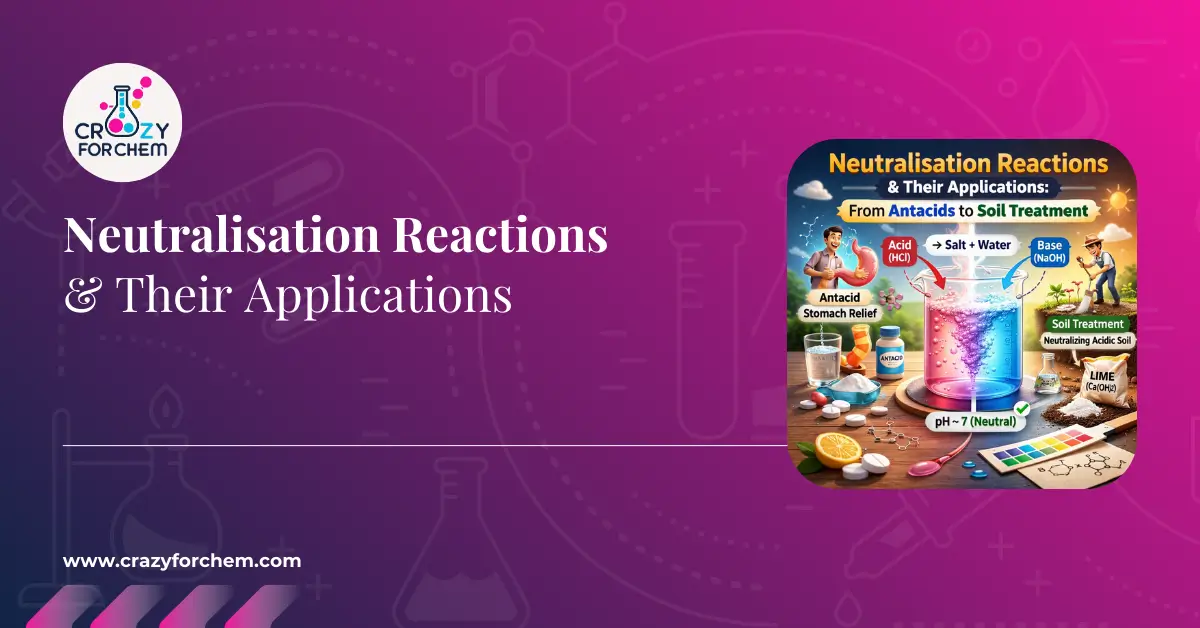
In the world of chemistry, a neutralisation reaction is a fundamental process where an acid reacts with a base (alkali) to produce two distinct products: a salt and water.
This process is classified as a double displacement reaction, as the positive and negative ions of the reactants effectively “swap partners” to form new substances.
Neutralisation reaction and its applications are vital to our daily existence, helping to maintain the delicate chemical balance required in our bodies, our industries, and the wider environment
Table of Contents
The Chemistry of Neutralisation (The Basics)
At its most essential level, the chemical “magic” of neutralisation involves hydrogen ions (H⁺) from the acid combining with hydroxide ions (OH⁻) from the base to form neutral water (H₂O). The remaining ions from the reactants then combine to form the salt.
- The General Formula: Acid + Base → Salt + Water.
- The Ionic Equation: The core reaction is best represented as H⁺(aq) + OH⁻(aq) → H₂O(l).
- Exothermic Nature: Most neutralisation reaction and its applications involve the release of energy, meaning they are exothermic; as the reaction proceeds, you will often notice a slight rise in the temperature of the solution.
To see how this fits into the broader chemical landscape, explore our guide on the 7 Types of Chemical Reactions Every Student Must Master.
Not All Salts are Neutral: Predicting the pH
A common misconception among students is that every neutralisation reaction results in a perfectly neutral solution with a pH of 7. In reality, the final pH level depends entirely on the relative strength of the acid and base used as reactants.
- Strong Acid + Strong Base: These react completely to form a neutral salt with a pH of exactly 7.00 (at 25°C), such as the reaction between hydrochloric acid and sodium hydroxide to form sodium chloride (table salt).
- Strong Acid + Weak Base: This results in an acidic salt with a pH of less than 7. For example, the reaction between nitric acid and iron(III) hydroxide produces iron(III) nitrate.
- Strong Base + Weak Acid: This combination produces a basic salt with a pH greater than 7. A classic example is the formation of potassium carbonate from the reaction of potassium hydroxide and carbonic acid.
Antacids: How Chemistry Cures Indigestion
One of the most relatable neutralisation reaction and its applications is the use of medicines to treat stomach disorders.
Our stomachs naturally produce hydrochloric acid (HCl) to assist with digestion and kill harmful bacteria. However, eating spicy or oily food can trigger the production of excess acid, leading to a painful burning sensation known as indigestion or heartburn.
To alleviate this, we consume antacids, which contain mild bases. Common ingredients in these tablets include magnesium hydroxide [Mg(OH)₂], also known as Milk of Magnesia, or aluminium hydroxide [Al(OH)₃].
These basic compounds react with the excess hydrochloric acid in the stomach to neutralise it, forming harmless salt and water and restoring a comfortable pH level.
- Example Reaction: Mg(OH)₂(s) + 2HCl(aq) → MgCl₂(aq) + 2H₂O(l).
Neutralising the Earth: Soil Treatment in Agriculture
The health of our global food supply relies heavily on the pH level of the soil. Most plants are highly sensitive and struggle to grow if the soil becomes too acidic or too alkaline, as this affects the availability of essential nutrients.
- Treating Acidic Soil: Soil can become acidic due to the continuous use of certain fertilisers or acid rain. To correct this, farmers apply basic substances like powdered lime (calcium oxide), slaked lime (calcium hydroxide), or limestone (calcium carbonate). These bases neutralise the excess hydrogen ions in the soil, restoring fertility and improving crop yields.
- Treating Alkaline Soil: If the soil becomes too basic, organic matter, such as compost or manure is added. As these materials rot, they decompose to release organic acids, such as carbonic acid, which neutralise the alkalinity of the soil.
Acid-Base Titration: Precision in the Laboratory
In a professional laboratory setting, neutralisation reaction and its applications are used in a technique called titration. This is a quantitative method used to determine the unknown concentration of an acid or a base.
During a titration, a solution of known concentration (the titrant) is slowly added from a burette into a flask containing the unknown solution until the equivalence point is reached. This is the exact moment when the acid and base have been completely consumed in stoichiometric amounts.
Chemists use a pH indicator such as phenolphthalein to signal this point through a visible colour change. By measuring the volume used, the unknown molarity can be calculated using the formula M₁V₁=M₂V₂.
Choosing the right indicator is a science of its own. Learn more in our guide on [Indicators (Natural vs Synthetic)].
Everyday Applications of Neutralisation
Beyond the lab and the farm, neutralisation is a constant presence in our daily routines.
Toothpaste and Oral Hygiene
When we eat, bacteria in our mouths break down sugar and food particles, producing acids that can erode tooth enamel and lead to tooth decay.
Toothpaste is formulated to be alkaline (basic), containing mild bases like calcium carbonate and sodium hydroxide. Brushing your teeth neutralises these harmful oral acids, protecting your enamel and preventing cavities.
Hair Care and Conditioners
Have you ever wondered why your hair feels rough after using shampoo but becomes shiny after using conditioner? Shampoo is typically basic in nature, which can leave the hair cuticle open and rough.
Hair conditioners are formulated to be acidic, allowing them to neutralise the alkalinity of the shampoo, smoothing the hair and leaving it shiny.
Bee vs Wasp Stings (The Comparison Table)
One of the most common “first-aid” uses of neutralisation is treating painful insect stings. Because bee and wasp toxins have different chemical properties, they require different treatments.
| Insect Sting | Nature of Toxin | Recommended Treatment | Chemistry Logic |
|---|---|---|---|
| Bee Sting | Acidic (Formic/Methanoic Acid) | Baking Soda (Sodium Bicarbonate) | The mild base neutralises the acid to reduce pain. |
| Wasp Sting | Alkaline (Basic) | Vinegar (Acetic Acid) | The mild acid neutralises the alkalinity of the sting. |
Industrial & Environmental Protection
Large-scale industries rely heavily on neutralisation reaction and its applications to prevent environmental destruction and human health hazards.
- Neutralising Factory Waste: Many industrial processes result in liquid effluents that are either highly acidic or highly basic. For example, semiconductor manufacturing produces harmful hydrofluoric acid (HF). Factories must neutralise this toxic waste using substances like calcium hydroxide or sodium bicarbonate before it can be safely released into rivers or lakes, preventing pollution and protecting aquatic life.
- Controlling Air Pollution: Power stations and industrial plants often emit acidic gases such as sulphur dioxide (SO₂) into the atmosphere as by-products of burning fossil fuels. If left untreated, these gases can cause respiratory issues and combine with water in clouds to form acid rain. To prevent this, these gases are treated with lime (calcium oxide) or limestone, which neutralises the acidic oxides before they are released.
Conclusion
From the simple act of brushing your teeth to the massive systems used to neutralise industrial air pollution, neutralisation reaction and its applications are essential to modern life.
By understanding how acids and bases interact to form salt and water, we can solve critical problems in health, agriculture, and environmental conservation.
Mastering these reactions is not just about passing a chemistry exam; it is about understanding the fundamental balance that keeps our world functioning safely.
Want to learn more about the substances used in these reactions? Check out our Complete Guide to Acids and Bases (2026)!
Frequently Asked Questions
-
Why is neutralisation reaction important in daily life?
Neutralisation reactions and their applications are crucial because they maintain balance in various systems. They help in human health by treating indigestion (acid reflux), enable agriculture by correcting soil pH for crop growth, and protect the environment by neutralising toxic industrial waste before it reaches our rivers.
-
What are 5 examples of neutralisation in everyday life?
Antacids: Neutralising excess stomach acid.
Toothpaste: Neutralising oral acids to prevent tooth decay.
Soil Treatment: Using lime to fix acidic soil.
Hair Care: Using acidic conditioners to balance alkaline shampoo.
Insect Stings: Using baking soda for bee stings or vinegar for wasp stings. -
Why is baking soda used for a bee sting but not for a wasp sting?
A bee sting contains methanoic (formic) acid, which requires a mild base like baking soda to neutralise the pain. However, a wasp sting is naturally alkaline (basic). Using baking soda would not help; instead, a mild acid like vinegar is needed to neutralise the sting’s alkalinity.
-
Does neutralisation always result in a pH of 7?
No. A neutral pH of 7 is only achieved when a strong acid reacts with an strong base. If you react a strong acid with a weak base, the resulting salt will be acidic (pH < 7). Conversely, a weak acid with a strong base produces a basic salt (pH > 7).
-
Why are neutralisation reactions considered exothermic?
Neutralisation reactions and their applications are almost always exothermic because energy is released when H⁺ ions from the acid and
OH⁻ions from the base bond to form water molecules (H₂O). This bond formation releases heat into the surrounding solution.