
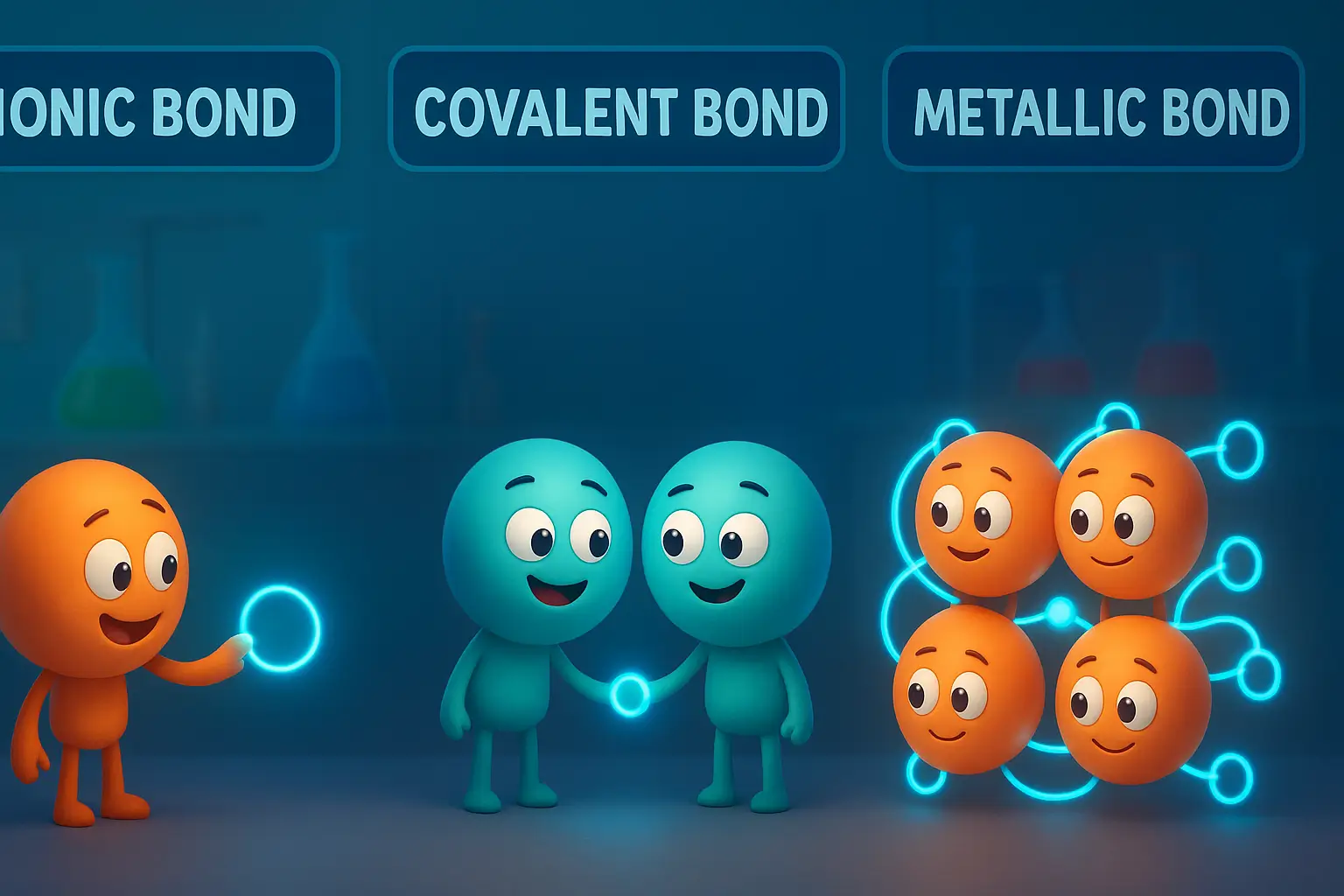
Ionic bonds = Electron TRANSFER → Metal + Non-metal (e.g. NaCl)
Covalent bonds = Electron SHARING → Non-metal + Non-metal (e.g. H₂O)
Metallic bonds = Electron SEA → Metal + Metal (e.g. Cu, Fe)
Want the full comparison with properties, examples, and exam tips? Keep reading ↓
Properties of Metallic Compounds
Property Characteristic Explanation Electrical Conductivity Excellent Mobile electrons carry current efficiently Thermal Conductivity Excellent Electrons transfer thermal energy rapidly Mechanical Properties Malleable and ductile Electron sea allows atoms to slide without breaking bonds Metallic Luster Shiny appearance Mobile electrons absorb and re-emit light Density Generally high Atoms packed efficiently in metallic lattices
What are the 3 main types of chemical bonds?
- Ionic Bonds – Complete electron transfer between metal and nonmetal atoms (e.g., NaCl)
- Covalent Bonds – Electron sharing between nonmetal atoms (e.g., H₂O, CO₂)
- Metallic Bonds – Delocalised electron “sea” in metal structures (e.g., copper, iron)
Key Differences Between Ionic, Covalent, and Metallic Bonds:
- Conductivity: Metallic > Ionic (when dissolved) > Covalent
- Flexibility: Metallic (malleable) vs Ionic (brittle) vs Covalent (variable)
- Formation: Metal+Nonmetal vs Nonmetal+Nonmetal vs Metal+Metal
Table of Contents
Introduction: Why Chemical Bonds Shape Everything Around Us
Have you ever wondered why diamonds are incredibly hard while graphite is soft enough to write with, even though both are made of carbon atoms? The answer lies in understanding the three fundamental types of chemical bonds that govern how atoms connect and determine material properties.
Chemical bonding is the foundation of all matter—from the water molecules in your body to the steel in skyscrapers and the silicon in computer chips. This comprehensive guide will explore ionic, covalent, and metallic bonds, helping you master these essential chemistry concepts for academic success and real-world understanding.
What you’ll learn:
- How each type of chemical bond forms and functions
- Key properties and characteristics that distinguish each bond type
- Real-world applications and examples you encounter daily
- Common misconceptions and how to avoid them
- Expert tips for identifying bond types in any compound
Chapter 1: Understanding Chemical Bonds – The Foundation of Matter
What Are Chemical Bonds?
Chemical bonds are attractive forces that hold atoms together to form molecules and compounds. Think of them as invisible “glue” that prevents atoms from separating, creating stable structures we observe in everything from table salt to DNA molecules.
The driving force behind bonding: Atoms seek stability by achieving a complete outer electron shell, typically following the octet rule (8 electrons) or duet rule (2 electrons for hydrogen).
The Role of Valence Electrons
Valence electrons are electrons in an atom’s outermost shell that participate in chemical bonding. These electrons determine:
- Whether an atom will form bonds
- What type of bond it will form
- The compound’s final properties
Quick Reference:
- Group 1 metals: 1 valence electron
- Group 2 metals: 2 valence electrons
- Group 17 halogens: 7 valence electrons
- Group 18 noble gases: 8 valence electrons (stable)
Chapter 2: Ionic Bonds – The Electron Transfer System
How Ionic Bonds Form
Ionic bonds occur when one atom completely transfers electrons to another atom, creating charged particles called ions:
- Cation: Positively charged ion (lost electrons)
- Anion: Negatively charged ion (gained electrons)
Before comparing, here’s a quick reference for each bond:
👉 Ionic Bonds — complete guide
👉 Covalent Bonds — complete guide
👉 Metallic Bonds — complete guide
This article focuses purely on HOW these three bonds differ from each other in formation, properties, and real-world behaviour.
The Electron Sea Model
Imagine metal atoms as:
- Positive ions (metal cations) arranged in a regular pattern
- Surrounded by a “sea” of mobile electrons
- Electrons can move freely in all directions
- Non-directional bonding extends throughout the structure
Metallic Property Variations
Factors affecting metallic properties:
- Number of valence electrons
- Atomic size
- Crystal structure
Examples:
- Mercury (Hg): Liquid at room temperature (weak metallic bonding)
- Tungsten (W): Highest melting point (3,695°C) – strong metallic bonding
- Aluminium (Al): Lightweight but strong – optimal for aerospace
Applications of Metallic Bonding
Electrical applications:
- Copper wiring – Excellent conductivity
- Silver contacts – Superior conductivity
- Aluminum power lines – Lightweight conductivity
Structural applications:
- Steel construction – Strength with flexibility
- Titanium alloys – Aerospace applications
- Stainless steel – Corrosion resistance
Chapter 5: Comparative Analysis – The 8 Critical Differences
Complete Comparison Matrix
| Property | Ionic Bonds | Covalent Bonds | Metallic Bonds |
|---|---|---|---|
| Electron Behaviour | Complete transfer | Sharing between atoms | Delocalised “sea” |
| Formation | Metal + Nonmetal | Nonmetal + Nonmetal | Metal + Metal |
| Electrical Conductivity | Only when dissolved/molten | Generally poor | Excellent (solid state) |
| Thermal Conductivity | Poor | Variable | Excellent |
| Mechanical Properties | Hard but brittle | Variable | Malleable and ductile |
| Melting Points | Generally high | Variable (wide range) | Generally high |
| Crystal Structure | Ionic lattice | Molecular/network | Metallic lattice |
| Solubility | Often water-soluble | Depends on polarity | Generally insoluble |
Detailed Analysis of Key Differences
1. Electron Behaviour (Most Fundamental)
- Ionic: Complete e⁻ transfer creates charged ions
- Covalent: Shared e⁻ between specific atoms
- Metallic: Delocalised e⁻ belong to the entire structure
2. Electrical Conductivity Mechanisms
- Ionic: Mobile ions carry current (only when dissolved/molten)
- Covalent: Localised electrons cannot carry current
- Metallic: Mobile electrons carry current in a solid state
3. Response to Mechanical Stress
- Ionic: Brittle fracture when like charges align
- Covalent: Variable – molecular compounds flexible, network solids rigid
- Metallic: Plastic deformation – atoms slide past each other
Electronegativity and Bond Type Prediction
Electronegativity difference guide:
- 0.0-0.4: Nonpolar covalent
- 0.4-1.7: Polar covalent
- >1.7: Ionic
- Metals only: Metallic
Chapter 6: Advanced Concepts and Edge Cases
Mixed Bonding Systems
Many real compounds exhibit characteristics of multiple bond types:
Polyatomic Ions
- Sulfate ion (SO₄²⁻): Covalent bonds within ion, ionic bonds between ions
- Ammonium chloride (NH₄Cl): Covalent N-H bonds, ionic NH₄⁺-Cl⁻ interaction
Coordinate Covalent Bonds
- One atom provides both electrons for sharing
- Common in transition metal complexes
- Example: Ammonia-boron trifluoride complex
Network vs. Molecular Covalent Compounds
Network Covalent (Giant Structures)
- Diamond: 3D network of C-C bonds – extremely hard
- Silicon dioxide: 3D Si-O network – high melting point
- Graphite: 2D sheets with metallic-like properties
Molecular Covalent (Discrete Molecules)
- Water: H-O-H molecules with hydrogen bonding
- Carbon dioxide: Linear O=C=O molecules
- Methane: Tetrahedral CH₄ molecules
Intermolecular Forces in Covalent Compounds
Van der Waals forces:
- London dispersion forces (all molecules)
- Dipole-dipole interactions (polar molecules)
- Hydrogen bonding (H bonded to N, O, or F)
These determine physical properties of molecular compounds.
Chapter 7: Problem-Solving Strategies
Step-by-Step Bond Identification
Method 1: Element-Based Approach
- Identify elements present
- Metal + Nonmetal → Likely ionic
- Nonmetal + Nonmetal → Likely covalent
- Metal + Metal → Metallic
- Check electronegativity difference
- Calculate ΔEN between atoms
- Apply electronegativity rules
- Verify with properties
- Compare predicted vs. observed properties
Method 2: Property-Based Approach
- Examine physical properties
- Conductivity, brittleness, solubility
- Test electrical conductivity
- Solid vs. solution conductivity
- Observe crystal structure
- Regular ionic lattice vs. molecular packing
Common Student Mistakes and Solutions
Mistake 1: Confusing Ionic and Polar Covalent
Problem: Similar partial charges Solution: Focus on complete vs. partial electron transfer
Mistake 2: Assuming All Metal Compounds Are Ionic
Problem: Some metal compounds have covalent character Solution: Check electronegativity differences and properties
Mistake 3: Forgetting Conductivity Conditions
Problem: Thinking ionic compounds always conduct Solution: Remember ions must be mobile (dissolved/molten)
Mistake 4: Oversimplifying Bond Strength
Problem: Assuming ionic bonds are always strongest Solution: Consider specific examples and structures
Memory Aids and Mnemonics
Bond Type Memory Device:
- Ionic = I give (electron transfer)
- Covalent = Cooperative sharing
- Metallic = Mobile electron sea
Property Memory Chain:
- Ionic: Crystal → Conduct when dissolved → Crack under stress
- Covalent: Molecular → No conduction → Variable properties
- Metallic: Lustrous → Always conducts → Bends don’t break
Chapter 8: Real-World Applications and Case Studies
Technology Applications
Semiconductor Industry
Silicon (covalent network):
- Pure silicon: Semiconductor properties
- Doped silicon: Enhanced conductivity
- Silicon dioxide: Insulating layers
Battery Technology
Lithium-ion batteries:
- Ionic conduction in electrolyte
- Metallic electrodes for electron flow
- Covalent compounds in electrode materials
Construction Materials
Concrete and steel:
- Ionic compounds (cement) provide strength
- Metallic reinforcement (steel) provides flexibility
- Combined system optimizes properties
Biological Systems
Protein Structure
Multiple bond types:
- Covalent peptide bonds (backbone)
- Ionic salt bridges (stability)
- Metallic coordination (enzyme active sites)
DNA Structure
Hierarchical bonding:
- Covalent sugar-phosphate backbone
- Hydrogen bonding between base pairs
- Ionic interactions with proteins
Environmental Applications
Water Treatment
Ion exchange resins:
- Covalent polymer matrix
- Ionic functional groups
- Selective ion removal
Catalysis
Heterogeneous catalysts:
- Metallic active sites
- Covalent support structures
- Ionic promoters
Chapter 9: Advanced Problem Sets
Practice Problems
Problem Set 1: Bond Type Identification
- MgCl₂ – Identify bond type and explain
- CO₂ – Determine bonding and molecular geometry
- Cu – Explain conductivity mechanism
- H₂SO₄ – Identify multiple bond types present
Problem Set 2: Property Prediction
- Compare melting points: NaCl, H₂O, Cu
- Predict solubility: CaF₂ in water vs. CCl₄ in benzene
- Explain why graphite conducts but diamond doesn’t
Problem Set 3: Real-World Applications
- Why are copper wires used for electrical transmission?
- Explain why ionic compounds are used in batteries
- How does metallic bonding enable shape memory alloys?
Worked Solutions and Explanations
Solution 1: MgCl₂ Analysis
- Elements: Mg (metal) + Cl (nonmetal)
- Electronegativity: ΔEN = 3.0 – 1.2 = 1.8 (>1.7)
- Conclusion: Ionic bonding
- Properties: High melting point, conducts when dissolved, forms crystals
Chapter 10: Exam Preparation and Study Strategies
Key Concepts Summary
Must-Know Definitions
- Ionic bond: Electrostatic attraction between oppositely charged ions
- Covalent bond: Sharing of electron pairs between atoms
- Metallic bond: Delocalised electrons in a metal lattice
- Electronegativity: An atom’s ability to attract bonding electrons
Critical Property Relationships
- Bond type → Structure → Properties → Applications
- Understanding this chain enables prediction and explanation
Study Techniques
Visual Learning
- Draw electron dot diagrams
- Create property comparison charts
- Use molecular models when possible
Practice-Based Learning
- Work through bond identification problems
- Predict properties from bond types
- Explain everyday examples using bonding theory
Connection-Making
- Link bond types to material properties
- Connect chemistry to real-world applications
- Understand historical development of bonding theories
Frequently Asked Questions
Q1: How do you determine if a bond is ionic or covalent?
A: Use the electronegativity difference between atoms:
ΔEN > 1.7: Ionic bond
ΔEN 0.4-1.7: Polar covalent bond
ΔEN < 0.4: Nonpolar covalent bond
Also consider the elements involved (metal + nonmetal suggests ionic).
Q2: Why don’t solid ionic compounds conduct electricity?
A: In solid ionic compounds, ions are fixed in crystal lattice positions and cannot move freely. Electrical conduction requires mobile charge carriers. When dissolved in water or melted, ions become mobile and can conduct electricity.
Q3: Can a compound have more than one type of bond?
A: Yes! Many compounds exhibit mixed bonding. For example:
Ammonium chloride (NH₄Cl): Covalent bonds within NH₄⁺, ionic bonds between NH₄⁺ and Cl⁻
Sulfuric acid (H₂SO₄): Covalent bonds within the molecule, potential ionic behaviour when dissolved
Q4: Which type of bond is strongest?
A: Bond strength depends on specific atoms and structures, not just bond type. Some examples:
Covalent: Diamond (C-C) – extremely strong network
Ionic: MgO – very strong due to high charges
Metallic: Tungsten – highest melting point of any element
Q5: Why are metals malleable but ionic compounds brittle?
A: In metals, the electron sea allows atoms to slide past each other without breaking bonds. In ionic compounds, shifting atoms can align like charges, causing repulsion and fracture.
Q6: How does bond polarity affect molecular properties?
A: Polar bonds can create molecular dipoles, affecting:
Solubility (“like dissolves like”)
Intermolecular forces (dipole-dipole interactions)
Physical properties (boiling/melting points)
Biological activity (enzyme binding, membrane transport)
Conclusion: Mastering Chemical Bonding
Understanding ionic, covalent, and metallic bonds provides the foundation for comprehending all chemical behaviour. These three fundamental bonding types through electron transfer, sharing, and delocalisation determine the properties of every material in our world.
📚 Continue Learning:
→ Complete guide: What are Ionic Bonds?
→ Complete guide: What are Covalent Bonds?
→ Complete guide: What are Metallic Bonds?
→ Overview: 7 Types of Chemical Bonds
Key Takeaways
- Bond type determines properties: The way atoms connect directly influences material behaviour
- Electrons are the key: Whether transferred, shared, or delocalised determines bond type
- Real-world relevance: Bonding theory explains everything from smartphone semiconductors to biological processes
- Predictive power: Understanding bonding allows property prediction and material design
Future Applications
As technology advances, understanding chemical bonding becomes increasingly important for:
- Developing new materials (superconductors, quantum dots)
- Drug design and delivery systems
- Energy storage and conversion technologies
- Environmental remediation strategies
Final Study Recommendations
- Practice regularly: Work through bond identification problems daily
- Connect concepts: Link bonding to everyday materials and phenomena
- Use multiple approaches: Combine visual, mathematical, and conceptual learning
- Stay curious: Question why materials behave as they do
The invisible forces that hold atoms together shape our entire physical reality. Master these concepts, and you’ll have unlocked one of chemistry’s most fundamental secrets—the key to understanding how matter behaves at its most basic level.
Whether you’re preparing for exams, pursuing advanced chemistry studies, or simply curious about the molecular world around you, this understanding of chemical bonding will serve as your guide to the remarkable science that governs all matter.
Practice identifying bond types in everyday materials, and remember that the different types of bonds in chemistry work together to create the incredible diversity of materials that make modern life possible.
Remember: Every time you dissolve salt in water, bend a paperclip, or marvel at a diamond’s brilliance, you’re witnessing the fundamental forces we’ve explored—ionic, covalent, and metallic bonds working together to create the incredible diversity of our material world.