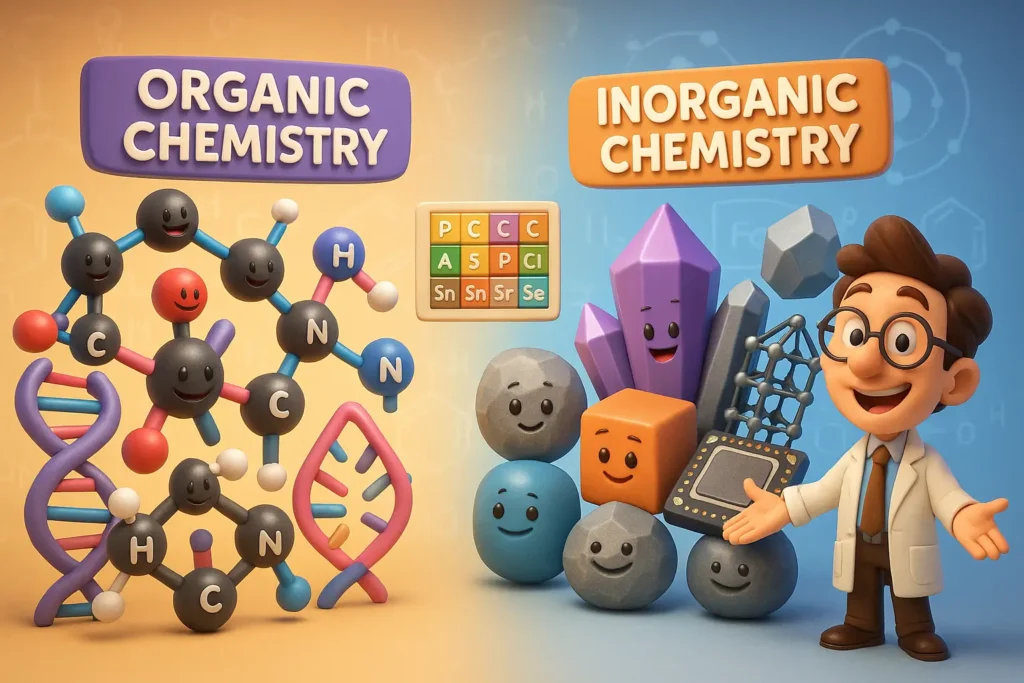
Understanding organic vs inorganic chemistry is essential for mastering chemical science. It also opens up diverse career paths in pharmaceuticals, materials science, and biotechnology.
These two main branches of chemistry look at matter from different angles and have unique principles and applications.
Organic chemistry deals with carbon-containing compounds. It accounts for 95% of all known chemical compounds, even though carbon is just one element on the periodic table. Inorganic chemistry includes all the other elements and their compounds.
This branch provides the basis for metallurgy, ceramics, semiconductors, and advanced materials.
Key distinctions include:
- Bonding mechanisms: covalent vs ionic dominance patterns
- Structural complexity: simple vs sophisticated molecular architectures
- Reaction mechanisms: selective vs complete transformation processes
- Industrial applications: specialised vs foundational technological uses
A notable statistic shows that organic chemistry drives $1.42 trillion in global pharmaceutical markets. Meanwhile, inorganic chemistry supports almost all modern electronics and construction materials.
Table of Contents
What Is Organic Chemistry? The Carbon-Centric Universe
Organic chemistry is the study of carbon-containing compounds and their complex relationships. Originally, scientists thought these compounds could only come from living things; this is why they called them “organic.” However, this view changed dramatically when Friedrich Wöhler synthesised urea in 1828. He showed that organic compounds could be made artificially.
Today, organic chemistry includes about 95% of all known chemical compounds, even though carbon is just one element on the periodic table. This impressive statistic highlights carbon’s unique ability to form stable, complex structures through covalent bonding.
The foundation of organic chemistry is based on carbon’s special properties:
- Tetravalency: Carbon atoms can form four covalent bonds.
- Catenation: Carbon can create long chains and rings.
- Versatile bonding: Carbon can form single, double, and triple bonds with other elements.
Key Characteristics of Organic Compounds
Organic compounds have unique properties that differentiate them from inorganic ones. These molecules generally have lower melting and boiling points because of weaker intermolecular forces.
They mostly consist of carbon and hydrogen, often along with oxygen, nitrogen, sulfur, and phosphorus. Most importantly, organic compounds are essential for life.
Every protein, carbohydrate, lipid, and nucleic acid in your body is an organic molecule that works hard to support your existence.
Understanding Inorganic Chemistry: The Elemental Powerhouse
Inorganic chemistry covers the study of all elements and compounds except organic ones. This broad field includes around 118 elements from the periodic table and their countless combinations, creating a diverse range of chemical possibilities.
Historically, inorganic chemistry came before organic chemistry. Early civilisations practised inorganic chemistry without realising it through activities like metallurgy, pottery, and glass-making.
These ancient techniques laid the foundation for the industrial processes we use today.
Fundamental Properties of Inorganic Compounds
Inorganic compounds usually have several key features:
Higher melting and boiling points: These result from stronger ionic or metallic bonds.
Electrical conductivity: Many inorganic compounds can conduct electricity.
Crystal structures: They often form ordered, repeating patterns.
These properties make inorganic compounds vital for technology, from the semiconductors in your smartphone to the steel frameworks of skyscrapers.
Organic vs Inorganic Chemistry
1. Bonding Mechanisms: Covalent vs. Ionic Dominance
Research shows that about 80% of organic compounds have pure covalent bonding, while 60% of inorganic compounds exhibit ionic characteristics.
2. Structural Complexity: Simple vs. Sophisticated Structures
Organic molecules can achieve remarkable complexity through carbon’s versatile bonding. For instance, proteins can consist of thousands of atoms arranged in specific three-dimensional configurations essential for biological function.
Inorganic compounds, while diverse, usually have simpler structures. However, this simplicity doesn’t make them less important.
For example, the straightforward structure of sodium chloride (table salt) carries out crucial biological functions despite its basic makeup.
3. Solubility Patterns: Like Dissolves Like Principle
The solubility behaviours of these compounds follow predictable patterns:
Organic compounds typically show:
- High solubility in organic solvents (like benzene and alcohol).
- Low solubility in water (except for polar organic molecules).
- Solubility is governed by molecular polarity.
Inorganic compounds generally demonstrate:
- High solubility in polar solvents (like water).
- Low solubility in non-polar solvents.
- Solubility is influenced by lattice energy and hydration energy.
This principle is essential in developing pharmaceuticals, as drug solubility directly affects bioavailability and effectiveness.
4. Reaction Mechanisms: Slow and Selective vs. Fast and Complete
Organic reactions often happen through complex, multi-step mechanisms that need specific conditions. They usually involve:
- Slower reaction rates due to breaking and forming covalent bonds.
- Selectivity, producing specific products under controlled conditions.
- Catalysts, often requiring enzymes or metal catalysts.
Inorganic reactions generally occur more quickly and completely:
- Faster kinetics as ionic compounds readily dissociate and recombine.
- Complete reactions that can proceed to completion under normal conditions.
- Predictable outcomes based on established patterns and rules.
5. Thermal Stability: Heat Sensitivity vs. Resilience
Temperature tolerance shows another significant difference between these chemical families:
Organic compounds tend to have:
- Lower decomposition temperatures (usually below 500°C).
- A tendency to degrade from heat.
- Formation of carbon residues upon heating.
Inorganic compounds often demonstrate:
- Higher thermal stability (frequently above 1000°C).
- Resistance to thermal decomposition.
- Predictable thermal behaviour.
This difference explains why ceramic materials can withstand extreme temperatures in jet engines, while organic polymers need careful temperature control during processing.
6. Biological Relevance: Life’s Foundation vs. Industrial Applications
The biological importance of these compounds varies greatly:
Organic chemistry is the basis of biochemistry, covering:
- All biomolecules (proteins, DNA, RNA, lipids).
- Metabolic pathways and energy production.
- Pharmaceutical compounds and natural products.
- All living tissue consists of organic molecules.
Inorganic chemistry supports biological systems with:
- Essential minerals and electrolytes.
- Enzyme cofactors and prosthetic groups.
- Bone mineralisation (like calcium phosphate).
- Oxygen transport (such as iron in haemoglobin).
7. Industrial Applications: Specialised vs. Foundational Uses
Both fields play significant roles in industrial applications, yet their functions differ considerably:
Organic chemistry powers industries such as:
- Pharmaceuticals ($1.42 trillion global market).
- Plastics and polymers.
- Petrochemicals and fuels.
- Agricultural chemicals.
Inorganic chemistry underpins:
- Metallurgy and materials science.
- Electronics and semiconductors.
- Ceramics and glass manufacturing.
- Catalysts and pigments.
Real-World Applications: Where Chemistry Meets Daily Life
Understanding the differences between organic and inorganic chemistry is vital when looking at practical applications. Take your smartphone, for example.
The organic polymers in the case provide flexibility and durability. In contrast, inorganic semiconductors enable the device’s electronic functions.
This combination of organic and inorganic chemistry results in the technology we rely on daily. In medicine, organic pharmaceutical compounds target specific biological pathways, while inorganic contrast agents improve medical imaging.
This complementary relationship between the two fields highlights their shared role in advancing human understanding and technology.
Future Perspectives: Bridging the Chemical Divide
Modern chemistry increasingly merges the traditional boundaries between organic and inorganic chemistry.
Organometallic chemistry is an expanding area that combines organic ligands with metal centres to create compounds with unique properties.
Similarly, bioinorganic chemistry investigates how inorganic elements function in biological systems.
These interdisciplinary approaches suggest that future chemical breakthroughs will likely arise from the intersection of organic and inorganic principles, rather than from isolated studies of either field.
Conclusion
The organic vs inorganic chemistry goes beyond academic classification; it represents two complementary ways of understanding the molecular world.
While organic chemistry lays the foundation for life and biological processes, inorganic chemistry provides materials and technologies that support modern civilisation.
As you have seen throughout this exploration, the seven key differences—bonding mechanisms, structural complexity, solubility patterns, reaction mechanisms, thermal stability, biological relevance, and industrial applications—create distinct, yet interconnected, chemical landscapes.
Each field uniquely contributes to scientific progress and technological development. Whether you are studying chemistry, working in a related field, or simply curious, knowing these differences helps you appreciate the complexity of chemical science.
The next time you encounter a chemical phenomenon, you’ll be able to identify whether it’s organic or inorganic chemistry at play. Remember, chemistry isn’t just about memorising facts and formulas; it’s about understanding the fundamental principles that govern matter and energy in our universe.
By grasping these core ideas, you’re not just learning chemistry; you’re uncovering the mysteries of existence itself. Ready to dive deeper into the intriguing world of chemistry?
Explore more advanced topics and see how these principles apply to cutting-edge research and emerging technologies. The journey of discovering chemistry goes on, and you’re now ready to be a part of this exciting scientific adventure.
Frequently Asked Questions
What is the main difference between organic and inorganic chemistry?
Organic chemistry studies carbon-containing compounds and their reactions, while inorganic chemistry covers all other elements and compounds (the remaining 117 elements). Organic chemistry represents 95% of all known chemical compounds despite focusing on just one element – carbon.
What are examples of organic vs inorganic compounds?
Organic compounds: Proteins, DNA, plastics, gasoline, sugar, alcohol, vitamins, and all living tissue. Inorganic compounds: Table salt (NaCl), water (H₂O), metals like iron and copper, ceramics, glass, minerals, and most rocks and stones.
Is water organic or inorganic?
Water (H₂O) is inorganic because it doesn’t contain carbon. Despite being essential for life, water lacks the carbon backbone that defines organic compounds. This is a common misconception since water is so vital to biological systems.
Why does organic chemistry focus only on carbon?
Carbon has unique properties that make it special: it can form four covalent bonds (tetravalency), create long chains and rings (catenation), and form single, double, or triple bonds. These abilities allow carbon to create an extraordinary variety of complex structures, explaining why 95% of all known compounds contain carbon.
Which type of chemistry is harder to learn – organic or inorganic?
This depends on your learning style. Organic chemistry requires understanding complex molecular structures and multi-step reaction mechanisms, making it challenging for visualisation. Inorganic chemistry involves memorising the properties of many different elements and their compounds. Both require different skill sets and thinking approaches.
Do organic or inorganic compounds have higher melting points?
Inorganic compounds typically have much higher melting and boiling points due to stronger ionic or metallic bonding. Most organic compounds decompose below 500°C, while many inorganic compounds can withstand temperatures exceeding 1000°C. This is why ceramics (inorganic) are used in jet engines.
How do solubility patterns differ between organic and inorganic compounds?
Following the “like dissolves like” principle: Organic compounds generally dissolve in organic solvents (alcohol, benzene) but not water, unless they’re polar. Inorganic compounds typically dissolve well in water (polar solvent) but poorly in organic solvents. This affects everything from drug delivery to cleaning products.
Which field has more industrial applications?
Both are crucial but serve different purposes. Organic chemistry drives pharmaceuticals ($1.42 trillion global market), plastics, petrochemicals, and agricultural chemicals. Inorganic chemistry underpins metallurgy, electronics, semiconductors, ceramics, and construction materials. Modern technology requires both working together.
Are organic compounds always found in living things?
No, this is a historical misconception. While the term “organic” originally meant “from living organisms,” chemists can now synthesize organic compounds artificially. Friedrich Wöhler proved this in 1828 by creating urea in the lab. Today, many organic compounds are manufactured industrially and never existed in nature.
Do organic or inorganic compounds react faster?
Inorganic reactions typically occur faster because ionic compounds readily dissociate and recombine. Organic reactions often proceed slowly through complex, multi-step mechanisms requiring specific conditions and sometimes catalysts. However, some organic reactions (like combustion) can be extremely rapid.
Which branch of chemistry is more important for biology and medicine?
Organic chemistry forms the foundation of biochemistry since all biomolecules (proteins, DNA, lipids, carbohydrates) are organic. However, inorganic chemistry is equally vital – providing essential minerals, electrolytes, enzyme cofactors, and elements like iron in hemoglobin. Medicine uses both: organic drugs and inorganic contrast agents.
Can a compound be both organic and inorganic?
Traditional classification says no, but modern chemistry has blurred these lines. Organometallic chemistry combines organic ligands with metal centers, creating compounds with properties of both. Bioinorganic chemistry studies how inorganic elements function in biological systems. These interdisciplinary fields bridge the traditional divide.
How do you identify if a compound is organic or inorganic?
Look for carbon: If the compound contains carbon-hydrogen bonds, it’s likely organic (exceptions: CO₂, carbonates, and cyanides are considered inorganic). Check the formula – organic compounds typically show carbon connected to hydrogen, oxygen, nitrogen, or other carbons. Inorganic compounds usually involve metals or lack carbon entirely.
Which chemistry field offers better career opportunities?
Both offer excellent career prospects but in different areas. Organic chemistry leads to careers in pharmaceuticals, biotechnology, materials science, and environmental chemistry. Inorganic chemistry opens doors to metallurgy, semiconductors, catalysis, ceramics, and mining. The choice depends on your interests and the specific industry sectors in your region.
Why are organic compounds generally less stable than inorganic ones?
Organic compounds have weaker intermolecular forces and more complex structures that can break down under heat or other stresses. Their covalent bonds, while strong individually, create molecules that decompose at relatively low temperatures. Inorganic compounds often have ionic or metallic bonding that creates more thermally stable structures.
How do organic and inorganic compounds differ in electrical conductivity?
Most organic compounds are electrical insulators because electrons are localized in covalent bonds. Exceptions include organic conductors and semiconductors. Many inorganic compounds conduct electricity well due to mobile ions (in solutions) or delocalized electrons (in metals). This is why metals are used for electrical wiring.