Think about the last time you made a paratha on a tawa.
That moment when the ghee hits the hot surface, and the dough turns from pale to a deep, speckled golden-brown, releasing that irresistible nutty aroma that fills the entire kitchen, that is not just good cooking. That is chemistry.
The same transformation happens when a dosa crisps up on a cast-iron pan, when the edges of a roti char slightly over an open flame, or when a cup of filter coffee deepens in colour during roasting.
In each case, a single chemical process is silently at work, turning simple ingredients into something that smells and tastes extraordinary.
This process is called the Maillard reaction in cooking, and once you understand it, you will never look at your tawa, oven, or frying pan the same way again.
Named after the French chemist Louis Camille Maillard in 1912, this process explains why “browned” food almost always tastes better than food that has been boiled or steamed.
By understanding Maillard reaction science, we can transform the kitchen from a place of recipes into a fascinating domestic laboratory where we control the “invisible architect” of taste.
This comprehensive guide explores the molecular dance between sugars and proteins, providing expert insights into how to master the perfect sear and golden crust.
Table of Contents
1. The Chemistry of the “Molecular Handshake”
The Maillard reaction in cooking is a collaborative performance between Reducing Sugars (like Glucose/Fructose) and amino acids, which are the building blocks of proteins.
When manipulated by heat, these compounds engage in what can be described as a “molecular handshake,” kickstarting a massive chemical cascade that generates hundreds of various flavour and aroma molecules.
The Three Stages of Transformation
Scientists generally summarise this complex reaction into three pivotal stages:
- The Early Stage (Colourless and Odourless): A sugar molecule is transformed by an amino group to form a Schiff base, which subsequently rearranges into stable ketoamine compounds known as Amadori or Heyns rearrangement products.
- The Intermediate Stage: At this point, the molecules fragment and dehydrate, giving rise to sugar dehydration products containing carbonyl groups, including heterocyclic furfurals. This is also where Strecker degradation occurs, a reaction where amino acids are deaminated and decarboxylated to give aldehydes, which are crucial for aroma.
- The Final Stage: Complex polymerisation occurs, leading to the formation of melanoidins. These are brown nitrogenous polymers responsible for the characteristic golden-brown hue and the deep, savoury flavours we associate with well-cooked food.
2. Maillard Reaction vs Caramelisation: Clearing the Confusion
While both processes result in the browning of food, they are fundamentally different chemical transformations.
- Maillard Reaction: This requires both sugar and protein (amino acids). It is responsible for savoury, “meaty,” and “roasty” flavours. It begins to accelerate rapidly above 140°C (285°F).
- Caramelisation: This is a “sugar-only party” involving the oxidation and thermal decomposition of sugar molecules alone. It produces a profile that is sweet, nutty, and slightly bitter, often described as “buttery”. It generally requires much higher heat, starting around 160°C (320°F).
Table 1: Key Differences at a Glance
| Feature | Maillard Reaction | Caramelisation |
|---|---|---|
| Key Ingredients | Reducing Sugars + Amino Acids | Sugars ONLY |
| Typical Temp | Starts at 140°C (285°F) | Starts at 160°C (320°F) |
| Flavour Output | Savoury, Umami, Meaty, Toasty | Sweet, Nutty, Buttery, Bitter |
| Cooking Method | Searing, Baking, Roasting | Melting sugar, Torching Crème Brûlée |
3. The Golden Rules of the Sear: Temperature and Dryness
Mastering the Maillard reaction in cooking requires precise control over the cooking environment. Two factors, dryness and temperature, are the key controls for the rate of the reaction.
The 140°C Rule and the Danger of Burning
The optimal temperature range for the Maillard reaction in cooking to proceed effectively is between 140°C and 165°C (284°F–330°F).
If the temperature gets too low, the reaction slows significantly; however, if it exceeds 180°C (355°F), a different set of reactions occurs: pyrolysis.
Pyrolysis is the heat-induced decomposition of food that creates bitter, scorched flavours and potentially toxic black carbon.
The Moisture Barrier
Surface moisture is the enemy of browning. As long as food is very wet, its surface temperature cannot climb above the boiling point of water (100°C), which is too low for the Maillard reaction to occur.
This is why you must pat meat and fish dry with a towel before cooking. The sound of sizzling in a hot pan is an auditory signal that surface moisture is evaporating, paving the way for a rich, brown crust to form.
4. “The Alkaline Advantage”: The pH Hack
One of the most effective ways to influence the speed of the Maillard reaction is by adjusting the pH level. The reaction proceeds much faster in alkaline (basic) environments.
- Baking Soda in the Kitchen: Adding a pinch of baking soda to sautéing onions increases the pH, causing them to brown faster and develop a remarkably sweet, caramel-like flavour. This alkalinity facilitates the destruction of onion cell walls, resulting in a more rapid release of intracellular juices and faster browning.
- The Science of Pretzels: Traditional German pretzels achieve their mahogany colour and iconic flavour by being dunked in an alkaline solution (lye or baking soda water) before baking. This alters the pH on the surface of the dough, giving the Maillard reaction an accelerated boost.
5. The Dark Side: Acrylamide and Food Safety
While the Maillard reaction creates delicious flavours, it can also produce acrylamide, a heat-induced chemical first identified in food in 2002.
What is Acrylamide?
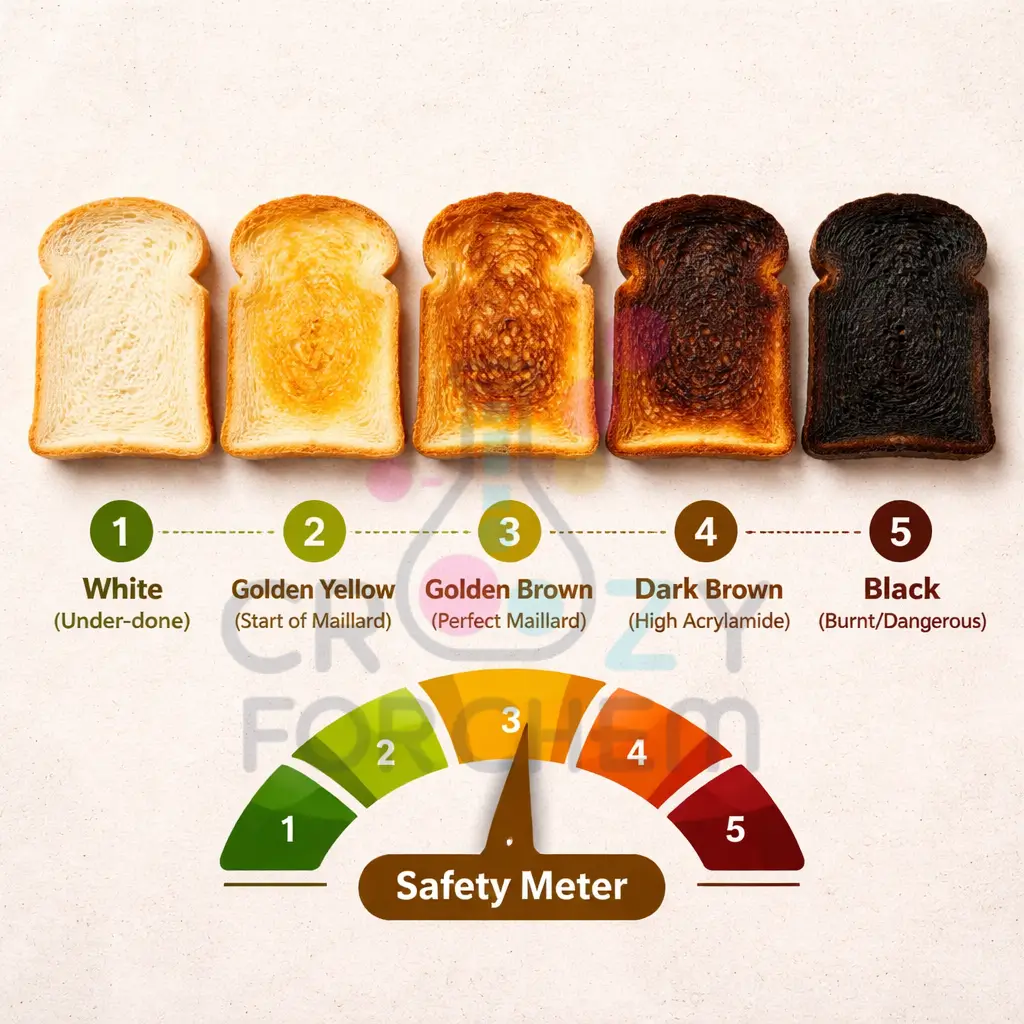
Acrylamide is formed when Reducing Sugars and the amino acid asparagine undergo the Maillard reaction at temperatures above 120°C. It is primarily found in crispy bread, potato chips, French fries, and roasted coffee.
The International Agency for Research on Cancer (IARC) classifies acrylamide as a probable human carcinogen.
“As a chemistry educator, I often tell my students: chemistry isn’t just about formulas; it’s about making safer choices in our daily lives. Understanding acrylamide is a step towards healthier cooking.”
Mitigation Strategies
To enjoy the benefits of the Maillard reaction in cooking while minimising risks, consider these safety tips:
- Avoid Excessive Browning: Aim for a “golden yellow” or “light brown” colour rather than dark brown or black.
- Pre-process Interventions: Soaking potatoes in water for 15–120 minutes or blanching them in hot water can reduce acrylamide precursors by up to 97%.
- Incorporate Acids: Adding mild acids like vinegar or lemon juice to marinades can effectively reduce acrylamide levels by lowering the pH and inhibiting the specific pathway that leads to its formation.
6. Culinary Applications: From Coffee to Croissants
The Maillard reaction in cooking is an essential part of the culinary arts, used almost everywhere from the baking industry to daily home life to make food tasty.
- Baking and Pastry: The flour in dough provides the proteins and sugars needed for a golden crust. Brushing yeast buns or croissants with an egg wash (protein source) or milk (protein + lactose sugar) enhances browning and adds a glossy finish.
- The Brewing Industry: Malt kilning involves drying and heating germinated malt to create the conditions for the Maillard reaction, which determines the colour and flavour profile of different beer styles, from green malt to chocolate malt.
- Coffee Roasting: Roasting green beans at temperatures above 200°C triggers the Maillard reaction, generating melanoidins that account for up to 29% of the dry weight of brewed coffee. Darker roasts involve longer roasting times and higher acrylamide levels.
7. Benefits Beyond Flavour
Interestingly, the products of the Maillard reaction offer benefits beyond mere taste:
- Antioxidant Properties: Melanoidins are potent antioxidants that can scavenge free radicals and protect cells from oxidative damage.
- Shelf-Life Extension: The reaction produces antimicrobial substances, such as furans, which can inhibit the growth of spoilage bacteria, thereby acting as natural preservatives.
- Nutrient Bioavailability: The Maillard reaction can create complexes that enhance the solubility and absorption of minerals like iron and zinc.
8. Mastering Advanced Techniques
Pressure Cookers
Contrary to popular belief, the Maillard reaction can occur in wet environments if the pressure is high enough. In the sealed environment of a pressure cooker, the boiling point of water is raised, allowing the temperature to reach levels where Maillard flavours can develop in soups and purees.
Sous Vide and Searing
In sous vide cooking, meat is brought to a precise core temperature in a water bath. However, because the temperature remains low, it lacks the savoury crust of grilled meat. This is solved by a quick post-sear in a sizzling hot pan or with a blowtorch to induce the Maillard reaction on the surface.
9. Conclusion: The Evolutionary Appeal of Maillard
Our ancestors’ shift to cooked food was a pivotal moment in human history.
The flavours and aromas produced by the Maillard reaction are evolutionary signals indicating that the food is not only safe to consume but also packed with the proteins and carbohydrates essential for survival.
Today, understanding the Maillard reaction science allows us to consciously manipulate these signals. By controlling heat, moisture, and pH, we can take our cooking from simply edible to something truly worth remembering.
Whether you are searing a steak or toasting a slice of sourdough, you are participating in a timeless chemical process that defines the very essence of deliciousness.
Frequently Asked Questions (FAQs)
-
What is the Maillard reaction in simple terms?
The Maillard reaction in cooking is a chemical reaction between amino acids (from proteins) and reducing sugars that occurs when food is heated. It is responsible for the browning of food and the creation of hundreds of complex flavour and aroma compounds, such as the crust on bread or the sear on a steak.
-
At what temperature does the Maillard reaction start?
The Maillard reaction typically begins to accelerate at temperatures between 140°C and 165°C (284°F–330°F). If the temperature is too low (like in boiling water at 100°C), the reaction will not occur. If the temperature exceeds 180°C, the food may begin to char or undergo pyrolysis, leading to bitter flavours.
-
Is the Maillard reaction the same as caramelisation?
No. While both cause browning, they are different processes. The Maillard reaction requires both proteins and sugars and produces savoury, meaty flavours. Caramelisation involves the thermal decomposition of sugars only, occurs at higher temperatures (above 160°C), and produces sweet, nutty, or buttery notes.
-
Why does adding baking soda speed up browning?
Adding baking soda increases the pH level of the food’s surface, making it more alkaline. In an alkaline environment, amino acids react much faster with sugars. This is why a pinch of baking soda helps onions brown more quickly or gives pretzels their deep mahogany colour.
-
Is the Maillard reaction healthy or harmful?
The reaction creates the delicious flavours we love and produces some antioxidants (melanoidins). However, if starchy foods are overcooked at very high temperatures, the Maillard reaction can produce acrylamide, a potential carcinogen. To stay safe, aim for a golden-brown colour rather than a dark or burnt finish.
-
Why doesn’t boiled or steamed food turn brown?
Boiling and steaming limit the food’s surface temperature to 100°C (the boiling point of water). Since the Maillard reaction requires temperatures above 140°C to proceed effectively, boiled food remains pale and lacks the complex roasted flavours found in fried or roasted dishes.
-
Can the Maillard reaction happen in a pressure cooker?
Yes. Although it is a wet environment, a pressure cooker increases the internal pressure, which raises the boiling point of water above 100°C. This allows the temperature to reach the threshold required for the Maillard reaction to occur, resulting in deeper flavours in stews and stocks.
-
How can I use the Maillard reaction in my everyday cooking?
The most effective way to harness the Maillard reaction in everyday cooking is to ensure your cooking surface is sufficiently hot before adding food. Pat meat, fish, or paneer dry before placing it in the pan, as surface moisture prevents browning. For rotis and parathas, allow the tawa to preheat properly and use a small amount of ghee or butter to encourage even browning. Even adding a pinch of baking soda to onions whilst sautéing will trigger faster, deeper browning, a simple hack that dramatically improves flavour.
-
What foods benefit the most from the Maillard reaction?
Almost any food containing both proteins and reducing sugars will benefit from the Maillard reaction. In an Indian kitchen, this includes parathas, rotis, dosas, and tandoori preparations. More broadly, the greatest flavour transformations are seen in seared meats and fish, crusty bread and baked goods, roasted coffee beans, malted grains used in brewing, and pan-fried vegetables such as cauliflower and mushrooms. The higher the protein and sugar content of a food, the more pronounced and complex the browning will be.
-
How do I control the Maillard reaction at home without burning my food?
Controlling the Maillard reaction at home comes down to three variables: temperature, moisture, and time. Keep your cooking surface between 140°C and 165°C hot enough to brown, but not so hot as to char. Always dry the surface of your food before cooking, as water dramatically slows the reaction. If you notice the food darkening too quickly, lower the heat slightly or briefly move the pan off the flame. Aiming for a golden-yellow to light-brown colour is the safest visual guide. This is where flavour is at its peak, and acrylamide formation remains minimal.