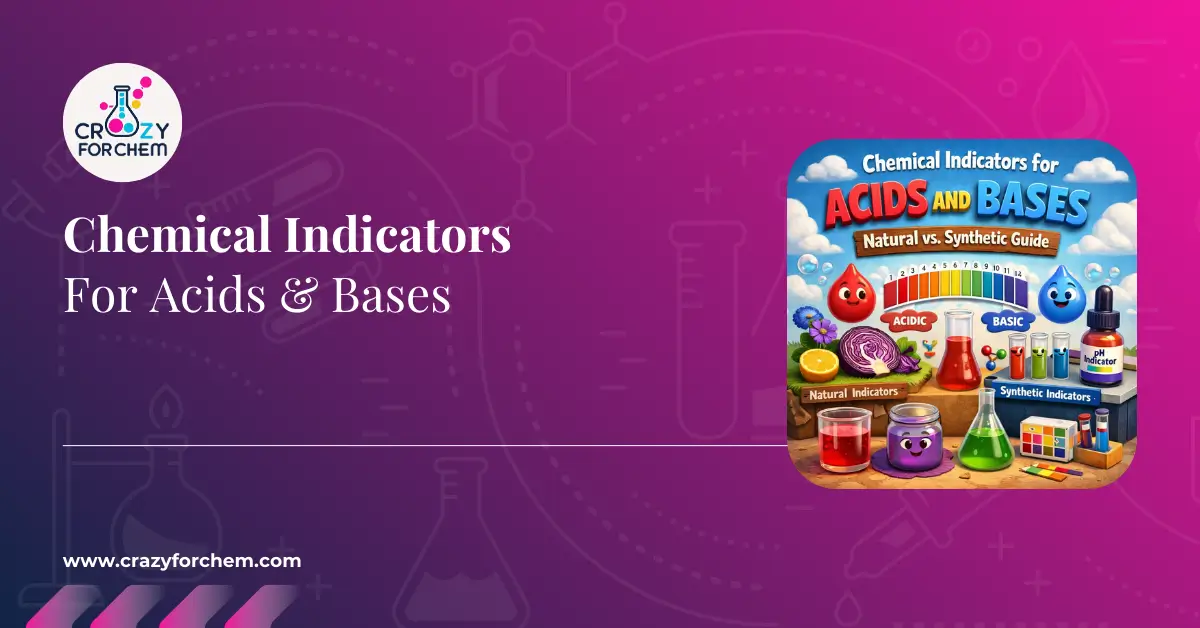
In the fascinating world of chemistry, we often encounter substances that we cannot identify simply by looking at them.
Tasting chemicals in a laboratory is strictly forbidden and dangerous, so scientists rely on chemical indicators for acids and bases to reveal the hidden nature of a solution.
These substances are known as indicators, which act as chemical detectors for hydronium (H₃O⁺) or hydrogen (H⁺) ions.
An acid-base indicator is typically a weak organic acid or a weak organic base that undergoes a visible colour change when it comes into contact with an acidic or basic solution.
By understanding the properties of indicators, natural vs synthetic, students and scientists can accurately determine the pH of various substances without needing complex machinery.
Table of Contents
What is an acid-base indicator?
The working mechanism of chemical indicators for acids and bases is deeply rooted in chemical equilibrium. These substances exist in a delicate balance between two different structural forms: their acid form (often represented as HIn) and their conjugate base form (In⁻).
The Mechanism of Colour Change
According to the principles of equilibrium, each form of the indicator reflects a different colour. For example, if the indicator is a weak acid, it reaches an equilibrium in an aqueous solution as shown:
HIn(aq) + H₂O(l) ⇌ In⁻(aq) + H₃O⁺(aq).
- In acidic solutions: When you add acid to the indicator, the high concentration of hydronium ions shifts the equilibrium to the left, towards the HIn form, displaying its characteristic “acid colour”.
- In basic solutions: When added to a base, the hydroxide ions react with H₃O⁺, reducing its concentration and shifting the equilibrium to the right, towards the In⁻ form, displaying the “base colour”.
Indicators are essential in neutralisation reactions, which you can learn more about in our 7 Types of Chemical Reactions post.
Natural Indicators: Chemistry from Nature
Natural indicators are substances derived directly from organic sources, such as plants, flowers, or even vegetables. These are widely used in schools to demonstrate the basic principles of acidity and alkalinity using common household items.
1. Litmus (The Gold Standard)
Litmus is the most commonly used natural chemical indicator in laboratories. It is a solution of different dyes extracted from Lichens, which are small plants often found on tree trunks or rocks.
💡 The “BAR” Mnemonic (Memory Trick) Many students struggle to remember which colour corresponds to which state. Use this simple trick to never forget again: BAR — Base turns Acid’s Red to Blue. This means that if you have red litmus paper (which indicates an acidic or neutral state), a Base will turn it Blue.
2. Turmeric (Haldi)
Turmeric is a common kitchen spice that contains a bright yellow pigment called curcumin, which serves as an excellent natural indicator.
- Colour Behaviour: Turmeric remains yellow in acidic or neutral solutions. However, it turns a distinct brownish-red colour when it comes into contact with a basic solution.
🏠 Daily Life Chemistry: The Turmeric Stain Have you ever noticed that if you get a yellow curry stain on a white shirt and try to wash it with soap, the stain suddenly turns red? This happens because soap is basic in nature. The base in the soap reacts with the curcumin in the turmeric, shifting its colour from yellow to reddish-brown. If you rinse it with an acid like lemon juice, the yellow colour often returns!
3. China Rose (Hibiscus)
China Rose, or Gurhal, is another popular natural indicator easily found in many gardens. A solution made from China Rose petals reacts beautifully to pH changes:
- Acidic Solutions: Turns a bright pink or magenta.
- Basic Solutions: Turns a distinct green colour.
4. Red Cabbage Juice
Red cabbage is perhaps the most versatile natural indicator because it contains a mixture of coloured substances called anthocyanins that can show a wide spectrum of colours. It turns deep red in strong acids, purple in neutral solutions, and shifts through blue and green to yellow in strong bases.
Synthetic Indicators: Lab-Made Precision
While natural options are excellent for classroom demonstrations, professional scientists often require more precise tools. Synthetic chemical indicators for acids and bases are man-made substances created through industrial processes like condensation or diazotisation.
These are often preferred in professional settings because they are more consistent and can be tailored for specific, narrow pH ranges.
1. Phenolphthalein
Phenolphthalein is a colourless synthetic indicator and is a staple in titration experiments involving strong bases.
- In acidic solutions, it remains completely colourless.
- In Basic Solutions: It dissociates to form a magenta or pink anion when the pH rises above 8.3.
2. Methyl Orange
Methyl Orange is another critical synthetic indicator used to detect endpoints in acidic ranges.
- In acidic solutions, it turns a dark red-orange (at pH 3.1 or lower).
- In Basic/Neutral Solutions: It turns yellow (at pH 4.4 or higher).
To see how these synthetic indicators are used to measure the strength of solutions, read our Complete Guide to Strong vs Weak Acids.
Olfactory Indicators: Testing via Smell
An intriguing category of indicators does not rely on sight but on our sense of smell. Olfactory indicators are substances whose odour changes in acidic or basic media.
- Onion and Vanilla: These substances have a very strong, characteristic smell. In an acidic medium, they retain their smell. However, in a basic medium (like a sodium hydroxide solution), their smell cannot be detected.
- Cloves: Similar to onions, cloves lose their characteristic aroma in alkaline solutions but retain it in acidic conditions.
Comparison: Indicators – Natural vs Synthetic
When choosing the right chemical indicators for acids and bases, chemists must consider factors such as precision, chemical stability, and the specific pH range required for the experiment.
| Feature | Natural Indicators | Synthetic Indicators |
|---|---|---|
| Origin | Derived from plants/organic sources | Man-made in laboratories |
| Examples | Litmus, turmeric, and Red Cabbage | Phenolphthalein, Methyl Orange |
| Precision | Less precise; colours can vary | Highly precise with sharp colour changes |
| Stability | May degrade or spoil over time | Generally more stable and longer-lasting |
| Range | Often have a narrower or less specific range | Can cover almost the entire pH range |
The Science Behind the Colour: Major Theories
Two major theories explain why indicators change colour when the environment shifts from acidic to basic.
- Ostwald’s Theory: This theory suggests that colour change is due to the ionisation of the indicator. The unionised molecule (the acid form) has one colour, while the ionised form (the conjugate base) has a different colour.
- Quinonoid Theory: This theory proposes that the colour change is due to a structural transformation within the molecule. The molecule exists in two tautomeric forms: the benzenoid form (usually colourless or light) and the quinonoid form (intensely coloured).
Practical Tips for Laboratory Titrations
In professional chemistry, selecting the right indicator is a science in itself. A “good” indicator must show a rapid and easily detected colour change.
- Selection Rule: The indicator should have a transition interval (pKin) that is close to the expected pH at the equivalence point of the titration.
- Indicator Choice: For titrating a weak acid with a strong base, phenolphthalein is the best choice because the equivalence point is basic (pH > 7). For a strong acid with a weak base, methyl orange is preferred, as the endpoint is acidic.
- Quantity: Always use only a few drops. Using too much indicator can interfere with the reaction and lead to inaccurate results.
Understand the reactions behind these titrations in our post on Acids vs Bases vs Salts: Properties & pH Differences.
DIY Home Experiment: Red Cabbage pH Indicator
You can easily explore the world of natural vs synthetic indicators at home using red cabbage.
- Prepare the Extract: Chop some red cabbage and boil it in a small amount of water until the water turns a deep purple.
- Strain the Liquid: Once cooled, strain out the cabbage pieces. This purple liquid is your indicator.
- Test Your House: Pour the liquid into small glasses and add household items. Watch it turn red/pink with vinegar (acid), stay purple with water (neutral), and turn green or yellow with baking soda or soapy water (base).
Conclusion
Ultimately, chemical indicators for acids and bases are indispensable tools that bridge the gap between invisible chemical properties and our visible world.
Whether you are using a natural indicator like turmeric from your kitchen or a high-precision synthetic indicator like phenolphthalein in a university lab, these substances provide a window into the molecular nature of matter.
By mastering how they work and when to use them, students can unlock the secrets of pH and excel in both practical and theoretical chemistry.
Ready to master more chemistry? Check out our next pillar post on the pH Scale in Real Life to see how these acidity levels affect your health and the environment!
Frequently Asked Questions
-
Which chemical indicator for acids and bases is used for weak acid and strong base titration?
Answer: Phenolphthalein is the ideal indicator for this titration. In a reaction between a weak acid and a strong base, the equivalence point (where the acid is neutralised) occurs in the basic range (pH > 7). Since phenolphthalein changes colour between pH 8.3 and 10.0, it accurately signals the end of the reaction by turning from colourless to pink.
-
What is a natural indicator for acids and bases?
Answer: A natural indicator is a substance derived from plants or organic sources that changes colour depending on the acidity or alkalinity of a solution. Common examples include Litmus (from lichens), Turmeric (contains curcumin), China Rose petals, and Red Cabbage juice. These are widely used in classrooms to safely demonstrate chemical properties.
-
Which indicator turns bright pink in a basic solution?
Answer: Phenolphthalein is the synthetic indicator that turns a vibrant pink or magenta in basic solutions (pH above 8.3). Among natural indicators, China Rose (Hibiscus) extract also turns a deep pink or magenta, but it does so in acidic solutions, while turning green in bases.
-
Why is phenolphthalein colourless in acid?
Answer: According to Ostwald’s Theory, phenolphthalein is a weak organic acid that remains mostly in its unionised (HIn) form in acidic conditions. In this molecular state, it does not absorb light in a way that produces colour. Only when a base is added does it ionise into In⁻ ions, which have a different chemical structure (the quinonoid form) that reflects a pink colour.
-
Can blind or visually impaired students use chemical indicators for acids and bases?
Answer: Yes, they can use a special category called Olfactory Indicators. Unlike traditional indicators that change colour, olfactory indicators like Onion, Vanilla essence, or Clove oil change their characteristic smell in different environments. For example, the strong smell of onion vanishes in a basic solution but remains detectable in an acidic one, allowing students to identify the substance through scent.
-
Why does turmeric not change colour in lemon juice?
Answer: Turmeric contains the pigment curcumin, which is only sensitive to alkaline (basic) environments. Lemon juice is highly acidic (pH ~2.0). Since there are no hydroxide ions (
OH⁻) to react with the curcumin molecules, the chemical structure remains stable, and the turmeric retains its natural yellow colour. -
Can a single indicator show all pH levels from 0 to 14?
Answer: No, a single indicator usually only has one specific “transition range” where it changes colour. To see the entire spectrum, chemists use a Universal Indicator. This is a complex mixture of several different indicators (like methyl red, bromothymol blue, and phenolphthalein) that produces a variety of colours across the full pH range.