
Last Updated: November 2025
Types of titrations are analytical methods used to determine the concentration of unknown solutions by adding a standardised solution until the reaction reaches completion.
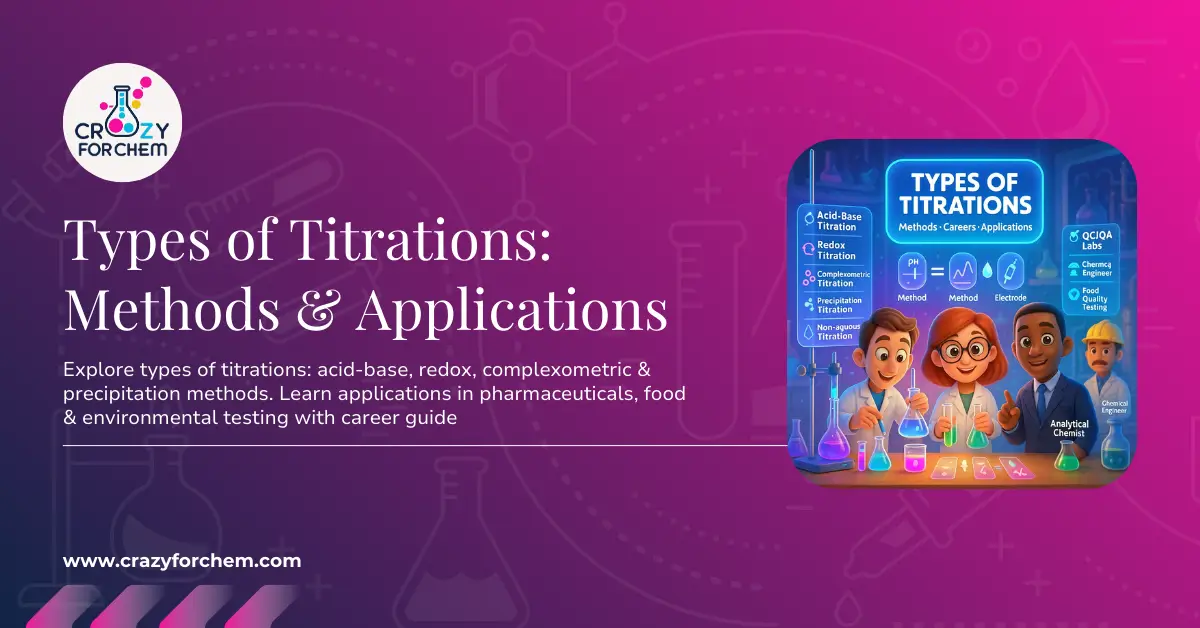
The five main types of titrations include acid-base, redox, complexometric, precipitation, and non-aqueous titrations, each serving specific analytical purposes in pharmaceutical, environmental, and industrial laboratories worldwide.
Table of Contents
What Are Types of Titrations? Understanding the Foundation
Types of titrations represent fundamental analytical techniques that chemists use to measure the exact concentration of substances in solutions.
The process involves gradually adding a solution of known concentration, called the titrant, to an unknown solution until the chemical reaction reaches its endpoint. This precise measurement is critical for quality control, research, and safety across countless industries.
The beauty of types of titrations lies in their versatility and reliability. Developed over centuries, these methods have evolved from simple visual indicators to sophisticated automated instruments, yet the fundamental principle remains unchanged: precise volumetric analysis for accurate quantification.
Understanding the distinctions between different types of titrations enables analytical professionals to select the most appropriate method for their specific analytical challenge. Each type operates on different chemical principles, offering unique advantages for particular applications.
The Five Main Types of Titrations: Comprehensive Analysis
Type 1: Acid-Base Titration – The Foundation of Analytical Chemistry
History
Acid–base titration dates back to the late 1700s, when early chemists used simple burettes and natural dye indicators. Antoine Lavoisier’s work on acids and bases laid the groundwork, and precision improved greatly in the 1820s with Joseph Louis Gay-Lussac’s calibrated burettes.
The field became more quantitative after Søren Sørensen introduced the pH scale in 1909. In the 20th century, glass electrodes, pH meters, and later automated titrators made acid–base titration increasingly accurate, fast, and reliable.
Acid-base titration stands as the most widely employed of all types of titrations in laboratory environments globally. This method quantifies the concentration of acids or bases through neutralisation reactions, where hydrogen ions combine with hydroxide ions to form water and salt.
How Acid-Base Titration Works
An acid with a known concentration gradually neutralises a base with an unknown concentration, or vice versa. The reaction follows the fundamental equation: H⁺ + OH⁻ → H₂O. As the titrant adds drop by drop, the solution’s pH changes gradually until reaching the equivalence point where the acid and base quantities balance precisely.
Common Indicators and Detection Methods
Methyl orange transforms from red to yellow between pH 3.1 and 4.4, making it ideal for strong acid-strong base titrations. Phenolphthalein shifts from colourless to pink between pH 8.2 and 10.0 and serves weak acid-strong base analyses. Modern potentiometric titrations using pH electrodes provide automatic endpoint detection without relying on visual colour changes.
Subcategories of Acid-Base Titration
Strong acid-base titrations reach their equivalency point at pH 7, producing sharp colour transitions. Strong acid-weak base reactions generate acidic equivalence points around pH 3-5, requiring careful indicator selection.
Strong base-weak acid titrations produce basic equivalence points around pH 8-10. Weak acid-weak base titrations present analytical challenges with gradual pH transitions, often requiring instrumental methods rather than visual indicators.
Pharmaceutical and Food Industry Applications
Pharmaceutical manufacturers employ acid-base titration to verify active pharmaceutical ingredient concentrations in raw materials and finished products. Food producers measure acidity in beverages through titration, ensuring consistency and compliance with food standards. Environmental laboratories assess water alkalinity to determine treatment requirements and safety for municipal supply systems.
Type 2: Redox Titration – Electron Transfer Analysis
History
Redox titration began with early studies of oxidation and reduction, initially defined by Lavoisier in the 18th century as simply the gain of oxygen. In the 1800s, scientists like Justus von Liebig expanded the concept to include electron transfer, laying the groundwork for modern redox chemistry.
Major progress came in the late 19th century when Robert Bunsen introduced iodine-based titrations and strong oxidising agents, such as potassium permanganate and potassium dichromate, became standard reagents.
By the 20th century, advances in electrochemistry led to amperometric and potentiometric redox titrations, making the technique essential in fields such as metallurgy, water treatment, and pharmaceutical analysis.
Redox titrations, representing another critical category of types of titrations, measure electron transfer between oxidising and reducing agents. Unlike acid-base reactions involving proton exchange, redox titrations focus on the movement of electrons from one species to another.
Permanganate Titrations: Self-Indicating Oxidizing Agent
Potassium permanganate’s distinctive purple colour serves as a built-in indicator, eliminating the need for external indicators.
This self-indicating property makes permanganate titrations particularly practical for routine analyses. The method effectively quantifies oxalic acid, ferrous salts, hydrogen peroxide, and various transition metal ions.
When permanganate encounters reducible substances in acidic solution, the purple colour disappears as permanganate converts to colourless manganese ions.
The endpoint appears when a single drop of excess permanganate imparts a persistent pink tint to the solution. This makes permanganate one of the most user-friendly titration approaches for training new laboratory technicians.
Dichromate Titrations: Secondary Standard Oxidizing Agent
Potassium dichromate provides a primary standard alternative to permanganate, offering superior stability and reproducibility over extended storage periods.
While dichromate titrations require external indicators like diphenylamine or potassium ferricyanide, they provide exceptional accuracy for quantifying ferrous ions and iodides. Regulatory laboratories often prefer dichromate methods for compliance documentation due to their established standardisation protocols.
Iodometric and Iodimetric Methods: Precision in Analysis
Iodometric titrations employ free iodine as the direct titrant, useful for quantifying strong oxidising agents. Iodimetric methods use oxidising agents to liberate iodine from iodides, then titrate the liberated iodine. Starch serves as the indicator, producing a distinctive blue-black complex with iodine that disappears sharply at the endpoint.
These methods prove invaluable in food analysis for determining oxidative stability, in pharmaceutical testing for verifying antioxidant effectiveness, and in environmental monitoring for detecting various oxidisable contaminants.
Industries Utilizing Redox Titrations
Semiconductor manufacturers employ redox titrations for quality control of process chemicals. Petroleum companies assess product stability through redox-based methods. Water treatment facilities monitor oxidation processes using permanganate titrations. Chemical manufacturers verify product purity through dichromate standardisation procedures.
Type 3: Complexometric Titration – Metal Ion Mastery
History
Complexometric titration emerged in the 20th century following Alfred Werner’s coordination chemistry work, which clarified metal–ligand bonding. The technique truly advanced in the 1940s–1950s when Ferdinand Schwarzenbach introduced EDTA as a universal chelating agent, making metal ion analysis far more precise and selective.
With the development of metallochromic indicators like Eriochrome Black T and Murexide, complexometric titrations gained clear visual endpoints. Today, EDTA titration is essential for water hardness testing, environmental metal analysis, and clinical applications, with automated and spectrophotometric methods widely used for enhanced accuracy and efficiency.
Complexometric titration, essential among types of titrations for metal analysis, employs chelating agents that form stable complexes with metal ions. This method revolutionised metal ion quantification by enabling the precise measurement of virtually all metallic species.
EDTA: The Universal Chelating Agent
Ethylenediaminetetraacetic acid (EDTA) represents the most versatile complexometric titrant, forming stable 1:1 complexes with divalent and trivalent metal ions throughout the periodic table.
A single EDTA molecule wraps around a metal ion with multiple binding sites, creating remarkably stable chelate complexes resistant to precipitation or interference.
The EDTA titration process involves gradually adding a standardised EDTA solution to a metal ion-containing sample. As EDTA binds each metal ion, colour-changing indicators signal when all metal ions have been complexed.
When free metal ions are no longer present in the solution, the indicator detaches from its metal-indicator complex and experiences a sharp colour transition, indicating that the endpoint has been reached.
Indicator Selection and Color Transitions
Eriochrome Black T produces a wine-red metal-indicator complex that shifts to pure blue when metal ions are completely chelated. Murexide generates a pink metal-indicator complex, transforming to yellow at the endpoint.
The choice between the indicators depends on the specific metal ion being quantified and the sample pH, with different metals requiring optimised conditions for sharp endpoint transitions.
Water Hardness Determination: Practical Application
Water hardness testing represents the most common practical application of complexometric titration. Calcium and magnesium ions cause hardness, and EDTA quantifies total hardness by chelating both ions simultaneously.
Water treatment operators use this method to monitor hardness levels and adjust treatment chemicals, directly affecting water safety and industrial equipment longevity.
Heavy Metal Contamination Assessment
Environmental laboratories employ complexometric titration to detect lead, cadmium, zinc, and copper contamination in soil and water samples. Clinical laboratories quantify trace metal concentrations in blood samples to diagnose metal poisoning or nutritional deficiencies.
Quality control departments in electronic component manufacturing verify metal ion concentrations in manufacturing solutions using EDTA titrations.
Type 4: Precipitation Titration – Insoluble Salt Quantification
History
Precipitation titration originated in 19th-century inorganic chemistry, beginning with Karl Friedrich Mohr’s 1856 method using silver nitrate to determine chloride through silver chloride precipitation.
The technique expanded in the early 20th century with Fajans’ method, which introduced adsorption indicators for sharper endpoints, and Volhard’s method, which applied back-titration to halide analysis in complex samples.
Today, precipitation titrations remain essential for chloride and halide determination, food salt analysis, and water quality testing, and despite modern instrumental methods, these classical techniques continue to be highly reliable.
Precipitation titrations, another important category within types of titrations, quantify ions based on their reactions with titrants to form insoluble compounds. This classical method provides economical analysis for halides and related species.
Mohr’s Method: The Classic Chloride Determination
Mohr’s method remains the standard protocol for chloride analysis in regulatory laboratories. Silver nitrate solution titrates chloride-containing samples, with silver chloride precipitating as a white solid.
When all chloride ions are removed from solution, excess silver ions react with the potassium chromate indicator, producing a distinctive brick-red silver chromate precipitate that signals the endpoint.
The beauty of Mohr’s method lies in its simplicity and visual clarity. The sharp colour transition from a white precipitate (silver chloride) to a red precipitate (silver chromate) provides unmistakable endpoint detection without instrumental equipment. This makes Mohr’s method ideal for field testing and resource-limited laboratories.
Fajans’ Method: Extended Halide Analysis
Fajans’ method extends precipitation titration capabilities beyond chloride to bromide and iodide ions. Using anionic indicators like fluorescein that adsorb onto precipitate surfaces, Fajans’ method provides sharper endpoints than Mohr’s method for certain applications. The precipitate surface changes colour as adsorption transitions occur, providing an excellent visual indication.
Volhard’s Method: Indirect Halide Determination
Volhard’s method employs an indirect approach, first adding excess silver nitrate to precipitate all halides as insoluble silver halides, then back-titrating excess silver with potassium thiocyanate. This method proves particularly useful for analysing samples containing substances that interfere with direct precipitation titrations.
Industrial Quality Control Applications
Food manufacturers use precipitation titrations to verify salt content in processed foods. Pharmaceutical companies employ these methods during quality control testing of halide-containing drugs. Clinical laboratories previously used precipitation titrations extensively, though instrumental methods now dominate this application.
Type 5: Non-Aqueous Titrations – Beyond Water Solutions
History
Non-aqueous titration was developed to analyse substances that were insoluble, unstable, or too weakly acidic or basic to be measured in water. Early efforts between 1900 and 1930 used solvents such as alcohols, glacial acetic acid, and acetic anhydride to overcome the limitations of aqueous systems.
Major progress occurred from the 1940s to the 1960s with the introduction of perchloric acid in glacial acetic acid as a strong titrant, the creation of reliable non-aqueous indicators like crystal violet and thymol blue, and electrodes specially designed for organic solvents.
Today, non-aqueous titrations are widely used in pharmaceutical analysis for weak organic acids, bases, and poorly ionisable drug molecules, with automated potentiometric systems ensuring high precision and improved safety.
Non-aqueous titrations are specialised types of titration designed for samples that contain minimal water or require organic solvent systems. These methods extend titration capabilities to analytes unsuitable for aqueous analysis.
When Non-Aqueous Conditions Prove Essential
Very weakly acidic or basic substances show insufficient pH variation in aqueous solutions to enable accurate titration. Hygroscopic compounds prone to hydrolysis cannot tolerate aqueous environments. Organic acids and bases with extremely low aqueous solubility require non-aqueous systems for accurate quantification.
Solvent Selection and Technical Requirements
Dimethylformamide provides excellent dissolution properties for organic compounds while maintaining adequate conductivity for potentiometric endpoint detection. Acetic anhydride creates a highly acidic medium suitable for weak base titration. Perchloric acid solutions offer strongly acidic environments for weak base quantification.
Non-aqueous titrations demand specialised electrode systems designed for organic solvents, as standard aqueous electrodes may malfunction in non-aqueous media. Environmental controls preventing atmospheric moisture contamination prove critical, as water ingress dramatically affects results.
Pharmaceutical Applications and Specialty Chemistry
Poorly ionisable pharmaceutical compounds require non-aqueous titration for potency determination. Chemical manufacturers analyse organic acids and bases in production environments using non-aqueous methods. Research institutions employ non-aqueous titration for fundamental studies of organic reactivity and solution chemistry.
Specialized Titration Techniques: Instrumental Methods
Beyond the five main types of titrations, several instrumental methods provide enhanced capabilities for specialised applications.
Potentiometric Titration: Electrode-Based Endpoint Detection
Potentiometric titrations employ metal electrodes measuring electrical potential changes as titrant is added. Rather than visual indicators, this method continuously monitors potential differences between the sample and reference electrode. When a sharp potential change occurs, the endpoint is detected automatically by the instrument.
This method excels for coloured solutions where visual endpoints prove impossible, turbid samples that obscure colour changes, and reactions where traditional indicators interfere. Potentiometric titration provides superior accuracy for weak acid-weak base titrations and serves as the standard method in highly regulated pharmaceutical manufacturing.
Conductometric Titration: Electrical Conductivity Measurement
Conductometric methods monitor changes in solution conductivity as titrant is added. As ions are consumed or produced during reaction, the solution’s ability to conduct electricity changes measurably. Plotting conductivity against titrant volume produces curves with distinct breakpoints indicating the equivalence point.
This technique proves particularly valuable for analyses where traditional indicators would interfere, reactions produce coloured products, and solutions have unusual pH properties. Environmental laboratories frequently employ conductometric titration for salinity and ion content determination.
Photometric Titration: Light Absorption Analysis
Rather than observing colour changes with the human eye, photometric titrations measure precise light absorption at specific wavelengths. Automated instruments detect absorption changes far more accurately than human observation, enabling the analysis of solutions where visual endpoints appear ambiguous or colour changes occur subtly.
Medical laboratories employ photometric titration for chloride determination in blood samples, where precision directly impacts patient care decisions. Research environments use photometric methods for kinetic titration studies measuring reaction rates during the titration process.
Amperometric Titration: Electrical Current Measurement
Amperometric methods measure electrical current flowing between a titrant and probe at fixed potential. As analytes are oxidised or reduced, the current flow changes proportionally with the reactant concentration. This technique enables rapid analysis, despite solution clarity variations or unusual colouration.
Blood analysis for electrolyte determination frequently employs amperometric titration due to its speed and precision. Clinical chemistry analysers incorporate amperometric titration for immediate patient result reporting, where delays could compromise clinical decision-making.
Standard Titration Procedure: Laboratory Protocol
Understanding the systematic procedure for conducting titrations ensures accuracy and reproducibility across different titration types.
Step 1: Titrant Standardization
Before any analysis, the titrant’s precise concentration must be established through standardisation against the primary standard substance. This critical step provides the exact titrant concentration essential for accurate analyte determination. Standardisation reduces systematic errors and ensures traceability to national standards.
Step 2: Apparatus Preparation and Calibration
Burettes must be carefully cleaned and rinsed with the titrant solution before use. Burettes are calibrated instruments, and any residual water or inappropriate cleaning solutions would affect volume measurements. The burette is filled to just above the zero mark, then excess solution is expelled to fill the tip and eliminate air bubbles that would introduce measurement errors.
Step 3: Sample Preparation and Transfer
Solid samples require complete dissolution in appropriate solvents before titration. The sample solution is pipetted into a conical flask in precisely measured volumes. Auxiliary reagents such as buffers, indicators, or complexing agents are added according to the specific titration method requirements.
Step 4: Titrant Addition and Endpoint Approach
The titrant is carefully dispensed from the burette into the sample flask with continuous swirling to ensure homogeneous mixing. As the endpoint approaches, the colour change becomes more persistent, requiring slower titrant additions of half-drops or quarter-drops. This careful approach near the endpoint prevents overshooting, which would invalidate the analysis.
Step 5: Final Endpoint Detection
The endpoint is defined as the point where the indicator permanently changes colour and does not revert when the flask is swirled. This permanent colour change indicates that all analyte has been consumed by the titrant. Multiple titrations (typically three to five) are performed to establish reproducible results.
Step 6: Calculation and Result Reporting
The fundamental equation governing titration calculations is n₁V₁ = n₂V₂, where n represents moles of each reactant and V represents solution volumes. Using this equation along with the reaction’s stoichiometry, the analyte concentration is calculated from the average titrant volume consumed across multiple analyses.
Real-World Industry Applications of Types of Titrations
Pharmaceutical Manufacturing Quality Control
Pharmaceutical companies depend on types of titrations for verifying active pharmaceutical ingredient concentrations in raw materials, work-in-progress samples, and finished products.
Acid-base titration determines base content in alkaloid drugs. Redox titrations verify antioxidant effectiveness in formulations. Complexometric titration quantifies metal impurities that could compromise product quality or safety.
Process validation studies employ titration methods to confirm manufacturing consistency. Stability testing conducted over extended storage periods uses titration to monitor product degradation.
Regulatory submissions require analytical methods validation using titration procedures, making this technique fundamental to pharmaceutical development.
Environmental and Water Quality Testing
Municipal water treatment facilities conduct daily titration analyses to ensure water safety. Water hardness testing using EDTA complexometric titration guides lime and soda ash addition for softening. Alkalinity measurement through acid-base titration indicates water’s buffering capacity and corrosion potential.
Wastewater treatment facilities employ redox titrations to monitor oxidation processes before discharge. Industrial discharge permits often specify titration-based testing requirements for regulatory compliance. Environmental consultants assess soil and groundwater contamination using types of titrations for heavy metal determination.
Food and Beverage Industry Applications
Food producers employ acid-base titration to monitor product acidity, ensuring consistency and safety across production batches. Beverage manufacturers measure juice acidity through titration to maintain flavour profiles and regulatory compliance. Salt content verification in processed foods uses precipitation titration methods.
Antioxidant effectiveness testing in food products employs redox titration to verify product shelf-life preservation. Oil and fat analysis uses iodometric titration to measure oxidative stability. Food safety compliance testing frequently involves titration-based methods for chemical contamination detection.
Chemical Manufacturing and Quality Assurance
Chemical manufacturers employ multiple types of titrations for raw material acceptance testing, ensuring suppliers meet specification requirements. Process monitoring during manufacturing uses titration to verify intermediate product purity and reaction completion. Final product analysis confirms specification compliance before shipment.
Titration methods serve as reference standards for instrument calibration and validation. When newer instrumental methods require comparison to established procedures, titration provides the authoritative analytical basis.
Recent Technological Advances Transforming Titration Analysis
Automated Titration Systems and High-Throughput Platforms
Modern automated titrators integrate sophisticated sensors, precise liquid handling systems, and computer controls, enabling rapid, consistent analyses. These instruments automatically detect endpoints using potentiometric, photometric, or conductometric methods, eliminating observer bias present in manual titration.
High-throughput platforms process multiple samples simultaneously, dramatically accelerating analytical workflows in pharmaceutical development and quality control environments. Laboratories handling hundreds of samples daily benefit tremendously from automation, improving both speed and consistency.
Integration with Laboratory Information Management Systems
Contemporary titration instruments generate digital data immediately compatible with Laboratory Information Management Systems (LIMS). This integration streamlines sample tracking, result reporting, and regulatory compliance documentation. Automated data handling reduces transcription errors and accelerates reporting timelines.
Advanced data analysis software identifies trends in product quality, detects anomalies indicating process problems, and flags out-of-specification results automatically. Predictive analytics help anticipate manufacturing issues before they impact product quality.
Green Chemistry Innovations
Emerging focus on environmental sustainability drives development of safer titrant solutions and reduced-chemical analytical protocols. Researchers explore biodegradable chelating agents as alternatives to traditional EDTA for complexometric titrations. Waste minimisation strategies reduce chemical consumption and disposal costs.
Water-based alternative solvents replace hazardous organic solvents in non-aqueous titrations where possible. These innovations reduce laboratory waste while maintaining analytical quality.
Career Opportunities in Analytical Chemistry and Types of Titrations
The Future of Titrations: Skills, Tech & Opportunities You Can’t Miss
The analytical chemistry field demonstrates robust growth with consistent demand for skilled professionals. Understanding career pathways and salary prospects proves valuable for professionals considering this speciality.
Entry-Level Positions in Laboratory Analysis
Laboratory technicians conduct routine experiments, prepare solutions, and support senior scientists under supervision. This entry-level position provides foundational laboratory experience with typically a bachelor’s degree requirement. Starting salaries range from $38,000 to $48,000 annually, with benefits packages typical in industrial settings.
Quality control analysts test raw materials and finished products for safety, compliance, and specification adherence across pharmaceutical, food, chemical, and manufacturing industries. These positions offer excellent growth potential with salaries ranging from $42,000 to $58,000 for entry-level positions. QC roles often provide shift differentials and overtime opportunities.
Mid-Career Professional Positions
Analytical chemists develop and implement analytical methods, including various types of titrations, troubleshoot analytical challenges, validate new methodologies, and train junior staff. These positions typically require 2-3 years of experience and command salaries from $58,000 to $80,000 annually. Professional certifications enhance advancement potential significantly.
Pharmaceutical analysts focus specifically on drug formulation analysis and potency verification using advanced analytical techniques. Specialised pharmaceutical backgrounds command premium compensation, with salary ranges from $65,000 to $92,000. These positions frequently offer professional development funding and conference attendance support.
Senior and Leadership Roles
Senior analytical chemists develop innovative methodologies, manage regulatory submissions, and lead analytical teams in research and quality environments. These roles require 10+ years of experience and advanced credentials, with typical compensation ranging from $85,000 to $125,000 annually. Leadership development opportunities frequently accompany these positions.
Research scientists in academic institutions and corporate laboratories conduct advanced research in analytical method development. PhD credentials typically accompany these positions, with salaries from $70,000 to $115,000+, depending on institution prestige and research focus.
Emerging Specializations and Growing Opportunities
Automation and instrumentation specialists skilled in modern automated titration systems and data management command premium compensation from $58,000 to $88,000 annually. As laboratories increasingly adopt sophisticated instrumentation, demand for these specialists continues growing.
Data science in chemistry science represents an emerging specialisation combining analytical chemistry expertise with computational analysis and programming skills. These highly sought positions command salaries from $78,000 to $125,000+, reflecting the scarcity of professionals with dual expertise.
Green chemistry specialists developing sustainable analytical methods attract growing employer investment. Organisations committed to environmental responsibility actively recruit professionals specialising in sustainable analytical techniques.
Regulatory Affairs Specialists bridging analytical chemistry and regulatory compliance represents another growth area. These positions ensure analytical methods and data comply with regulatory requirements (FDA, EMA, ICH). Typical compensation ranges from $65,000 to $95,000.
Frequently Asked Questions About Types of Titrations
What distinguishes the endpoint from the equivalence point in titrations?
The equivalence point represents the theoretical point where titrant moles exactly match analyte moles required for complete reaction, determined through stoichiometric calculations. The endpoint represents the practical observation point where the indicator signals reaction completion. In ideal acid-strong base titrations, these points coincide precisely. In weak acid-strong base or weak acid-weak base titrations, the endpoint may differ slightly from the equivalence point. Selecting appropriate indicators minimises this difference and ensures analytical accuracy.
Which type of titration provides the highest accuracy for routine laboratory analysis?
Acid-base titration with standardised strong acid or strong base solutions generally provides excellent accuracy for routine analyses when performed with proper technique. The sharp equivalence point at pH 7 for strong acid-strong base titrations enables precise endpoint detection. Complexometric titration with EDTA rivals acid-base titration for accuracy, particularly for metal ion quantification with minimal interference. Accuracy ultimately depends on proper technique, precise burette calibration, and appropriate indicator selection rather than titration type alone.
How do I select the appropriate titration method for my analytical challenge?
Selection depends on analyte identity, required accuracy level, sample matrix complexity, and available instrumentation. Acid-base titration suits acidic or basic analytes requiring straightforward quantification. Redox titration addresses analytes capable of electron transfer. Complexometric titration specifically targets metal ion analysis. Precipitation titrations quantify halides and similar species. Consulting analytical chemistry references, experienced colleagues, or your organisation’s standard operating procedures provides reliable guidance for method selection.
Can types of titrations be applied to coloured or turbid solutions?
Traditional visual endpoint detection proves challenging with coloured or turbid samples where colour changes become difficult to observe. However, instrumental methods overcome these limitations effectively. Potentiometric titration using electrodes works regardless of solution colour or clarity. Conductometric methods similarly function with any solution appearance. Automated photometric titration detects endpoint colour changes instrumentally, providing accurate results unaffected by sample appearance. These alternatives enable precise analysis even with challenging sample matrices.
What are the primary error sources in titration analysis, and how can they be minimised?
Common error sources include improper burette calibration introducing systematic volume measurement errors, inconsistent titrant concentration from incomplete standardisation procedures, operator technique variations affecting endpoint detection, and environmental factors affecting sample integrity. Minimising errors involves careful burette validation before analysis, rigorous standardisation procedures ensuring exact titrant concentration, developing consistent technique through deliberate practice, and controlling environmental conditions preventing contamination or temperature fluctuations. Systematic analysis of blank samples and duplicate specimens helps identify and quantify random and systematic errors.
How has automation changed analytical titration in modern laboratories?
Automated titration systems dramatically improve consistency, speed, and precision compared to manual analysis. Modern instruments integrate sophisticated sensors for automatic endpoint detection, precise liquid handling systems, and computer controls. Automated systems enable high-throughput sample processing, reduce operator-dependent variability affecting results, and generate detailed analytical records supporting regulatory compliance documentation. These systems particularly benefit pharmaceutical quality control and research environments processing hundreds of samples daily.
Are there safety considerations specific to different titration types?
Safety considerations vary by method and specific reagents employed. Permanganate and dichromate titrations require careful handling due to oxidising agent hazards. Amperometric titrations involving electrodes demand electrical safety awareness and proper grounding. Complexometric titrations with EDTA present minimal acute hazards but require basic chemical safety precautions. All titrations demand appropriate personal protective equipment, including laboratory coats, chemical-resistant gloves, and safety glasses. Understanding specific hazards associated with each method’s reagents proves essential for safe laboratory practice.
Can titrations be performed outside traditional laboratory settings?
While titrations require careful technique and appropriate equipment, applications extend beyond traditional chemistry laboratories. Quality control departments in food plants conduct daily titrations for process monitoring. Pharmaceutical manufacturing facilities employ titration-based methods for in-process quality verification. Water treatment plants use portable titration kits for rapid hardness and alkalinity testing. However, accuracy requirements for regulatory compliance and pharmaceutical applications typically demand laboratory-based analyses with calibrated instrumentation rather than field-based methods.
What certifications enhance analytical chemistry careers?
Professional development opportunities abound in analytical chemistry. The American Chemical Society offers professional certifications in analytical chemistry through formal examination. Specialised certifications in HPLC, GC-MS, and LC-MS techniques significantly enhance marketability and earning potential. Training in regulatory compliance (cGMP, GLP) opens doors to pharmaceutical industry career advancement. Six Sigma and lean process improvement certifications appeal to manufacturing environments seeking process optimisation. Advanced degrees (Master’s or PhD) enable progression to senior research and management positions. Continuous education through conference attendance and professional societies strengthens career prospects throughout one’s analytical chemistry career.
Conclusion: Types of Titrations in Modern Analytical Practice
Types of titrations remain cornerstones of analytical chemistry despite centuries of historical development. The fundamental simplicity combined with remarkable accuracy and versatility ensures continued relevance across pharmaceutical, food, environmental, and chemical industries worldwide.
Understanding the full spectrum of types of titrations, from classical acid-base methods to sophisticated potentiometric and photometric techniques, provides analytical professionals with comprehensive problem-solving capabilities. Whether quantifying drug potency, verifying water safety, analysing environmental contaminants, or conducting cutting-edge research, mastery of appropriate titration methods proves indispensable.
The field offers compelling career opportunities across diverse sectors with competitive compensation, opportunities for meaningful specialisation, and clear advancement pathways. Professionals combining strong fundamental titration knowledge with emerging specialisations in automation, data science, and green chemistry position themselves for sustained long-term career success.
As laboratories continue embracing automation, data integration, and sustainability initiatives, types of titrations continue evolving while maintaining their analytical reliability. For chemistry students, early-career professionals, and experienced analytical chemists alike, titration expertise remains a valuable asset in contemporary and future analytical chemistry practice.
Read Article
Types of Chemical Compounds: 7 Essential Categories
Types of Chemical Mixtures: 7 Essential Classifications
The Future of Titrations: Skills, Tech & Opportunities You Can’t Miss